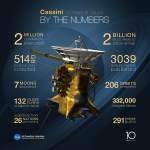
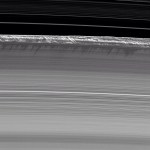
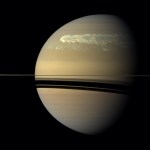
Read moreCassini recently celebrated a decade in orbit around Saturn. We have learned more about the complex ring structure and many moons of the ringed gas giant than ever expected.
Keep up the great work Cassini! Be on the lookout for more detailed information on these photos as well as the individual moons.
-ALT
Galleries
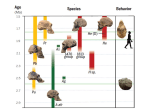
A large brain, long legs, the ability to craft tools and prolonged maturation periods were all thought to have evolved together at the start of the Homo lineage as African grasslands expanded and Earth’s climate became cooler and drier. However, new climate and fossil evidence analyzed by a team of researchers, including Smithsonian paleoanthropologist Richard Potts, Susan Antón, professor of anthropology at New York University, and Leslie Aiello, president of the Wenner-Gren Foundation for Anthropological Research, suggests that these traits did not arise as a single package. Rather, several key ingredients once thought to define Homo evolved in earlier Australopithecus ancestors between 3 and 4 million years ago, while others emerged significantly later.
The team’s research takes an innovative approach to integrating paleoclimate data, new fossils and understandings of the genus Homo, archaeological remains and biological studies of a wide range of mammals (including humans). The synthesis of these data led the team to conclude that the ability of early humans to adjust to changing conditions ultimately enabled the earliest species of Homo to vary, survive and begin spreading from Africa to Eurasia 1.85 million years ago.
Potts developed a new climate framework for East African human evolution that depicts most of the era from 2.5 million to 1.5 million years ago as a time of strong climate instability and shifting intensity of annual wet and dry seasons. This framework, which is based on Earth’s astronomical cycles, provides the basis for some of the paper’s key findings, and it suggests that multiple coexisting species of Homo that overlapped geographically emerged in highly changing environments.
“Unstable climate conditions favored the evolution of the roots of human flexibility in our ancestors,” said Potts, curator of anthropology and director of the Human Origins Program at the Smithsonian’s National Museum of Natural History. “The narrative of human evolution that arises from our analyses stresses the importance of adaptability to changing environments, rather than adaptation to any one environment, in the early success of the genus Homo.”
The team reviewed the entire body of fossil evidence relevant to the origin of Homo to better understand how the human genus evolved. For example, five skulls about 1.8 million years old from the site of Dmanisi, Republic of Georgia, show variations in traits typically seen in African H. erectus but differ from defining traits of other species of early Homo known only in Africa. Recently discovered skeletons of Australopithecus sediba (about 1.98 million years old) from Malapa, South Africa, also include some Homo-like features in its teeth and hands, while displaying unique, non-Homo traits in its skull and feet. Comparison of these fossils with the rich fossil record of East Africa indicates that the early diversification of the genus Homo was a period of morphological experimentation. Multiple species of Homo lived concurrently.
“We can tell the species apart based on differences in the shape of their skulls, especially their face and jaws, but not on the basis of size,” said Antón. “The differences in their skulls suggest early Homo divvied up the environment, each utilizing a slightly different strategy to survive.”
Even though all of the Homo species had overlapping body, brain and tooth sizes, they also had larger brains and bodies than their likely ancestors, Australopithecus. According to the study, these differences and similarities show that the human package of traits evolved separately and at different times in the past rather than all together.
In addition to studying climate and fossil data, the team also reviewed evidence from ancient stone tools, isotopes found in teeth and cut marks found on animal bones in East Africa.
“Taken together, these data suggest that species of early Homo were more flexible in their dietary choices than other species,” said Aiello. “Their flexible diet – probably containing meat – was aided by stone tool-assisted foraging that allowed our ancestors to exploit a range of resources.”
The team concluded that this flexibility likely enhanced the ability of human ancestors to successfully adapt to unstable environments and disperse from Africa. This flexibility continues to be a hallmark of human biology today, and one that ultimately underpins the ability to occupy diverse habitats throughout the world.
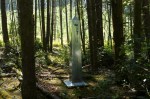
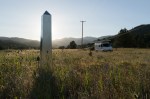
Read moreRead moreMonuments 02 and 03 are in place. A long day of work. Time for some food and sleep. Stories recounting the interesting people we met later.
Awesome new experimental geography project:
“DELIMITATIONS is a collaborative project by Marcos Ramírez ERRE and David Taylor. During the month of July we will travel from the Pacific Coast to the Gulf of Mexico and mark the 1821 border between Mexico and the United States. That boundary was never surveyed and its brief, 27 year history exists mainly in the form of treaty documents and antique maps. We intend to make it visible for the first time…”
(Thanks to Pepe Rojo for the tip!)
Read moreNO OTHER OBJECTS HAVE VENTURED THIS FAR FROM HOME
- The primary mission of Voyager was the exploration of Jupiter and Saturn. After making a string of discoveries there — such as active volcanoes on Jupiter’s moon Io and intricacies of Saturn’s rings — the mission was extended. Voyager 2 went on to explore Uranus and Neptune, and is still the only spacecraft to have visited those outer planets. The adventurers’ current mission, the Voyager Interstellar Mission (VIM), will explore the outermost edge of the Sun’s domain. And beyond.
- The Voyager 1 & 2 spacecrafts will be the third and fourth human spacecrafts to fly beyond all the planets in our solar system. Pioneers 10 and 11 preceded Voyager in outstripping the gravitational attraction of the Sun but on February 17, 1998, Voyager 1 passed Pioneer 10 to become the most distant human-made object in space.
- As of June 8, 2014 Voyager 1 is 19 BILLION km away from Earth while Voyager 2 is 15.6 BILLION km away
- Both Voyager spacecrafts carry a greeting to any form of life, should that be encountered. The message is carried by a phonograph record – a 12-inch gold-plated copper disk containing sounds and images selected to portray the diversity of life and culture on Earth. The contents of the record were selected for NASA by a committee chaired by Carl Sagan of Cornell University. Dr. Sagan and his associates assembled 115 images and a variety of natural sounds.
- Voyager 1 is speeding along at about 57,600 kph (35,790 mph) — fast enough to travel from the Earth to the sun three and a half times in one year.
- NASA’s Voyager 1 became humankind’s most distant spacecraft on Aug. 25, 2012 when scientists believe it entered interstellar space, or the space between stars. Much of interstellar space is actually inside our solar system. It will take about 300 years for Voyager 1 to reach the inner edge of the Oort Cloud and possibly about 30,000 years to fly beyond it.
- Alpha Centauri is currently the closest star to our solar system. But, in 40,000 years, Voyager 1 will be closer to the star AC +79 3888 than to our own sun. AC +79 3888 is actually traveling faster toward Voyager 1 than the spacecraft is traveling toward it.
- Barring any serious spacecraft subsystem failures, the Voyagers may survive until the early twenty-first century (~ 2025), when diminishing power and hydrazine levels will prevent further operation. (Source: http://voyager.jpl.nasa.gov/)
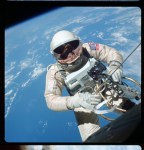
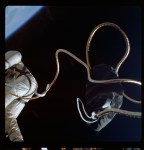
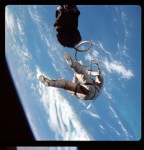
Read more“I felt red, white and blue all over.”
Astronaut Ed White on his walk in space, quoted in Life magazine, June 25, 1965
via astronautfilm
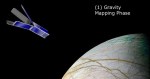
In its first stage, a small satellite about as large as a half-gallon of milk would orbit the moon. Using two highly accurate accelerometers, it could sense small changes in Europa’s gravitational field, eventually mapping the gravity of the entire surface. These detailed gravity maps could then suggest the location of watery oceans below the planet’s surface—or the openings to these oceans.
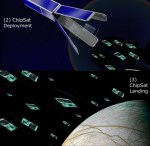
Once an ocean (or the entryway to one) was found, the probe would begin its second stage. The small satellite would release even smaller instruments over the interesting region. These “chipsats,” each no larger than a fingernail, could enter Europa’s thin atmosphere unharmed and float down to the surface.
“When there is an atmosphere, they flutter down like little pieces of paper, not like a rock,” said John West, leader of the advanced concepts team at Draper. He added that while they expect to lose some of the smaller “chipsats,” enough would be released that useful science could be performed.
Once deployed, the tiny chipsats would then send their measurements back to their orbiting mothership, which would in turn beam them back to Earth.
Read more“are we just not going to talk about the magically charred bodies?”
“it’s not magic, but it might as well be… must be what God feels like”
Read moreHandsome young Ranger Bryan Cranston and his heroic sacrifice that leads to the end of the Shadow War.
Read more