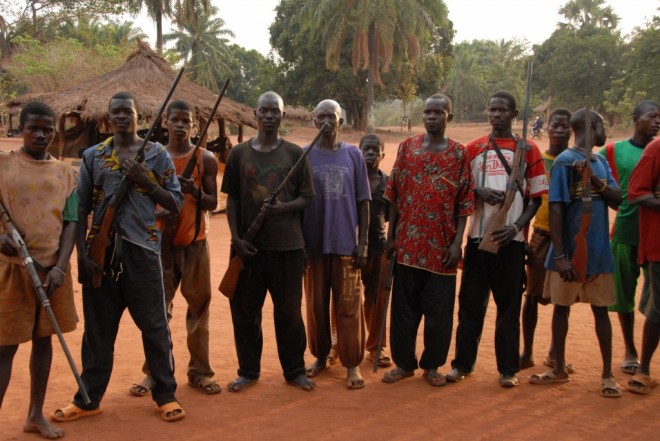
The Obo scouts represent a phenomenon found in many conflict zones. When government or occupying armies fail to provide security, vulnerable communities often organize their own forces. It’s happened in northern Iraq’s besieged Christian communities, across Afghanistan and, most famously, in Sunni-dominated north-central Iraq, where volunteer “Sons of Iraq” groups helped turn the tide against Iraqi insurgents.

The downside of these DIY militias is the risk they pose to the long-term stability of their countries. Baghdad and the U.S. military struggled to stand down and reintegrate Sons of Iraq groups after security improved and they became unnecessary. NATO has canceled several Sons of Iraq-style initiatives in Afghanistan after sedition-minded warlords co-opted some of the militia groups.

The Obo scouts could entail a similar long-term liability to Central African Republic’s weak government. “The very act of civilians taking up arms outside of their government’s direct control is a potentially problematic issue without an easy answer,” Finck admitted.

The scouts could also find themselves at odds with the Pentagon’s efforts in Africa.

Since its establishment in late 2008, U.S. Africa Command, headquartered in Germany, has participated in just one direct attack on the LRA. In December 2008, 17 Africom advisers helped plan, and provided fuel for, a complex assault on LRA strongholds in Congo. The main forces for the attack were 6,000 Ugandan and Congolese troops.

Operation Lightning Thunder was a disaster. A Ugandan jet fighter crashed early in the campaign, killing the pilot. The Ugandan troops leading the ground assault arrived at the main LRA camp days late. The LRA scattered in all directions, killing a thousand Congolese civilians as the Congolese army stood idly by.

In the operation’s bloody wake, Africom determined to take a more passive role in countering the LRA. Instead of directly attacking the rebels, the command sent trainers to help improve the Congolese and Central African armies. Africom is betting on the weak central governments of LRA-infested countries to eventually be able to handle the rebel threat on their own.

But the Obo scouts have all but given up on ever receiving help from their government. “Members of these local defense forces … feel that there is no other alternative [to arming themselves] and have committed to continuing their efforts until their community finds relief from the LRA,” Finck reported.

Thanks in part to Invisible Children and the Dutch group, Obo is better equipped than most communities to defend itself against the LRA, and to strike back using come-home messages. As long as African governments remain weak, and their foreign allies focus on assisting these regimes rather than protecting the civilians on the front lines, the kind of DIY security practiced in Obo could become widespread.

The implications of Obo’s self-defense efforts are huge for vulnerable communities across Africa, for the rebel groups that threaten them, and for the central governments whose legitimacy erodes by the day, as everyday people build their own armies and intelligence apparatuses from scratch.

via African Village Uses Tech to Fight Off a Rape Cult | Danger Room | Wired.com

Read more
The CIA has been ramping up its intelligence gathering efforts in Yemen in recent months in order to support a sustained campaign of drone strikes. The CIA coordinates closely with Saudi intelligence officers, who have an extensive network of on-the-ground informants, officials say.

The new CIA drone program will initially focus on collecting intelligence to share with the military, officials said. As the intelligence base for the program grows, it will expand into a targeted killing program like the current operation in Pakistan.

While the specific contours of the CIA program are still being decided, the current thinking is that when the CIA shifts the program from intelligence collection into a targeted killing program, it will select targets using the same broad criteria it uses in Pakistan. There, the agency selects targets by name or if their profile or “pattern of life"—analyzed through persistent surveillance—fits that of known al Qaeda or affiliated militants.

By using those broad criteria, the U.S. would likely conduct more strikes in Yemen, where the U.S. now only goes after known militants, not those who fit the right profile.

Most of the military’s strikes have been conducted with manned aircraft and cruise missiles. But last month, the U.S. military used an armed drone to try to kill Mr. Awlaki, the American-born radical cleric. The missile missed its target.

via CIA Plans Drone Strikes in Yemen – WSJ.com

Read more

Lulz Security posted files online which indicated they had been in the Senate network. However, none of the files appeared to be sensitive. “We don’t like the US government very much,” Lulz Security said at the top of a release. “This is a small, just-for-kicks release of some internal data from Senate.gov – is this an act of war, gentlemen? Problem?” it added. (via BBC News – Lulz attacks: US orders review as Senate site hacked)

Read more

In the case of these biolasers, human kidney cells have been genetically enhanced to produce the proteins that make jellyfish glow.

These glowing cells were stuck between two tiny mirrors barely bigger than the cell itself, and when the cell was energized with blue light through a microscope, it fired out a bright green directional laser beam that was visible to the naked eye, just like a little laser pointer. Under a microscope, it looks like this:

(see above)

Currently, the researchers are working on ways to stick the mirror array inside the cell itself, and there’s still the problem of the energizing light source, but that could be solved by routing optical fibers directly through the body. Yeah, we’re talking about implanted fiber optic cabling. To power your laser cells. Welcome to science.

via Scientists combine humans with jellyfish to create living lasers | DVICE

Read more

“There is a dramatic, nonlinear relationship between climate conditions and tundra fires, and what one may call a tipping point,” he said. Once the temperature rises above a mean threshold of 10 degrees Celsius (50 degrees Fahrenheit) in the

June-through-September time period, he said, “the tundra is just going to burn more frequently.”

For the past 60 years, annual mean temperatures during this warm season have fluctuated between about 6 and 9 degrees Celsius (42.8 to 48.2 degrees Fahrenheit), with temperatures trending upward since 1995. In 2007, the year of the historic fire, the mean temperature was a record 11.1 degrees Celsius, while precipitation and soil moisture dipped to an all-time low.

Higher precipitation, if it occurs, could dampen the effects of higher temperatures, but only to a limited extent, said Philip Higuera, a professor of forest ecology and biogeosciences at the University of Idaho and a co-author on the study.

“As temperature rises, so too does evaporation,” he said. “So even if future precipitation increases, it’s likely that increased evaporation will result in overall lower moisture availability. This affects plants, but it also makes dead vegetation more flammable and fire prone.”

Read more

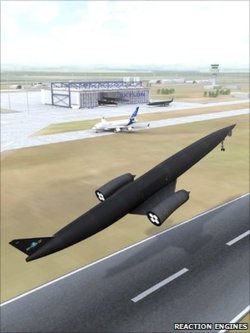
The proposed Skylon vehicle would do the job of a big rocket but operate like an airliner, taking off and landing at a conventional runway.

The European Space Agency’s propulsion experts have assessed the details of the concept and found no showstoppers.

They want the next phase of development to include a ground demonstration of its key innovation – its Sabre engine.

Realising the Sabre propulsion system is essential to the success of the project.

The engine would burn hydrogen and oxygen to provide thrust – but in the lower atmosphere this oxygen would be taken directly from the air.

This means the 84m-long spaceplane can fly lighter from the outset with a higher thrust-to-weight ratio, enabling it to make a single leap to orbit, rather than using and dumping propellant stages on the ascent – as is the case with current expendable rockets.

The price for launching a kilogram of payload into a geostationary orbit – the location for today’s big telecoms satellites – is currently more than $15,000 (£9,000). Skylon’s re-usability could bring that down to less than $1,000, claims REL.

Read more

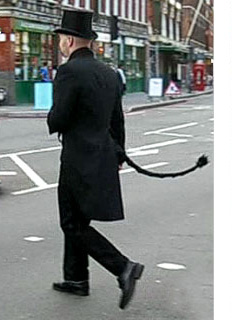
Clipping on to your belt or waistband, the Tail has many settings, selected by turning a switch in your pocket. Use a glorious mix of all of them for full Tail expressivity. Moves include slow-fast wag, standing up, tremble, shy, twist and many more. (via In the City)

Read more