Also, suggests Mr Hanff, the interactive nature of ‘Gladverts’ may offer a service in return for information – a trend already seen with public Wifi hotspots which require assorted personal details before use.

“We wouldn’t be surprised to see digital signage also serving as WiFi hotspots in the future to collect even more data.

"Since it is likely these signs will be networked, they serve as a very good opportunity for the industry to offer free Wifi hotspots as well.”

via Minority Report ads ‘next year’

Read more

Governments and companies now possess dozens of these independently developed computer programs, known in industry jargon as “safety codes.” Many of these institutions — including ones in Japan — are relying on forensic modeling to analyze the disaster at Fukushima Daiichi to plan for a range of activities, from evacuations to forecasting the likely outcome.

“The codes got better and better” after the accident at Three Mile Island revealed the poor state of reactor assessment, said Michael W. Golay, a professor of nuclear science and engineering at the Massachusetts Institute of Technology.

If events in Japan unfold as they did at Three Mile Island in Pennsylvania, the forensic modeling could go on for some time. It took more than three years before engineers lowered a camera to visually inspect the damaged core of the Pennsylvania reactor, and another year to map the extent of the destruction. The core turned out to be about half melted.

Micro-Simulation Technology, a software company in Montville, N.J., used its own computer code to model the Japanese accident. It found core temperatures in the reactors soaring as high as 2,250 degrees Celsius, or more than 4,000 degrees Fahrenheit — hot enough to liquefy many reactor metals.

“Some portion of the core melted,” said Li-chi Cliff Po, the company’s president. He called his methods simpler than most industry simulations, adding that the Japanese disaster was relatively easy to model because the observable facts of the first hours and days were so unremittingly bleak — “no water in, no injection” to cool the hot cores.

“I don’t think there’s any mystery or foul play,” Dr. Po said of the disaster’s scale. “It’s just so bad.”

The Sandia National Laboratories in Albuquerque wrote one of the most respected codes. It models whole plants and serves as a main tool of the Nuclear Regulatory Commission, the Washington agency that oversees the nation’s reactors.

Areva and French agencies use a reactor code-named Cathare, a complicated acronym that also refers to a kind of goat’s milk cheese.

On March 21, Stanford University presented an invitation-only panel discussion on the Japanese crisis that featured Alan Hansen, an executive vice president of Areva NC, a unit of the company focused on the nuclear fuel cycle.

“Clearly,” he told the audience, “we’re witnessing one of the greatest disasters in modern time.”

via Japan’s Nuclear Crisis Is Seen Clearly From Afar – NYTimes.com

Read more

The heliosphere, the bubble of energy provided by the sun which envelops all the planets in the solar system, was known to block cosmic rays coming in from the rest of the universe. It seems that it doesn’t do so alone. The Interstellar Boundary Explorer (IBEX) orbited earth, in an attempt to map the edges of the solar system. The maps it brought back show that there is a specific energy barrier wrapped around the solar system. IBEX scientists have looked over maps made by the mission, and have managed to chart the shape of this huge ribbon of energy.

The IBEX used cameras that were sensitive to energetic neutral atoms, instead of photons, to focus on the boundary of the bubble of energy around our solar system. The heliosphere is puffed up, to a large degree, by the high-energy particles that shoot out of the sun. The ribbon appears to stretch down and wind around the heliosphere like stripes on a candy cane, and then move on.

(via Our solar system is wrapped in a mysterious energy ribbon)

Read more

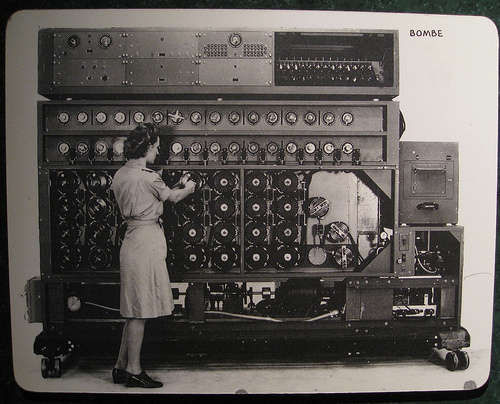
The US NAvy cryptanalytic Bombes had only one purpose: Determine the rotor settings used on the German cipher machine ENIGMA. Originally designed by Joseph Desch with the National Cash Register Company in Dayton, Ohio, the Bombes worked primarily against the German Navy’s four-rotor ENIGMAs. Without the proper rotor settings, the messages were virtually unbreakable. The Bombes took only twenty minutes to complete a run, testing the 456,976 possible rotor settings with one wheel order. Different Bombes tried different wheel orders, and one of them would have the final correct settings. When the various U-boat settings were found, the Bombe could be switched over to work on German Army and Air Force three-rotor messages.

US Navy Cryptanalytic Bombe (by brewbooks)

Read more

Of more pressing concern to TEPCO is the toxic water found in the basements of three turbine buildings and adjoining tunnels that approach the sea. The tunnels terminate in shafts that are less than 100 meters from the shore and the water level is close to the top.

Workers are putting sandbags and concrete blocks around the shaft openings to stop water reaching the sea, in case it overflows. They are also pumping water from the tunnels, but the operation is slow because they lack tanks to store it all. (via Japan on ‘Maximum Alert’ as Workers Try to Stem Leaks of Toxic Water | East Asia and Pacific | English)

Read more

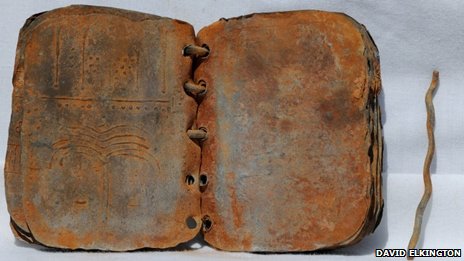
They could be the earliest Christian writing in existence, surviving almost 2,000 years in a Jordanian cave. They could, just possibly, change our understanding of how Jesus was crucified and resurrected, and how Christianity was born.

A group of 70 or so “books”, each with between five and 15 lead leaves bound by lead rings, was apparently discovered in a remote arid valley in northern Jordan somewhere between 2005 and 2007. (via BBC News – Jordan battles to regain ‘priceless’ Christian relics)

Read more