Read moreColonize the moon.
Images
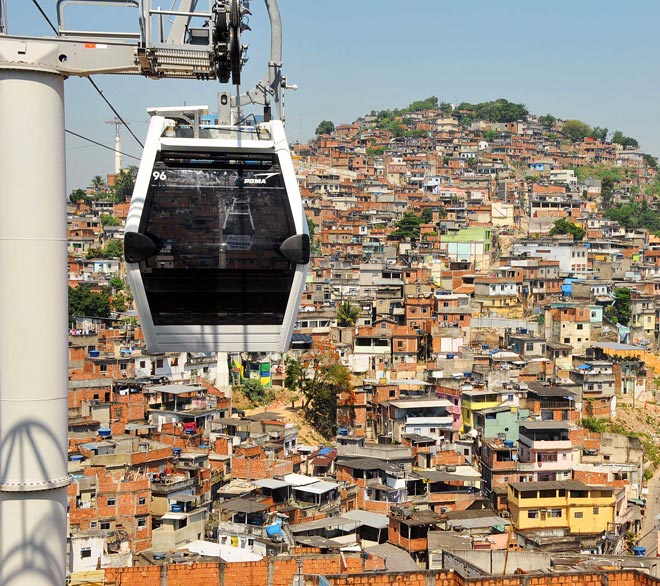
Read moreThat’s the direction for the newest transportation system in Rio, slated to open in March: a six-station gondola line running above a collection of favelas known as the Complexo do Alemão. The government says that 152 gondolas will carry 30,000 people a day along a 2.1-mile route over the neighborhood, transforming the hour-and-a-half trudge to a nearby commuter rail station into a 16-minute sky ride.

Color image of a region in Holden Crater. Credit: NASA/JPL/University of Arizona
Read moreObservations from two spacecraft, the Mars Reconnaissance Orbiter and Mars Express, have revealed potential subsurface ice deposits in areas just south of the equator, including one near Holden Crater, with an estimated reservoir of perennial subsurface water ice of about 50 – 500 kg m -2 just two or three meters beneath the surface. This is the first evidence of ice at “tropical” latitudes on Mars as low as 25 degrees.
In 2009, MRO observations revealed water ice as low as 45 degrees North in a recent small impact crater, and permanent water ice at Mars’ poles is known to exist. But most robotic missions – and hopefully one day human missions – need to land closer to the equator to meet safety criteria and engineering constraints. As evidence, the four proposed landing sites for the MSL hover within 25 degrees of the equator.*
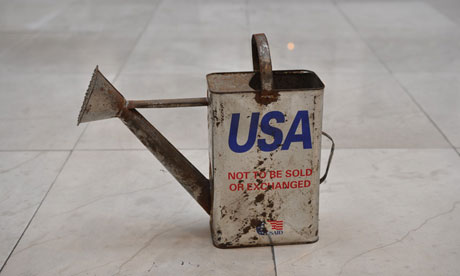
Read moreLet’s avoid the temptation to present this as an authentic design culture of Sarajevo, which for hundreds of years was one of Europe’s most diverse and tolerant cities. It is far from that. Instead, it is the design culture of an aberration, a temporary phenomenon within a historical blip. We are used to praising this kind of ad hoc ingenuity – often rather patronisingly – when we see it in Africa or India, but this was Europe, less than 20 years ago, and these people were not poor. Their money was simply no use to them, just as a Mercedes in a garage is no good without petrol to run it. The rote responses we apply to the developing world don’t work in this instance.
We think of design as one of the planes on which civilisation charts its course, measuring ourselves by our technological achievements and our talent for pleasing forms. But when civilisation breaks down, we resort to a cunning DIY culture with the resultant Mad Max mechanics and none of the Hollywood styling. Naive though some of these objects appear, their worth was weighed in how effective they were. In that sense, they represent a rare thing: a non-consumerist design culture. That’s not to say there was not a market for it – one of those pot-stoves would set you back seven packs of cigarettes if you couldn’t make your own – but this was an alternative economy that had nothing to do with novelty, desire or retail therapy. It was about staying alive.

Read moreOh hey, Murbarak. Nice pinstripes. Wait, what? Oh shit, those pinstripes are actually your name spelled over and over again. You’re a douche, no doubt, but that is some serious despot swag.


Read moreReblogged for Cloggy!
SteamGirl by ~ZephyrChef
Cloggy:——-
Thank you my Secret Tindink. What a lissome limb that young lady has, I’m entranced by it’s fascinating detail.
inky:
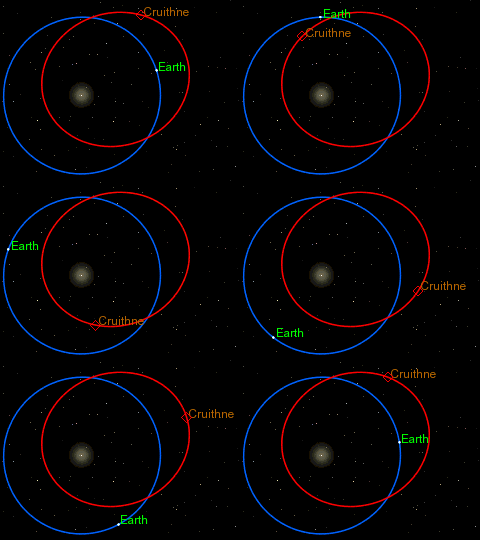
Read more3753 Cruithne, a planetoid whose orbit around the Sun is approximately 364 days.
Cruithne is approximately 5 kilometres (3.1 mi) in diameter, and its closest approach to Earth is approximately thirty times the separation between Earth and the Moon (12 Gm or twelve million kilometres). From 1994 through 2015, Cruithne makes its annual closest approach to Earth every November. Although Cruithne’s orbit is not thought to be stable over the long term, calculations by Wiegert and Innanen showed that it has probably been synchronized with Earth’s orbit for a long time.
 The Committee to Nuke Elysium