In order to bring broadband to the moon, scientists used four separate telescopes based in New Mexico to send an uplink signal to a receiver mounted on a satellite orbiting the moon. Each telescope is about 6 inches in diameter and is fed by a laser transmitter that beams information in coded pulses of infrared light.

Since our atmosphere bends the signal as it travels to the moon, the four telescopes transmit the light through different columns of air, each with different bending effects. This setup increases the chance that at least one of the laser beams will interact with the receiver, and establish a connection with the moon.

And if you’re fixing to binge on Netflix on the moon, the connection isn’t too bad, either. Scientists managed to send data from Earth to the moon at a rate of 19.44 megabits per second — on par with slower broadband speeds — and could download information from the moon at a rate of whopping 622 megabits per second. According to Wired UK, that’s over 4,000 times faster than current radio transmission speeds.

Read more

wolvensnothere:

a-b-c-demise:

after we go extinct, nature will reconquer the earth.

Depends on how we go extinct, and what you mean by “nature.” Venus is also “natural” but that way lies an antiseptic, brutally extreme planet with not a drop of life on it.

People, lots of things are natural.

Cf. My thesis: http://scholarworks.gsu.edu/philosophy_theses/37/

And this project: https://www.inkshares.com/projects/techne-investigating-the-state-of-the-art

LOTS of things are natural.

Read more

Nearly twice as tall as Mount Everest, Arsia Mons is the third tallest volcano on Mars and one of the largest mountains in the solar system. This new analysis of the landforms surrounding Arsia Mons shows that eruptions along the volcano’s northwest flank happened at the same time that a glacier covered the region around 210 million years ago. The heat from those eruptions would have melted massive amounts of ice to form englacial lakes — bodies of water that form within glaciers like liquid bubbles in a half-frozen ice cube.

The ice-covered lakes of Arsia Mons would have held hundreds of cubic kilometers of meltwater, according to calculations by Kat Scanlon, a graduate student at Brown who led the work. And where there’s water, there’s the possibility of a habitable environment.

“This is interesting because it’s a way to get a lot of liquid water very recently on Mars,” Scanlon said.

While 210 million years ago might not sound terribly recent, the Arsia Mons site is much younger than the habitable environments turned up by Curiosity and other Mars rovers. Those sites are all likely older than 2.5 billion years. The fact that the Arsia Mons site is relatively young makes it an interesting target for possible future exploration.

“If signs of past life are ever found at those older sites, then Arsia Mons would be the next place I would want to go,” Scanlon said

Based on the sizes of the formations, Scanlon could estimate how much lava would have interacted with the glacier. Using basic thermodynamics, she could then calculate how much meltwater that lava would produce. She found that two of the deposits would have created lakes containing around 40 cubic kilometers of water each. That’s almost a third of the volume of Lake Tahoe in each lake. Another of the formations would have created around 20 cubic kilometers of water.

Even in the frigid conditions of Mars, that much ice-covered water would have remained liquid for a substantial period of time. Scanlon’s back-of-the-envelope calculation suggests the lakes could have persisted or hundreds or even a few thousand years.

That may have been long enough for the lakes to be colonized by microbial life forms, if in fact such creatures ever inhabited Mars.

“There’s been a lot of work on Earth — though not as much as we would like — on the types of microbes that live in these englacial lakes,” Scanlon said. “They’ve been studied mainly as an analog to [Saturn’s moon] Europa, where you’ve got an entire planet that’s an ice covered lake.”

In light of this research, it seems possible that those same kinds of environs existed on Mars at this site in the relatively recent past.

There’s also possibility, Head points out, that some of that glacial ice may still be there. “Remnant craters and ridges strongly suggest that some of the glacial ice remains buried below rock and soil debris,” he said. “That’s interesting from a scientific point of view because it likely preserves in tiny bubbles a record of the atmosphere of Mars hundreds of millions of years ago. But an existing ice deposit might also be an exploitable water source for future human exploration.”

Read more

Earlier this week, the ISEE-3 Reboot project reached an official agreement with NASA, the first time the agency has approved an outside team attempting to resurrect a spacecraft that it never planned to use again. Now, Cowing, Mingo, and their team have until mid-June to fire the thrusters, diverting it into an orbit close to Earth. If they fail, ISEE-3 will swing around the Moon instead, continuing its solar orbit. It will not near Earth again for decades.

Before ISEE-3 Reboot, the pair operated the Lunar Orbiter Image Recovery Project, a highly successful effort to recover lost photographs from 1960s lunar satellites. This experience, as well as their NASA connections, served them well: they were able to collect reference material from some of the original mission team. “Typically, after 30 or 40 years, your wife says, ‘Why don’t you throw that crap out?’ And you keep saying ‘It’ll be important someday!’ Well, it was,” Cowing says. “They kept many of the documents that were required to tell the spacecraft what to do, because a lot of them knew that it was coming back to Earth in 2014.” Software-defined radio could compensate for hardware that no longer existed, making it possible to speak to ISEE-3 once again.

NASA couldn’t fund a recovery mission, though it provided advice and documents to Winger and Cowing. But the public, it turned out, could. A crowdfunding campaign reached its goal of $125,000 after a month, ultimately getting over $150,000. With that money and direct equipment donations, the team got two power amplifiers and set up ground stations at Morehead State University and the Arecibo Observatory in Puerto Rico, which houses the world’s largest and most powerful radio telescope. So far, they’ve detected a signal from ISEE-3, and Cowing believes they stand a very good chance of communicating with it in days or even hours.

If they can take control of ISEE-3, then what? It’s possible that it could start a new mission. As of 1999, 12 of the 13 instruments were known to be still working, and almost three-quarters of the original fuel supply remained. Though its battery is dead, the solar panels must be functioning at least enough for it to transmit a signal. Maintaining such a mission, however, would take money that the team doesn’t have right now. Instead, one of the project’s greatest findings could simply be that it’s possible to bring an abandoned spacecraft back under control, and that NASA will give its blessing to these unofficial projects.

Citizen scientists of the future, for example, might want to resurrect the Spitzer space telescope, an exoplanet probe that’s facing shutdown as part of NASA budget cuts. “People said, ‘Why don’t you take control of that?’ Well, one lost spacecraft at a time,” says Cowing, noting that Spitzer is a more complex craft that would take more work to capture. “But it’s only a couple million dollars a year to run these things, so all it takes is somebody with a little philanthropic intent to either write a big check or — look, we’ve raised more than a tenth of a million dollars. We’re like 10 percent of the way there to running a far more sophisticated spacecraft. So if we can do it, others can.”

As NASA pursues an ambitious Mars mission in the face of constant budget crunch, Cowing hopes that everyday citizens will be able to build new spacecraft, not just commandeer old ones.

Read more

“TrES-2b is considerably less reflective than black acrylic paint, so it’s truly an alien world,” said astronomer David Kipping of the Harvard-Smithsonian Center for Astrophysics (CfA), lead author on the paper reporting the research.

TrES-2b orbits its star at a distance of only three million miles. The star’s intense light heats TrES-2b to a temperature of more than 1,800° Fahrenheit – much too hot for ammonia clouds. Instead, its exotic atmosphere contains light-absorbing chemicals like vaporized sodium and potassium, or gaseous titanium oxide. Yet none of these chemicals fully explain the extreme blackness of TrES-2b.

“It’s not clear what is responsible for making this planet so extraordinarily dark,” stated co-author David Spiegel of Princeton University. “However, it’s not completely pitch black. It’s so hot that it emits a faint red glow, much like a burning ember or the coils on an electric stove.”

Read more

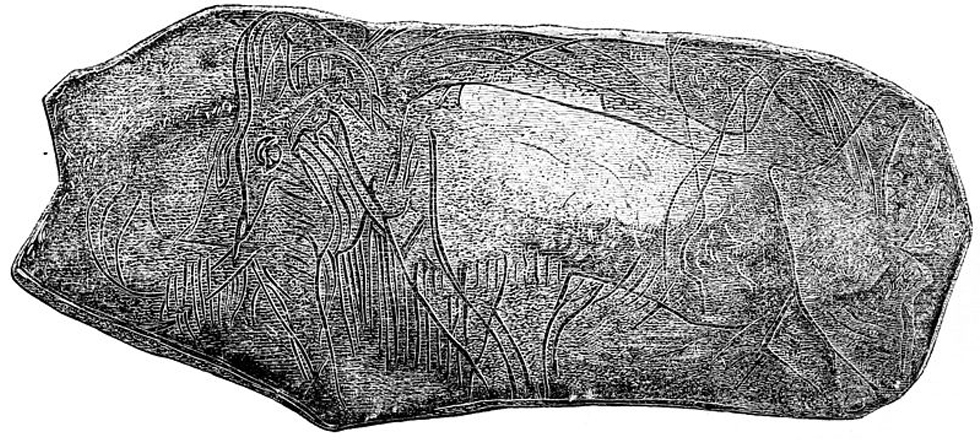
The uncovering of the engraving, in 1864, was the handiwork of a joint British-French archaeological expedition and it provided the first, unambiguous evidence that human beings had once shared this planet with long-extinct animals such as the mammoth. Its discovery was also an act of extraordinary good fortune, it transpires.

“The site has since lent its name to a period known as the Magdalenian era, which thrived across Europe between 12,000 and 16,000 years ago, and which we now appreciate was a time of incredible artistic creativity,” says Professor Chris Stringer, curator of the Natural History Museum exhibition.

The site has certainly produced many wonders, but in terms of their sheer scientific importance none can match the splintered mammoth figurine that was spotted by Lartet and Falconer on that day in May 1864. In their hands lay fragments, freshly dug from the earth, of a beautiful engraving of a mammoth, with its distinctive domed head, that was, for good measure, made of mammoth ivory.

“You couldn’t really top that in terms of proving that humans had lived at the same time as mammoths,” says Stringer. “Indeed, when you examine the piece you can see details of the mammoth’s anatomy that we only know about today from the frozen mammoth carcasses that we have found in Siberia.”

In other words, only an artist who had shared that ancient landscape (the Madeleine mammoth was carved about 14,000 years ago) with these creatures would have been able to record one with such precision and flair – and on a piece of the animal’s own ivory.

***HAPPY 150TH BIRTHDAY, DEEP TIME!***

Read more