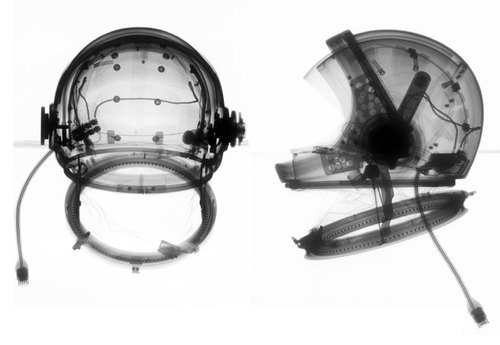
Two private spacesuit designers unveiled their first steps toward serious attire for future space travelers Friday night in front of a young, hip crowd of artists and tech geeks in Manhattan.

A spacesuit model arched his back experimentally, flashed the thumbs up and struck other poses that drew chuckles from the crowd gathered inside the Eyebeam Art and Technology Center. He showed off a bright yellow pressure suit topped by the dome of a roomy space helmet, with a blue glove on the right hand and a black glove on the left hand.

Moiseev and Southern push a design philosophy that embraces easier manufacture. Southern created spacesuit pieces from heat-sealed nylon coated by urethane laminant in his art studio.

“Our whole angle is super-easy manufacture and very affordable,” Southern explained. Manufacturing the pressure suit components alone had cost perhaps $15,000 in all, Southern said.

That price does not include all the other parts of a working spacesuit, such as communications gear and life support. (via SPACE.com – New Private Spacesuit Unveiled With New York Flair)

Read more

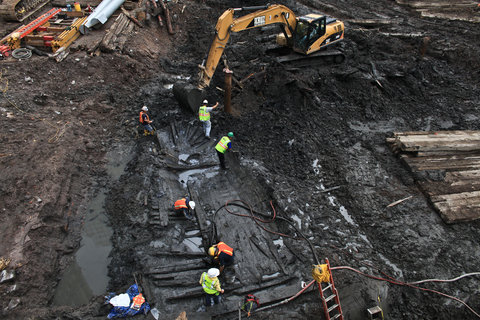
a 30-foot length of a wood-hulled vessel had been discovered about 20 to 30 feet below street level on the World Trade Center site, the first such large-scale archaeological find along the Manhattan waterfront since 1982, when an 18th-century cargo ship came to light at 175 Water Street.

The area under excavation, between Liberty and Cedar Streets, had not been dug out for the original trade center. The vessel, presumably dating from the mid- to late 1700s, was evidently undisturbed more than 200 years.

About the farthest Mr. Mackey and Mr. Pappalardo would go in conjecture was to say that the sawed-off beams seemed to indicate that the hull had deliberately been truncated, most likely to be used as landfill material.

A 1797 map shows that the excavation site is close to where Lindsey’s Wharf and Lake’s Wharf once projected into the Hudson.

(via 18th-Century Ship Found at Trade Center Site – City Room Blog – NYTimes.com)

Read more

On July 11, 2010, the new moon passed directly in front of the sun, causing a total solar eclipse in the South Pacific. In this image, the solar eclipse is shown in gray and white from a photo provided by the Williams College Expedition to Easter Island and was embedded with an image of the sun’s outer corona taken by the Large Angle Spectrometric Coronagraph (LASCO) on the SOHO spacecraft and shown in red false color (via NASA – The View From Easter Island)

Read more

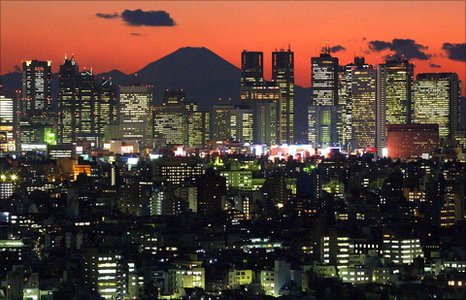
Despite the country’s showy internet speeds and some of the cheapest broadband around many Japanese are happier doing things the old way.

Figures for internet users in Japan remain around 70% compared to neighbouring South Korea’s 82%.

And even among those online there is a divide between those who are dependent on the internet and those who could live without it.

One government poll shows that although 44% of Japanese use the internet at least once or twice a month, the rest responded that they use it “hardly at all” or “not at all”.

Considering Japan’s top heavy society of over 50s, many of whom have not got to grips with the internet, and who make up 30% of the population and that figure begins to make sense.

Many of Japan’s older men – who are those most likely to run a business – have a marked preference to stay offline even in the office, says Tokyo-based entrepreneur Terrie Lloyd.

“There is a clear cut-off for Japanese bosses who know how to use PCs and mobile web-capable devices and those who don’t,” he said.

“The easiest way to tell is whether they have an e-mail address on the all-important name card. If they’re over 50 and don’t have an e-mail address, it’s a dead giveaway that you either use the phone or forget about contacting them.”

(via BBC News – Revealing Japan’s low-tech belly)

Read more

The series also features an anachronistic style: using fashion from the 1960s, technology that is a mix of ‘80s era computer technology alongside modern technology, and an alternate universe style political status quo in the form of the Soviet Union still being active in the year 2010. (via Archer (TV series) – Wikipedia, the free encyclopedia)

Read more

OLPC failed in its initial plan to drop millions of inexpensive computers into villages, to hook kids directly to the Web and, in effect, get them to educate themselves. The Indian establishment locked OLPC out precisely because it perceived the effort as inappropriate technological colonialism that cut out those responsible for education in the country—policymakers, teachers, curriculum builders, parents. OLPC never got into China either. Or most of the large nations it had originally targeted. (via Is Humanitarian Design the New Imperialism? | Co.)

Read more

Lava tubes are formed when the upper layer of lava flowing from a volcano starts to cool while the lava underneath continues to flow in tubular channels. The hardened lava above insulates the molten lava below, allowing it to retain its liquid warmth and continue flowing. Lava tubes are found on Earth and can vary from a simple tube to a complex labyrinth that extends for miles.

If the tunnels leading off the skylights have stood the test of time and are still open, they could someday provide human visitors protection from incoming meteoroids and other perils.

“The tunnels offer a perfect radiation shield and a very benign thermal environment,” says Robinson. “Once you get down to 2 meters under the surface of the Moon, the temperature remains fairly constant, probably around -30 to -40 degrees C.”

That may sound cold, but it would be welcome news to explorers seeking to escape the temperature extremes of the lunar surface. At the Moon’s equator, mid-day temperatures soar to 100 deg C and plunge to a frigid -150 deg C at night

via science.nasa.gov / http://science.nasa.gov/science-news/science-at-nasa/2010/12jul_rabbithole/

Read more