spacewatching:

This 1929 Hermann Noordung image depicts a three-unit space station as seen from a space ship. Hermann Potocnik (1892-1929), also known as Herman Noordung, created the first detailed technical drawings of a space station. The three units were the habitat, the machine room, and the observatory, each connected by an umbilical. The Earth is in the background, approximately 26,000 miles away. The station in this image is roughly above Cameroon’s southern tip, in a geosynchronous orbit on the median of Berlin.

Read more

fuckyeahdarkextropian:

retronauthq:

1936-1939: Life On Other Planets

Source

From Daily Mail – Have aliens already visited Earth? Nasa book suggests that ancient rock art could have been created by extraterrestrials:

Vakoch begins the 330-page book by postulating how difficult it might be to make first contact.

‘If a radio signal is detected in a modern Seti experiment, we could well know that another intelligence exists, but not know what they are saying,’ he writes in the book’s introduction.

He goes on to add: ‘Even if we detect a civilisation circling one of our nearest stellar neighbours, its signals will have traversed trillions of miles, reaching Earth after travelling for years.’

‘To move beyond the mere detection of such intelligence, and to have any realistic chance of comprehending it, we can gain much from the lessons learned by researchers facing similar challenges on Earth,’ he continues.

‘Like archaeologists who reconstruct temporally distant civilisations from fragmentary evidence, Seti researchers will be expected to reconstruct distant civilisations separated from us by vast expanses of space as well as time.

‘As we attempt to decode and interpret extraterrestrial messages, we will be required to comprehend the mindset of a species that is radically Other.’

Translation: YOU WANNA LIVE IN THE GALAXY? GROW UP! A civilization that Others, belongs in the Zoo.

So when we’re talking about genuinely progressing our culture – extended personhood, #thereisnonormal, gender fluidity, trans rights, empathy for all living things, posthumanism, etc – we’re preparing ourselves to enter a galactic culture. Worst case, we grow up.

Just like climate change action – worst case we clean up the planet and build a better world.

Right.

Read more

hidden-writing:

`Cowboy 1: “What’s your scene, man?”
Cowboy 2: “Reification”
Cowboy 1: “Yeah? I guess that means pretty hard work with big books and piles of paper on a big table.”
Cowboy 2: “Nope. I drift. Mostly I just drift.”`

<)%)_&^$>

{[andré bertrand—LE RETOUR DE LA COLONNE DURUTTI—détourned film stills & photographs/wheatpasted comic strip-1966{} <@&*%)>

Read more

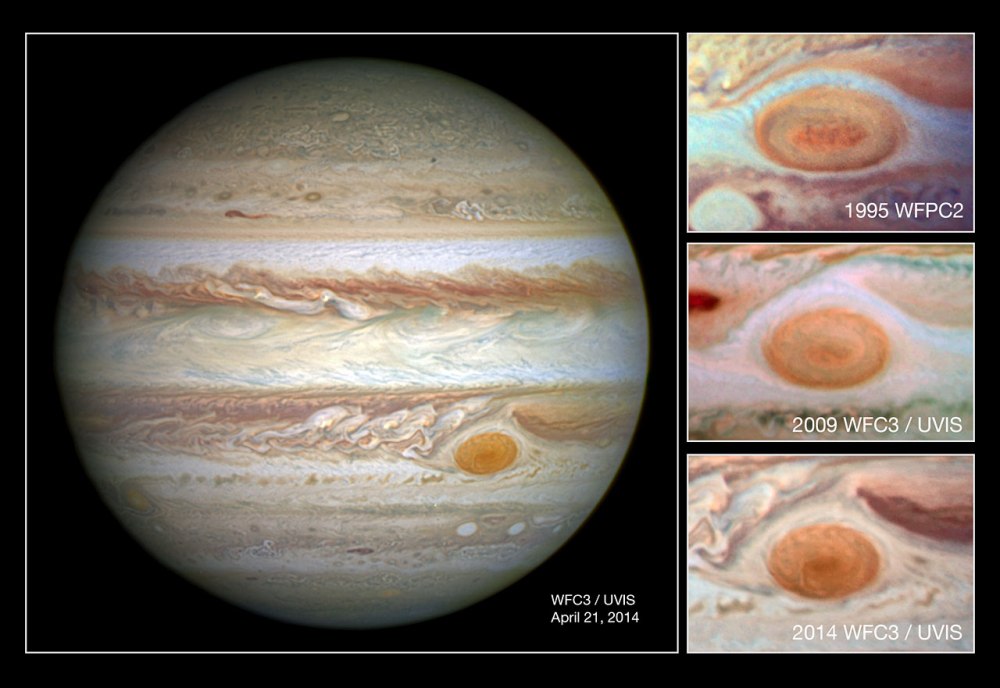
The first definitive observation of the spot in Earth telescopes was done by Samuel Heinrich Schwabe in 1831, so we know its been around at least that long, but it may have been observed as far back as the late 1600s. When Schwabe saw it, the Great Red Spot was gauged to be more than 25,000 miles across, large enough for three planet Earths to sit side by side within it.

But sightings since the 1930s have shown the spot shrinking. A recent Hubble photo (seen above) observes the Great Red Spot at its smallest size yet —- just over 10,000 miles across, barely big enough for 1.3 Earths to fit inside. Scientists are studying small eddies at the edge of the storm that may somehow be sapping it of its strength. Will this monstrous cyclone continue to downsize? Researchers can’t say for sure.

Read more

new-aesthetic:

ISS HD Earth Viewing Experiment, ISS HD Earth Viewing Experiment NASAtelevision on USTREAM. Science

The High Definition Earth Viewing (HDEV) experiment aboard the ISS was activated April 30, 2014. It is mounted on the External Payload Facility of the European Space Agency’s Columbus module. This experiment includes several commercial HD video cameras aimed at the earth which are enclosed in a pressurized and temperature controlled housing. Video from these cameras is transmitted back to earth and also streamed live on this channel. While the experiment is operational, views will typically sequence though the different cameras. Between camera switches, a gray and then black color slate will briefly appear. Since the ISS is in darkness during part of each orbit, the images will be dark at those times. During periods of loss of signal with the ground or when HDEV is not operating, a gray color slate or previously recorded video may be seen.

the simplest and most profound thing they’ve done up there.

Read more

grinderbot:

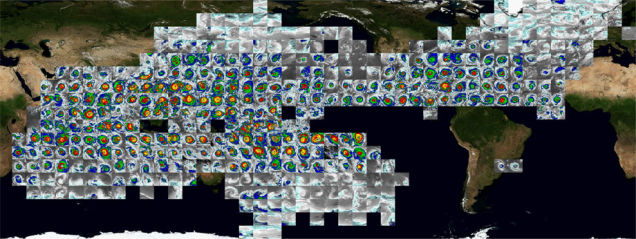
Hurricanes have been moving towards the Earth’s poles, at a rate of about 30 miles each decade. As the storms move further northwards and southwards, the scientists caution that we could increasingly see hurricanes hit harder and more frequently in areas where the storms were typically sparse. Interestingly, they also note that the same time period has also seen an expansion of the tropics themselves towards the poles, into the areas that have previously been classified as subtropical.

Which is just awesome news if you live in the Southern Archonic Protectorate with its new “Infrastructure Prime Minister” in charge. Except that government is dismantling everything Green and doesn’t recognize or acknowledge the climate threat. So just keep building roads bro. And cutting funding to basic science. Just keep on truckin in a spy way.

I’m sure Melbourne will get hit last its cool bro.

PS – maybe we get our cool Hexagon from this. Nice space marker.

Read more