
Here. Go here.

Read morefig. 2 ~ Protostar
stars are formed from collapsing clouds of gas and dust, when a gravitational “center” develops in a molecular cloud

Read moreGandhi has been historically the most aggressive character in Civilization due to an original bug in the first game that caused him to go all-out once he reaches democracy. They just kept the thing going ever since.
To further explain this bug, because I was chatting with mothmonarch about Civilization and other strategy games last night and I never got around to explaining this fully, but I love this story:
Gandhi’s AI in the original game had its aggression set to the absolute minimum (0 on a scale of 0 to 10, I believe, I may have this wrong but the basic idea I’m about to explain is accurate, as far as I can tell). Adopting democracy lowers an AI civ’s aggression by 2 points, so when someone who is fully peaceful loses two points of aggression, they should still be nice and polite, right?
Except this is an old DOS game, and so computer math is in place. What actually happened was that Gandhi’s aggression level ticked backwards two steps, from 0 to 255. On a scale of 0 to 10, Gandhi is now 255 points of pure nuclear rage.
And that’s the story as I recall it, but again I may have gotten some details wrong, so feel free to correct me! After that, as the original poster said, the devs loved the bug so much that they just kept it in as a running joke!
Automation: glitching warfare since 19xx
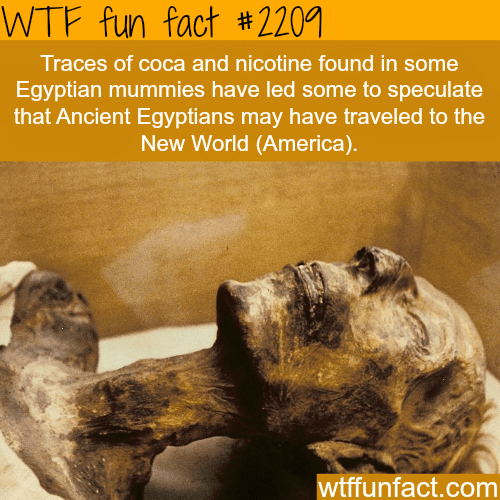
Traces of coca and nicotine found in Egyptian mummies – WTF fun facts
well DUH. a lot of historians are still trying to process the fact that ancient egyptians knew how to build boats, which is ridiculous. why would they not be seafarers and explorers?
this is not new or surprising information at all. it pretty much day one of any african-american studies course.
the egyptians knew that if they put their boats in front of the summer storm winds it’d blow them right across the sea to the Americas and they shared that with the greeks.
It’s really hard for people to understand that everyone had boats, exploration, and trade interactions without the same level of murder, colonization, and violence that the Europeans did. It’s really hard for people to get that.
An 11,000 year old Iroqious boat.
A whole book about Ancient Egyptian Maritime technology and culture.
Scientists “shocked” to discover that humanity casually traveled the seas over 100,000 years ago.
The Sea-Craft of Prehistory (book; Eurocentric as heck)
Humans traveling long distances by sea and deep=sea fishing for c. 42,000 years
The Dufuna Canoe, Africa’s oldest surviving boat, is 8,000 years old (Nigeria)
A fleet of 5,000-year-old boats in Abydos, Egypt
7,000-year-old seaworthy vessels in Kuwait
7,500-year-old boat found in China’s Zhejiang Province.
Scientific Evidence for Pre-Columbian Transoceanic Voyages (273 pages-for the hardcore only!):
The only plausible explanation for these findings is that a considerable number of transoceanic voyages in both directions across both major oceans were completed between the 7th millennium BC and the European age of discovery. Our growing knowledge of early maritime technology and its accomplishments gives us confidence that vessels and nautical skills capable of these long-distance travels were developed by the times indicated. These voyages put a new complexion on the extensive Old World/New World cultural parallels that have long been controversial.I frequently feel that Tumblr is taking up the slack left by my schooling.
This is disproved by genetics. All indigenous Americans are genetically related to the Clovis people, which in turn are directly related to people from Beringia. No humans in any numbers worth speaking of came to the Americas via the Atlantic, and they all came there via the Bering land bridge in the late Paleolithic. Humans might have been capable of sailing across the Atlantic, but the one thing you can always count on migrating humans to do is interbreed. And they didn’t.
I don’t want to speculate too much on why. But just because someone has sea-worthy technology doesn’t mean they are going to go all Ferdinand Magellan. Consider the Chinese—during the 16th-17th centuries, they had better ocean-going technology than the Europeans. And yet, it was the Europeans who predominantly sailed to China, and not the other way around. It simply wasn’t worth it to the Chinese, so they didn’t do it. History isn’t just about having technology, it’s about deploying it. History is full of stories of someone having the right tools, but not doing the right job.
Say you are an iron age fisherman. You make your livelihood by risking your life against storms to land some big tuna from miles out, so you can feed your family and community for the 20-some years of life you’ve got. Why would you suddenly, without any idea of what is out there, decide to just sail west until you found something? To satisfy the exploration counter-narratives of Tumblr users in the 21st century? This is not to say it’s impossible, or even implausible. I liked Valhalla Rising as much as the next person. But… genetics. It just didn’t happen.
Cut to the 39th century. Hyper-Tumblxxxqox post:
“We’ve found ancient texts describing colonies on Mars. We haven’t found any human remains, but there are plenty of technological artifacts there, including plastics only used in the 20th century. We know that rocket technology had been improving since the 14th century when it was pioneers in China, and the Chinese had a fully-space going culture by the 23th century. Therefore, the only plausible conclusion is that China colonized Mars—probably starting around the 1970s.”
In the 39th century they still use bold to show when they are super-serious in a post.
This is one of those areas where the European conceptualization of the behaviour and culture of a lot of early indigenous people seems to be at odds with a mounting stack of physical evidence.
The weak point isn’t the materially supported travel over vast distances. And the weak point isn’t the genetic evidence. The weak point is the conceptualization of native peoples that can’t support societies complex enough to have enforced interbreeding taboos or even non-European approaches to birth control. There are all sorts of political and cultural scenarios that would cut down on interbreeding based on limited travel.
The point being, I think that we’re making a grave mistake when we decide to start pushing inconvenient material evidence out of the way to support the European narrative of history. I’m not saying that it’s all obviously 100% real, I’m just saying I find it problematic when evidence is discounted because it goes against a narrative with extremely shaky foundations.
I see what you’re saying. And certainly, no one knows for sure. However, I think the evidence that is being deemed “inconvenient” in this instance is the genetic evidence.
First, the reason that Clovis culture DNA leading 100% back to Asia is such a big deal, is because this refutes earlier theories that Clovis culture is part of a “first colonization” of the Americas. How else, these theories argue, could Clovis culture have spread so rapidly across the Americas? Why is it that Clovis culture closely resembles other tools found in Europe? Clearly, those discredited theories argue, Clovis culture must have come across the Atlantic some 15,000 years ago.
Well, turns out it didn’t. Genetics, in this case, proved where the people came from conclusively, while theories based on a supposed preponderance of archaeological evidence did not.
Second: is it possible that there was trans-atlantic trade that brought coca and tobacco back from the Americas to Africa/Europe, while somehow preventing any humans interbreeding/migrating, while preventing any animals or crops interbreeding/migrating? Sure, any theory of history for which there is no direct contradictory evidence is possible. But if you want to talk about what is “inconvenient” evidence, I would say that the genetics is much more “inconvenient” to that theory, than a report of trace chemical evidence.
What does a single, potential hand-off of coca really mean, anyway? This single instance of chemical trace evidence is being blown up beyond any reasonable weight. There were no language transfers, no other artifact transfers, no genetic exchanges. Even if a ship sailed from Egypt to the Americas and back, what does this really mean to human history compared to all the other giant, continuous, and drifting migratory patterns that we do have evidence for? This theory of the coca trading ship seems to be a pet narrative, more than it seems relevant to history. Did Egyptians have ships capable of reaching America? Sure. That isn’t in dispute. But this possibility didn’t seem to affect either culture in any way that we have evidence to prove. If we come across some evidence that one culture affected the other in a way other than leaving a few trace chemicals, then we’ll discuss that then. But in the meantime, like with the disproved Clovis theories, this seems like a poorly supported way of inserting a highly suspect footnote into the record. You want to leave open the possibility, fine. Let’s discuss the seaworthiness of ancient ships. But to talk about a theory of contact like it is proven, when in fact all our archaeological evidence except for a single chemical trace proves otherwise, does a disservice to all that we do know and the means by which we know it. But hey, remember that Evolution* is only a theory!
Third: humans are a highly migratory species. And when they do migrate, they leave genetic traces. This is not a “european” thing. This is a human thing. I’m not making any assumptions about non-european religions, economics, language, or kinship structure. I am saying that as humans, they migrate and produce offspring like humans. Pretty much every standing theory of human migration is backed up by evidence of haplogroup transfers. In fact, this is precisely the sort of evidence that makes race a myth—because there is no genetic or physiological basis for race, and if we look at the genetic history of migration we see that pretty much every supposed racial division based on geography was crossed many times over by genetics. This sort of evidence describes how many times “Europe” was invaded by non-europeans and seeded with non-european genetics, rendering anything specifically “european” to European’s genetics only a fraction of their genotype. It describes how Americans came from Asia, and how they spread throughout the American continents and islands not just once but many times, circling around and re-seeding and remixing, just in the way that humans do.
For an idea of just how complex all of this is, check out this article. Scientists still have many different theories of who-moved-where-when, but the one thing human beings didn’t do in the Neolithic/Bronze Age was stay in one place and not interbreed.
Also, see Cahokia. It was the biggest city in North America throughout all of history, until Philadelphia finally surpassed it in the late 19th century. As many as 40,000 people lived there around the year 1200, and the city was pretty much a place specifically founded for continental trade, religious work, and, you guessed it, intermarriage. This is what we have evidence for. This is what culture in the Americas was up to.
One more thing. I think that assuming that complex societies absolutely and without exception do not interbreed (because we’re not just talking cultural taboos here, like “first cousins on the mother’s side are preferred matches”, “or siblings are off limits”, we’re talking actually no genetic traces whatsoever), is a much more dangerous assumption than the opposite. Taboos get broken. Incest happens. But to think that there would be contact without any broken taboos could happen in “complex society” assumes that the underpinning notions of culturally-enforced racial purity are a functional, successful, and natural feature of evolved culture. It also assumes that humans of a “higher culture” (whatever that is) are somehow different than the rest of nature, because they are not bound by the same desire to travel throughout their habitat and breed. It assumes that rather than seek to extend their gene pool as much as possible, human beings are creatures who, once attaining “high culture,” basically comply with the theory of eugenics by privileging selectivity over availability. Perhaps humans of upper classes have the ability to pick the mate they like best overall. But the vast majority of the population ends up mating with whomever they like most from who is available. Animals and humans would rather mate at all (availability) than have unbreachable standards (selectivity), especially based upon such specious concepts as “outgroup”.
To be honest, I find your comment about “non-European methods of birth control” a little confusing. Because you are not simply assuming that they were capable of choosing not to have a child. You are assuming that when they would choose to have a child (which they have absolute control over), they would never, not once ever, choose to have a child with an outsider. So we explain the lack of genetic evidence for this theory by claiming early Americans were the most efficiently selectively breeding society in the history of the world?
In cultures who claim to enforce racial purity, when their genetics are analyzed, they are not nearly as good at enforcing it as they think they are. Eugenics is so ridiculous because even if it was not ethically disgusting, it would be impossible to enforce without universal sterilization. It is a theory completely opposed to the way humans actually behave. Race and nationality is a cultural definition, and therefore a self-fulfilling prophecy. But genetics tells the actual story. To suggest that a population interbreeds with a migrating population of the same species is not Eurocentrism. It is to suggest that humans act resolutely like humans, like the biological creatures that they are.
It’s funny, Cahokia was one of the main things driving my response. After all, in my lifetime we’ve gone from a very simple vision of the mound-builder culture where the notion of a mound-builder city was, to quote one of my earliest mentors back at the Cincinnati Natural History Museum “up there with aliens in the pyramids” to where the notion of a massive mound-builder city with trade up and down the Mississippi is the norm.
And let’s be clear, I do question the narrative the post tries to frame as well and I think it probably does massively overestimate any inter-culture contact. But to discount the whole theory due to the lack of a major haplogroup transfer amongst US Natives seems to ignore vast amount of physical evidence as well as in many cases the self-reporting of these cultures. I mean it obviously casts extreme doubt on any sort of migration.
Also, I pointedly didn’t use any “higher culture” terminology because of exactly how poisonous that notion can get but what really confuses me is the desire to say “so what” and write limited oceanic travel off as a footnote. History is built of footnotes, it’s the application of cultural power and hindsight that defines what is footnote and what is “history”. I’m not arguing that these contact points weren’t extreme outliers — I suspect I’d be in conflict with the original poster as to the extent of any possible pre-European contact — I’m arguing that outliers or not, our histories, especially our histories of pre-European contact need to have room for these things to be explored within the context of the evidence. There needs to be room these narratives to be challenged — especially in those cultures that have their own pre-European first contact stories — which it felt you were dismissing out of hand. No, there were no migrations and no vast trade-routes, likely just occasional outliers.
But outliers matter. Anyone who tells you different is usually trying to sell you a dominant paradigm.
[Edited to add: Just like anyone who hands you a collection of only outliers and calls it a “history” is also, likewise trying to sell something.]
/jumps into tumblr exchange on the Lie of History…
Let me open by quoting paleo-tumblr user ab3l1nc0ln01809:
"But still there is more. It calls up the indefinite past. When Columbus first sought this continent—when Christ suffered on the cross—when Moses led Israel through the Red-Sea—nay, even, when Adam first came from the hand of his Maker—then as now, Niagara was roaring here. The eyes of that species of extinct giants, whose bones fill the mounds of America, have gazed on Niagara, as ours do now. Contemporary with the whole race of men, and older than the first man, Niagara is strong, and fresh to-day as ten thousand years ago.”
posted Sept 30th 01848, The Collected Works of Abraham Lincoln
And drop one link proper before proceeding to unfettered rantage.
“Using short DNA sequences from the plants’ cell nuclei and chloroplasts, Roullier and her co-authors found that the vegetables not only carry the genetic heritage of their South American origin, but exist in different types in Polynesia and the western Pacific. The sweet potatoes in Polynesia were part of a distinct lineage that was already present in the area when European voyagers introduced different lines elsewhere. Each lineage may even have been introduced several times, further complicating the pattern of dispersal and exchange. “The present sample of herbarium accessions does not allow us to rule out multiple prehistoric introductions,” Roullier says. “
History is a damn mess.
The Cosmic Anthropological Method involves collecting what gordonwhite of RuneSoup fame basically calls jigsaw puzzle pieces from a thousand different puzzles. Those facts that break people’s known models of reality. The outliers. Contemplating the things that make other people go ‘huh…’, before resuming their everyday life. Meditating upon these facts, just letting them float around inside your mind, drifting together, almost interlocking, can give the most pleasurable sensawunda.
This is how one can assemble a metaphorical rocket ship capable of escaping the local gravity of one’s foundational civilisational mythology.
The trick is in entertaining a thousand different perspectives without falling subject to the narrative fallacy.
Like: maybe instead Egypt was trading with a contemporary Polynesian culture that had its tentacles across the breadth of the Pacific, and was far more complex than is currently credited even by the Kon Tiki contingent. Or maybe it was those oft overlooked Phoneticians. Or the “Sea People”.
And who were the Olmecs anyway?
And what’s up with those old sea maps that show a pre-IceAge Antarctic coastline?
There is DNA evidence that there was a colony of (South Asian) Indians for its still barely glimpsed Vedic culture that interbred with the indigenous population of Australia. Who’d arrived some eighty thousand years ago via some rather rapid coast hugging, sea jumping migration out of Africa. And were living alongside giant freaking Land Crocodiles for a thousand plus plus years on its eastern coast… but what’s a dragon???
(And also, there’s an equally strong hypothesis to rival the OutOfAfrica orthodoxy that modern humans emerged from the Great Southern Land.)
But how about those cities high in the South American mountains were we can barely breath, seamlessly built from properly massive rocks?
And those deserts with green glass in them that look exactly like what we’ve found after exploding atomic bombs. Except we didn’t, there. (But check out this ace map of where we have.)
But we are literally finding the footprints of ancestors in beaches and bogs in places we never knew they’d been, revealed just for a moment in history by the acts of a climate in chaos. Some of them the only trace of failed branches of the hominid tree. Which grows all the gnarlier the closer we look. We’re up to, what three or four, depending how you count it, different contemporaneous sub-species now. Make those Hobbit cousins of ours literal, and prehistory looks damn right Tolkienesque.
Which brings us back to Abe’s firm belief in, and casual mention of, Giants…
Don’t be a prisoner of certainty. Embrace the wonder. Stare into the Abyss. Be a scientist.
Read more
The skeletal trees are said to have given rise to the local legend of a lost kingdom, Cantre’r Gwaelod, drowned beneath the waves. The trees stopped growing between 4,500 and 6,000 years ago, as the water level rose and a thick blanket of peat formed.
This year a great swath of the lost forest has been revealed. Last month archaeologists also found a timber walkway nearby, exposed by the storms.
It has been dated to between 3,100 and 4,000 years old, built as the local people found ways to cope with living in an increasingly waterlogged environment.
Two years ago human and animal footprints were found preserved in the hardened top layer of peat, along with scatterings of burnt stones from ancient hearths.
Read moreLike many people I recently binge watched House of Cards. For me that meant the show in its entirety, because I’d quickly dismissed the remake as being far inferior to the supremely Machiavellian original series. But I was convinced to revisit it in light of the second series being dropped, and much recommendation of the first.
What hooked me early on was the backdrop of Energy Politics. Underwood trying to free himself from grip of the Big Oil lobbyists. Scheming to get renewable energy seriously deployed.
Playing chess with the evil billionaire, being a personification of the corrupt nature of Nuclear Power. And the complications involved in securing the rare earth minerals on which solar power, not to mention laptops and smart phones, depend.
Here, I thought, is a show that’s not just about power and politics, but seriously examining a civilisation in phase shift. Moving towards becoming a Type 1 Civilisation. Showing how the fingers of the energy cartels grip the corridors of power, and how that grip might be slipped and a new future born. A bright green future.
Here, I thought, just might be a mundane, contemporary set counterpart to Dracula. While the immediate fantastic comparison was Game of Thrones, just maybe the Fincher led remake was attempting to do more than portray primate politics, but also examine the nature of change on a global scale. Its price; its bloody at all costs, whatever it takes, do not back down, we are hijacking this reality and taking it to its scheduled destination, because we are beyond good and evil actors so don’t mind the ledger.
Nope, that’s just Dracula.
Spoiler: Underwood becomes President at the end of season 2.
The image above is the end moment of the current continuity. Newly minted President Underwood, who’s completed his move from House Whip, through Vice President to now Leader of the Free World TM, without a single vote from Amerika’s citizens. Punching the desk. Keeping his knuckles hard. Ready to defend his place at the top of the primate tree against any attackers.
No closer to overcoming Type 0 Civilisation problems. In fact, he’s the chief cause.
And how did the most weighty of recommendations describe this show? “Because primates.”
(Welcome to 2014: Obama loved this show.)
Because this is #Multiverse TV we turn to considering an expanded metafictional universe. Made all the more possible because if his lawyers are any good, Fincher should have to the rights to make this real (having directed The Girl With The Dragon Tattoo and presumably optioned the rest, and healming the (completely unnecessary) Utopia remake).
This was my immediate reaction:
Upon further reflection, in composing this entry, it seems even better to go completely nuts and pitch a 21st Century Planetary Rescue Squad.
The ultimate team up of Nietzschean, ubermensch characters to face off against the biggest, baddest, schemiest primate… a man that shits on the future, and holds all the cards.
The President of the US is something to be overcome.
[Pose like a Team graphic PENDING]
And the plot computes itself…
…but if you wanna pay me Fincher, call me baby!
Read more "Pitching a Metafictional Planetary Rescue Squad"




 The Committee to Nuke Elysium