The only diving suit that lets a human reach 1,000 feet underwater was put on display at the American Museum of Natural History on Thursday. Dubbed the “Exosuit,” the system lets humans dive to regions where bioluminescent fish lurk in the darkness, with the goal of studying the fish and their environments more closely, as well as leveraging their biology for medical research.

Not only will the suit allow divers to see and potentially capture fish more safely, they will also get to image them with cameras in their natural habitat. The deep ocean is naturally hostile to humans, and therefore scientists know relatively little about it. Sparks noted that the suit will also let researchers gather more information about how creatures at those depths speciate and diversify, a process that’s not currently well-known.

Read more

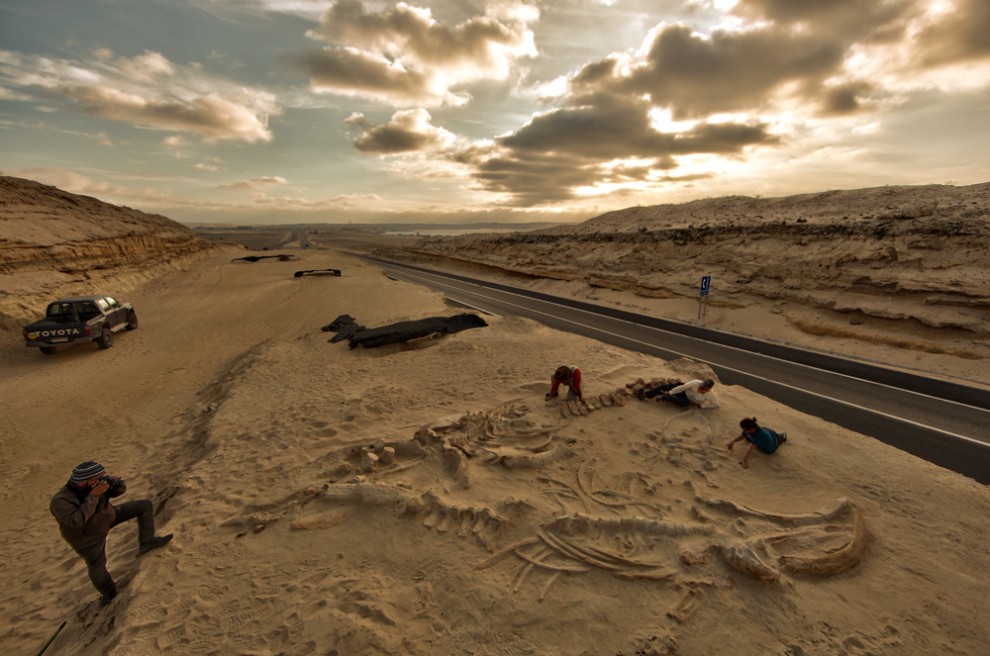
So far, the team have documented 40 separate skeletons, which are all between 6 and 9 million years old. Thirty-one of these were probably from the same species of rorqual whale—the family of giants that includes blues, fins and humpbacks.

There were other animals too, including a penguin, an extinct type of sperm whale, and two seals (one of which is new to science). There was a walrus-whale—a bizarre prehistoric dolphin with a tusked walrus-esque face.  There was even an aquatic sloth.

All of these specimens were found in an area of roadcut just 240 metres long and 20 metres wide. Pyenson estimates that there are hundreds of skeletons still buried in nearby areas that the construction teams didn’t touch. “What did they obliterate when they built the first two lanes of highway?” he wonders. “They must have dug up bone after bone.”

Read more

Giant elliptical galaxies are the most puzzling type of galaxy in the Universe. Since they mysteriously shut down their star-forming activity and remain home only to the longest-lived of their stars – which are low-mass ones and appear red – astronomers often call these galaxies ‘red and dead’.

Up until now, it was thought that red-and-dead galaxies were poor in cold gas – the vital raw material from which stars are born. While cold gas is abundant in spiral galaxies with lively star formation, the lack of it in giant ellipticals seemed to explain the absence of new stars.

While the six galaxies with plenty of cold gas harbour moderately active black holes at their centres, the other two show a marked difference. In the two galaxies without cold gas, the central black holes are accreting matter at frenzied pace, as confirmed by radio observations showing powerful jets of highly energetic particles that stem from their cores.

The jets could be an effect of the hot gas cooling down, and flowing towards the centre of the galaxies. This inflow of cold gas can boost the black hole’s accretion rate, launching the jets that are observed at radio wavelengths.

The jets, in turn, have the potential to reheat the galaxy’s reservoir of cold gas – or even to push it beyond the galaxy’s reach. This scenario can explain the absence of star formation in all the galaxies observed in this study and, at the same time, the lack of cold gas in those with powerful jets.

“These galaxies are red, but with the giant black holes pumping in their hearts, they are definitely not dead,” comments Werner.

Read more

A collage of radar images of near-Earth asteroid 2006 DP14 was generated by NASA scientists using the 230-foot (70-meter) Deep Space Network antenna at Goldstone, Calif., on the night of Feb. 11, 2014.

Delay-Doppler radar imaging revealed that the asteroid is about 1,300 feet (400 meters) long, 660 feet (200 meters) wide, and shaped somewhat like a big peanut. The asteroid’s period of rotation is about six hours. The asteroid is of a type known as a “contact binary” because it has two large lobes on either end that appear to be in contact. Previous radar data from Goldstone and the Arecibo Observatory in Puerto Rico has shown that at least 10 percent of near-Earth asteroids larger than about 650 feet (200 meters) have contact binary shapes like that of 2006 DP14.

Radar is a powerful technique for studying an asteroid’s size, shape, rotation state, surface features and surface roughness, and for improving the calculation of asteroid orbits. Radar measurements of asteroid distances and velocities often enable computation of asteroid orbits much further into the future than if radar observations weren’t available.

NASA places a high priority on tracking asteroids and protecting our home planet from them. In fact, the United States has the most robust and productive survey and detection program for discovering near-Earth objects. To date, U.S. assets have discovered more than 98 percent of the known near-Earth objects.

Read more

darklyeuphoric:

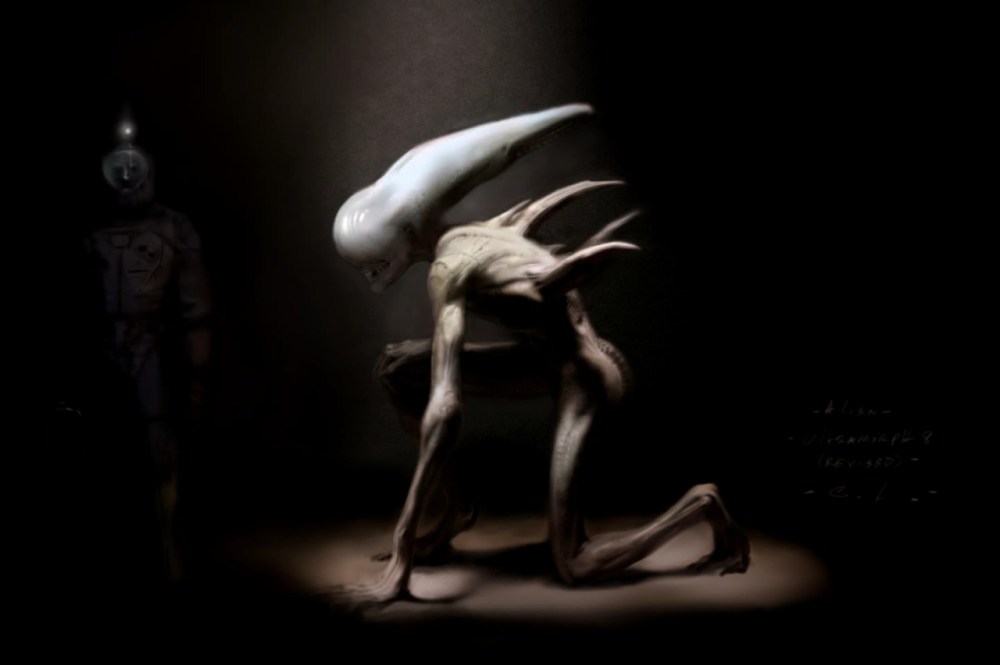
Holloway Alien concept art for Prometheus, via the always superb Strange Shapes.

“It is a humanoid demon, spindly limbs and bony back. Boneless and flexible and monstrously strong. A threshing eel’s tail. Its blunt head dolphin-like and elongated … A nightmare image, a translucent white goblin. Backlit, it shows the strange shape of a human face inside its fleshy skull. A mockery of Holloway.
And then it’s gone.”
~ Alien: Engineers, by Jon Spaihts.

The Strange Shapes article Ultramorphs, Xenomorphs, and Weapons of War investigates numerous variations of H.R. Giger’s iconic space monster considered for Prometheus. (It also makes me realize how brilliant and thoughtful Jon Spaihts’ original script was, and how the “not an Alien prequel” rewrite failed so badly in so many ways.)

Read more