
Images

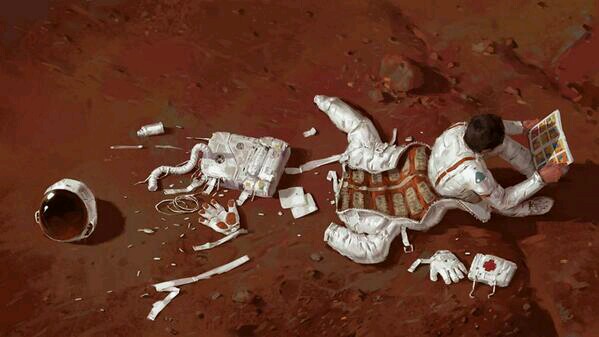
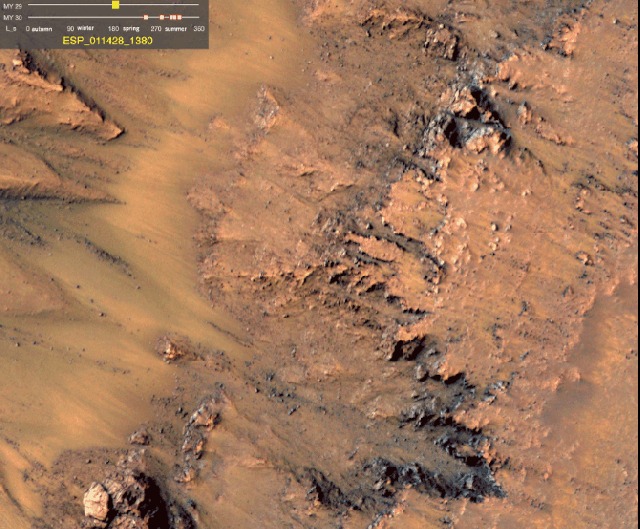
Researchers have long theorized that Mars had at one point held flowing water, and probably even held frozen water still. But, the presence of darkening lines moving downwards along a slope as the temperatures rise in the warmer months, suggests that there could be water flowing even now — and also suggests a mechanism for how it might be able to do it.
So, how does water flow in the frigid Martian temperatures that are present, even in the summer months? Researchers think that there may be a naturally-occurring anti-freeze in the water, caused by the high-iron content…
More details and pix http://io9.com/are-these-pictures-of-water-flowing-on-mars-right-now-1520115138
Read more
Shops and small stores are opening three months after Typhoon Haiyan. In a badly-hit part of Tacloban, a shop offering phone credit has already been built and is well stocked. Photograph: Eleanor Farmer/Oxfam
Read more
Sure, obviously you go hang out at a Lagrange point on the way back to Earth, after rendezvousing with a Type C Asteroid.
Read more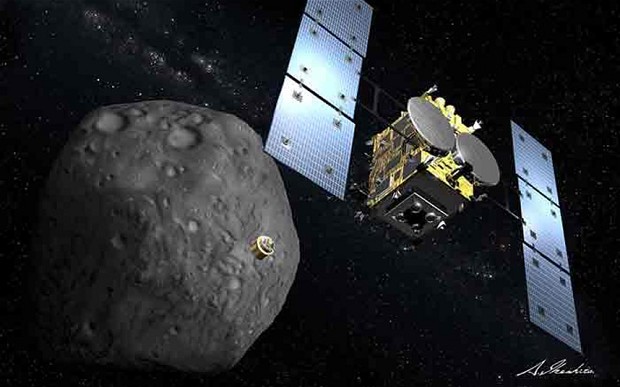
Read more‘Space Cannon’ To Be Fired Into Asteroid
Japanese craft to fire “space cannon” into asteroid in search for origins of the universe
Japan’s space agency has successfully test-fired a “space cannon” designed to launch a projectile into an asteroid as part of the search for the origins of the universe.
The device will be aboard the Hayabusa-2 space probe that is scheduled to take off in 2014 and rendezvous with an asteroid identified as 1999JU3 that orbits between Earth and Mars in 2018.
Once in position close to the asteroid, the space cannon will detach itself and remotely fire a 4lb metal projectile into the surface of the miniature planet.
“An artificial crater that can be created by the device is expected to be a small one, a few meters in diameter, but … by acquiring samples from the surface that is exposed by the collision, we can get fresh samples that are less weathered by the space environment or heat,” the Japan Aerospace Exploration Agency said in a statement.
The mother craft will then land close to the crater and use a small rover to collect samples that would have otherwise been below the surface of the asteroid and return to Earth in late 2020. In all, JAXA scientists say the craft will shadow the 2,950-foot-diameter asteroid for around 18 months.
The project has “the potential to revolutionise our understanding of pristine materials essential to understanding the conditions for planet formation and the emergence of life,” JAXA said.
“It can provide important information needed to develop strategies to protect the Earth from potential hazards,” the agency added.
“Moreover, robotic sampling missions to primitive bodies will be pathfinders for … human missions that might use asteroid resources to facilitate human exploration and the development of space.”
Hayabusa-2 is the second project to recover particles from deep space and will build on the success of Hayabusa, which in 2010 gathered surface dust from an asteroid and returned to Earth.
Source: telegraph UK


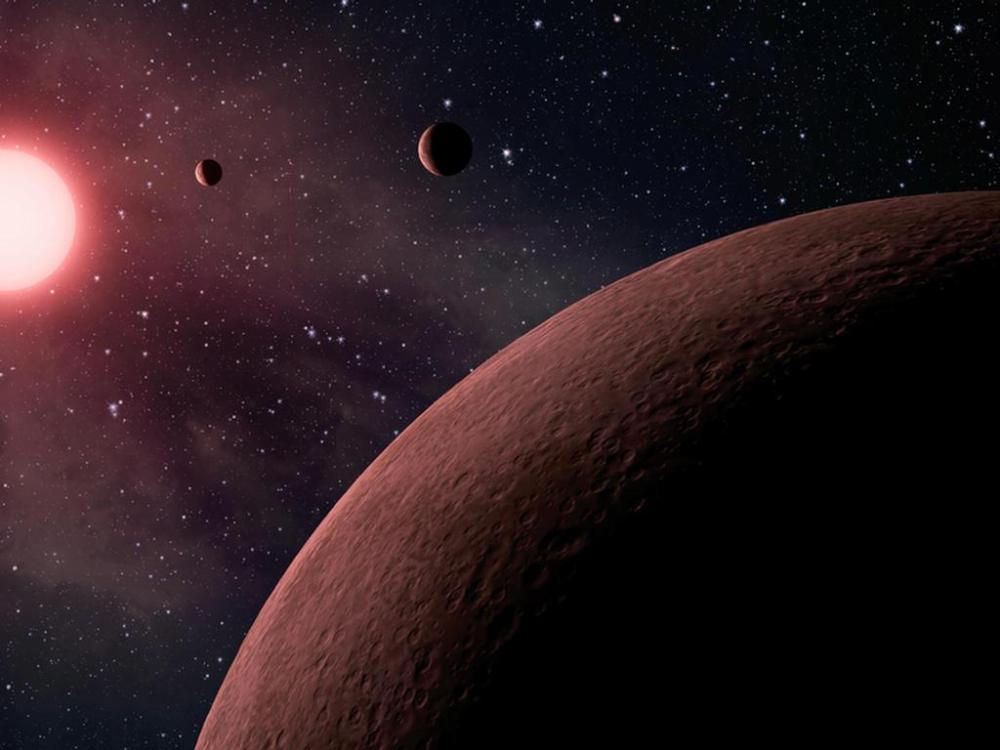
Read moreThis artist’s concept shows a tiny planetary system. It’s so compact that it’s more like Jupiter and its moons than a star and its planets. Astronomers using data from NASA’s Kepler mission and ground-based telescopes have confirmed that the system, called KOI-961, hosts the three smallest exoplanets known so far to orbit a star other than our sun. (Image credit: NASA/JPL-Caltech)
 The Committee to Nuke Elysium