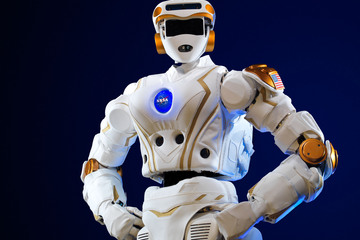
“Come with me if you want to spaaace”
This image shows NASA’s Valkyrie (R5) robot, which is NASA’s newest humanoid robot and was built to compete in the DARPA Robotics Challenge.
Read more
“Come with me if you want to spaaace”
This image shows NASA’s Valkyrie (R5) robot, which is NASA’s newest humanoid robot and was built to compete in the DARPA Robotics Challenge.
Read more
Though NASA’s StarDust mission flew through the tail of comet Wild2 in 2004, no craft has ever orbited one. Rosetta will orbit its target at a leisurely walking pace, searching for a landing spot. Things will get even more exciting in November, when the robotic lander Philae (illustrated) detaches from the mother ship and becomes the first spacecraft to land on a comet.
Philae will anchor itself with a harpoon before starting to dig. An on-board lab will analyse the scoops of rock and beam the results to Earth. Like asteroids, comets are thought to preserve material from the birth of the solar system, 4.6 billion years ago. Comets contain water, so the chemistry of the scoops could reveal whether our oceans, and a bunch of molecules necessary for life, came from comets smashing into early Earth.
Read more
The tree-dwelling dinosaur Dixon dubbed the “Nauger” was unlike any known dinosaur. Part woodpecker and part aye-aye, this dinosaur pecked holes in trees in order to snatch grubs with a specialized, elongated finger, but in 2002 two different teams of paleontologists described two specimens of a strikingly similar dinosaur. Known as Scansoriopteryx, this tiny dinosaur possessed a ludicrously elongated third finger, and a paper by a team of Chinese Academy of Sciences paleontologists led by Fucheng Zhang suggested that this dinosaur may have been using this digit to skewer insect larvae much like the aye-aye and Dixon’s hypothetical “Nauger.” These scientists also proposed that Scansoriopteryx may have been one of the few arboreal dinosaurs, although the paleobiology of this creature has not been thoroughly studied yet (via “Alternative Evolution” of Dinosaurs Foresaw Contemporary Paleo Finds [Slide Show]: Scientific American Slideshows http://www.scientificamerican.com/article.cfm?id=alternative-evolution-dinosaurs-foresaw-contemporary-paleo)
Read more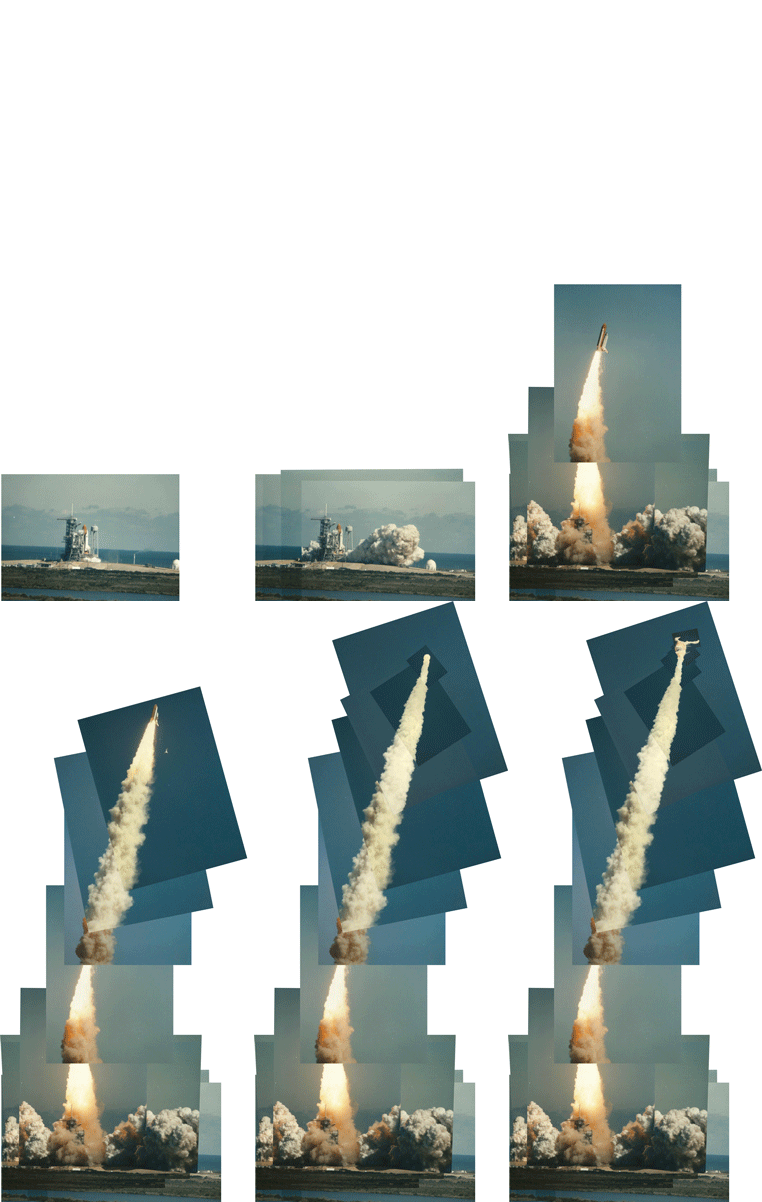
The Challenger disaster rendered as a composite gif set assembled from some photos a guy found in an attic.
Read more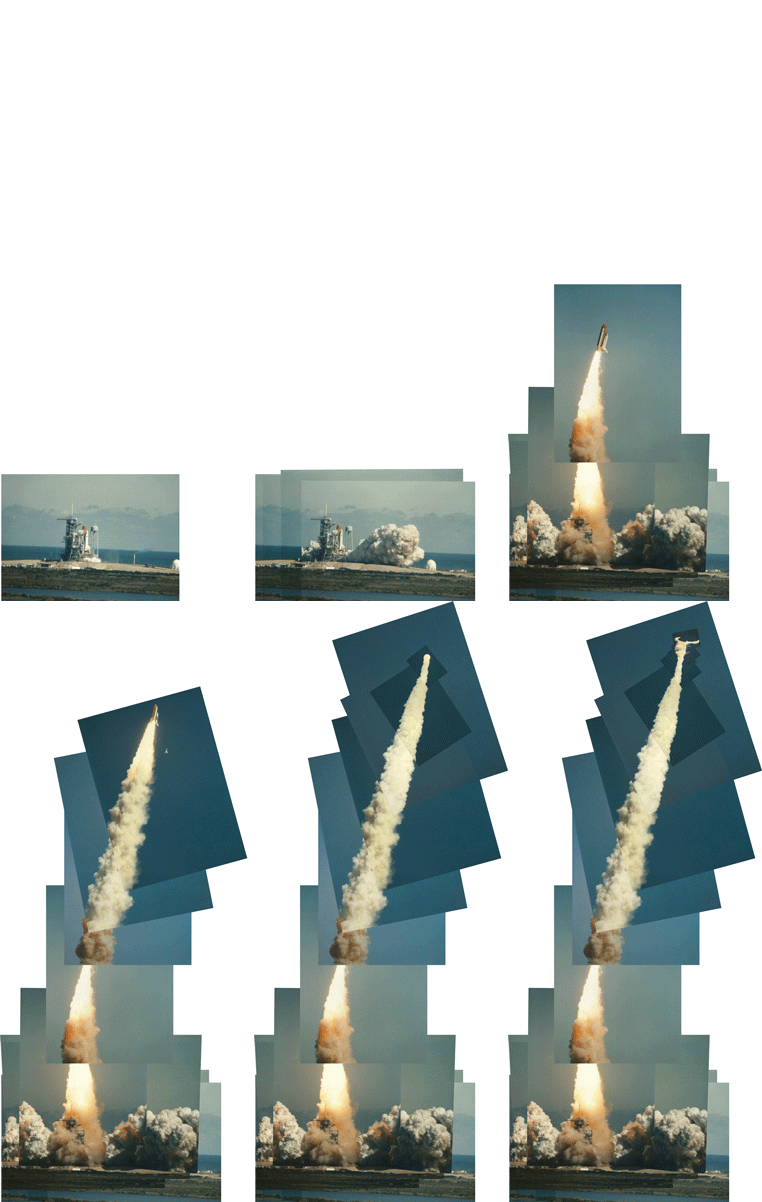
The Challenger disaster rendered as a composite gif set assembled from some photos a guy found in an attic.
Read more
Here’s where to look in the sky for star Y1194, twin to our sun, found to have at least one planet.
From The Apocalypse Trialogue, Pt2 (via Psychedelic Salon podcast)
Read moreRupert Sheldrake: “Interplanetary Morphic Resonance… planets of the species Gaia will be in resonance with ours. And planets of the species Venus will resonate with those, and so on…
If there is indeed morphic resonance between the planets, so that when a new form appears on Earth, it’s vastly more likely to appear on other planets, ‘til others caught up.”
Ralpha Abrahams: “A Cosmic Synchronization Principle.
…A spatial version of the God Whistle. A Cosmic Synchronization of God Whistles.”


 The Committee to Nuke Elysium