
Kate Bishop wakes up a little further from home than she thought on Flickr.
Read more
12:18 a.m. Greenwich Mean Time on Aug. 2, 1971, Commander David Scott of Apollo 15 placed a 3 ½-inch-tall aluminum sculpture onto the dusty surface of a small crater near his parked lunar rover. At that moment the moon transformed from an airless ball of rock into the largest exhibition space in the known universe.
…
Between mouthfuls, van Hoeydonck and Scott discovered shared obsessions with archaeology and Mayan mythology. At the end of the evening, van Hoeydonck praised Scott and Irwin: “ ‘You guys are like the knights that existed in medieval time—the astronauts of the Holy Grail,’ I told them. They toasted me, ‘Look what this guy says! Let’s get him a sculpture on the moon!’
…
Two days after the NASA press conference, van Hoeydonck wrote to the Apollo 15 crew: “To open the way to the Stars is the most important mission of man in this century.” In a separate letter, sent directly to Scott the same day, he added, “Sorry you didn’t find an ancient temple but … the experience of walking on the moon must be out of our dimensions.”
Read more
For the uninitiated, Saturn’s uncannily symmetric cloud system measures roughly 20,000-miles across, and is utterly unique in our solar system. Its dimensions and dynamics are just bizarre. At the hexagon’s center whirls a tightly wound hurricane roughly fifty-times larger than the average hurricane-eye on Earth. About it spins an assortment of smaller vortices, caught up in the hexagon’s jet stream, that rotate clockwise, even as the central hurricane, and the outer hexagon, rotate in the opposite direction. These smaller storms are visible in the image above as reddish ovals. The largest of the smaller vortices, appearing white in the lower right corner of the hexagon, spans about 2,200 miles – roughly twice the size of Earth’s largest hurricanes. (via New Hi-Res Footage Shows Saturn’s Mysterious Hexagon Like Never Before)
Read more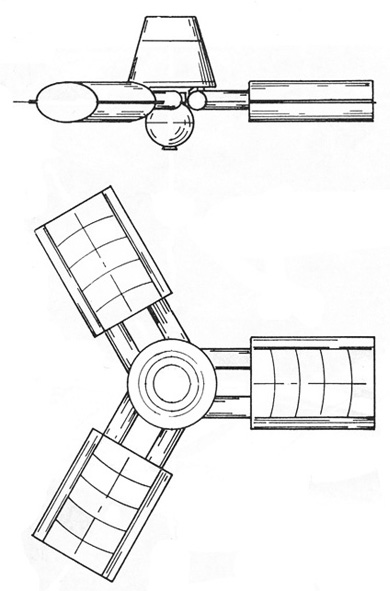
Meanwhile, in Houston, Texas, Edward Olling at the newly established Manned Spacecraft Center (MSC) was hard at work on a temporary space station program which he called Project Olympus. In April 1962, he circulated a draft planning document for comment; then, on 16 July 1962, he unveiled his Project Olympus “Summary Project Development Plan” to top-level MSC managers.
Olling explained that Project Olympus space stations would for the first time provide NASA with a large usable volume and enough scientific equipment, astronauts, and electrical power to carry out wide-ranging basic and applied research in space. Early station research would seek to answer basic questions about piloted spaceflight; for example, could humans work effectively for long periods in space? New objectives would be added over time. Beginning even with the first station, the Project Olympus stations would become space-environment research facilities, “national laboratories” for research into meteorology, geophysics, communications systems, navigation systems, and astronomy, and “orbital operations” facilities (that is, sites for assembling spacecraft bound for points beyond space station orbit). Each 138,600-pound Project Olympus station would comprise a large central hub with three evenly spaced arms. Each arm would include a pressurized crew module of oval cross-section nested between two cylindrical access tunnels. Apollo-derived logistics spacecraft (typical mass, 31,700 pounds), each bearing six astronauts, supplies, and equipment, would dock at the zero-gee central hub. The 150-foot-wide Project Olympus stations would spin four times per minute to create acceleration in their arms. On each station, the crew deck farthest from the hub would experience the greatest acceleration: the equivalent of one-quarter of Earth’s gravitational pull, or about midway between lunar and martian surface gravity. Crew decks closer to the hub would experience less acceleration. Olling hinted that the different levels of acceleration the astronauts would experience on decks at varying distances from the hub might be useful for scientific research, but he provided no specifics. (via Project Olympus (1962) – Wired Science)
Read more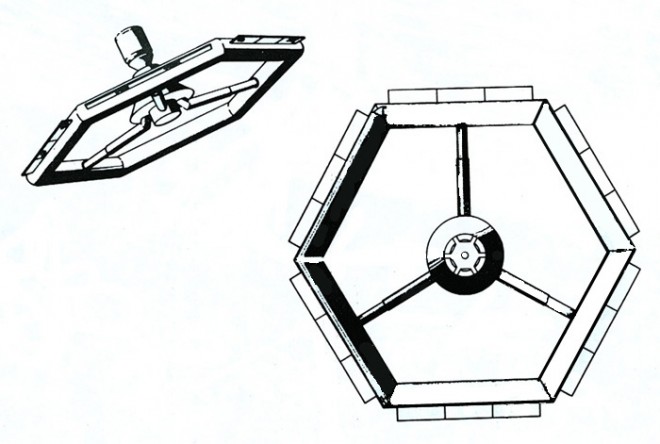
Langley Research Center (LaRC) was the early leader in NASA space station studies. A pioneering player in station work at the Hampton, Virginia-based laboratory was engineer Rene Berglund. He often designed stations that took advantage of existing or planned space hardware. In 1960, for example, Berglund designed a one-man space station comprising a metal-walled core, an inflatable fabric torus, a dish-shaped solar array, and a Mercury capsule at one end. At the time, Project Mercury had only recently begun flight testing. In May 1962, Berglund filed a patent for an “erectable” artificial-gravity space station that would reach orbit on a single two-stage Saturn C-5 (as the planned Saturn V rocket was then known). Folded atop its launch vehicle, Berglund’s station would measure just 33 feet across (the diameter of the rocket’s second stage, to which the station would joined as it ascended to orbit). The station would unfold in orbit into a hexagon 150 feet wide. Three spokes would link the hexagon to a central hub where piloted Apollo-derived logistics spacecraft would dock. The hexagon would revolve like a merry-go-round to create acceleration, which the crew inside would feel as gravity. “Down” would be away from the hub, toward the hexagon’s outer rim. (via Project Olympus (1962) – Wired Science)
Read more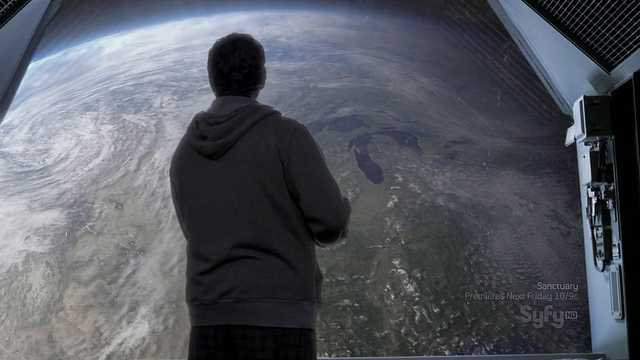
Eli’s #overvieweffect initiation into the Space Mysteries on Flickr.
Via Flickr:
Stargate: Universe pilot

The Picard uses the #overvieweffect to convince a local alien leader he isn’t a spacegod on Flickr.
Via Flickr:
Star Trek TNG – Who Watches the Watchers?



 The Committee to Nuke Elysium