wolvensnothere:

wolvensnothere:

So, I was teaching my small class about mind-body dualism, and I was talking about Descartes’ reasoning for why we have we need both mental and physical substances—that is the need for base physicality to highlight and refine the pure mental/soul stuff of the “real us.”

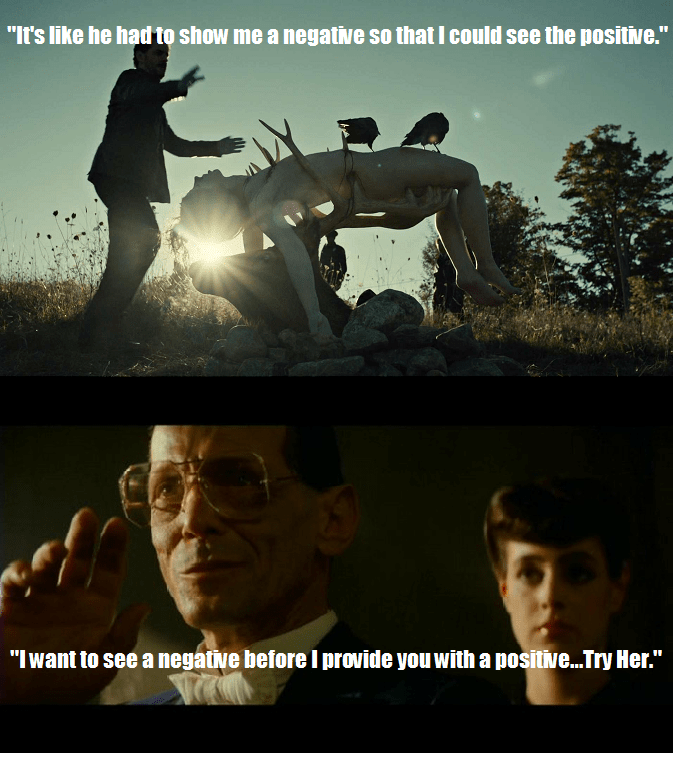
Anyway, I was talking about this, and I said “For Descartes, we have to have the negative, so that we can see the positive,” and all of a sudden both of these scenes just popped into my head, and it CLICKED.

Top: Cassie Boyle’s body on a stag head, with ravens, from NBC’s Hannibal. Line from Will Graham, about how Cassie Boyle’s murder by a copycat helped him to understand the original Minnesota Shrike: “It’s like he had to show me a negative so that I could see the positive.”

Bottom: Eldon and Rachael Tyrell, from Ridley Scott’s Blade Runner (1982). Line from Eldon Tyrell to Rick Deckard, about understanding the efficacy of the Voight-Kampf Test: “I want to see a negative before I provide you with a positive…Try her.”

Now, I don’t know if this was intentional, and the internals are really kind of intricate—Tyrell’s deception about Rachael being a “Negative” as correlated to Hannibal’s deception about the provenance of the actual negative, each used to guide the investigator down the road they want them to travel, fully knowing the nature of its end—but I do know that I can’t stop thinking about the really quite pleasant similarities between Hannibal and Blade Runner.

Good night.

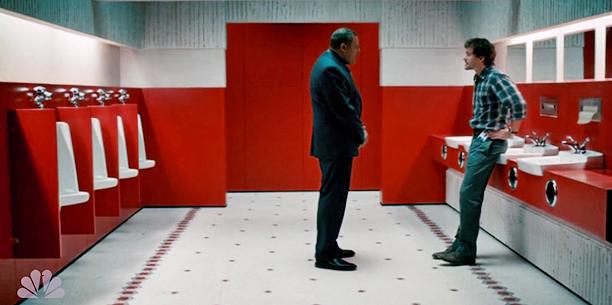
Crawford/Bryant to Graham/Deckard: “You know the score, pal! If you’re not cop, you’re little people.”

Help I Can’t Stop.
Read more

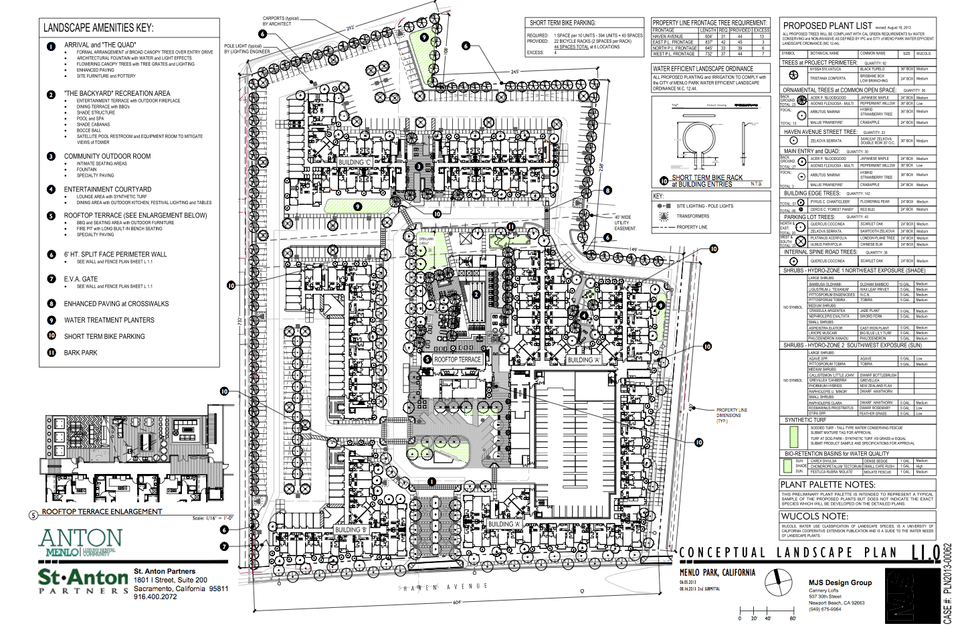
If Facebook staffers opt to move in to work, they’ll be getting a very sweet deal out of it: the Anton Menlo project includes all the comforts of suburbia and college combined. What 20-something engineer wouldn’t want to live in a walled compound?

Planning documents obtained by Valleywag detail the amenities some employees will soon enjoy: an area called “The Quad” with flowering trees, fountains, and “light effects.” A “backyard” rec zone with bocce ball, pool, cabanas, and BBQ pits. Of course, there’s an area for dogs, and an outdoor kitchen. To really finesse that You’ve been removed from the rest of society vibe, a six-foot wall surrounds most of the project.

Work is only five minutes away—and thanks to mediocre or non-existent public transit options, no one from The Outside will be able to easily visit. It’ll be like you never existed on Earth before joining Facebook.

* Facebook Think is Correct Think.
Now a division of Umbrella Corporation

Read more

Tesla’s CEO has apparently dropped $866,000 on the amphibious Lotus Espirit from The Spy Who Loved Me. His intent? He wants to turn the prop car (which never actually swam) into a true aquatic vessel, courtesy of a Tesla electric powertrain.

Read more

Iceberg homes became a phenomenon in the first place because, by some people’s standards, London’s luxury real estate isn’t really that luxurious at all. Prime neighborhoods such as Belgravia and Knightsbridge are filled mainly with Victorian buildings, built in an era when extravagance meant little more than carpets, hot water upstairs and enough room to separate the maids from the horses at night. Sumptuous by ordinary standards, these grand houses can seem a little poky to billionaires used to endless acres of flat space, and to swimming pools and cinemas in their own homes. Alas, with whole London streets protected by historical preservation orders, you can’t risk so much as trimming a hedge, let alone slapping a helipad on the roof. The answer for many ultra-rich owners looking to expand has been to build downwards, creating what are essentially the world’s fanciest basements.

And what basements they are. Iceberg homes’ lower quarters can go down three or four stories into the earth and contain swimming pools, spas, car lifts, gyms and cinemas, as well as windowless accommodation for the staff that service them. Thanks to extensive press coverage, they’ve caught the London public’s imagination in ways both negative and positive.

Certainly, there’s something undeniably cool about being rich enough to build a secret lair and pretend you’re Batman. On the other hand, Iceberg homes have also been read as proof of how weird London’s super rich are, half the time living out of town, the other half squirrelled away in sunless caverns of chrome and onyx.

Read more