
From @aneyeofsky: the ISS in front of the daytime moon.
Read more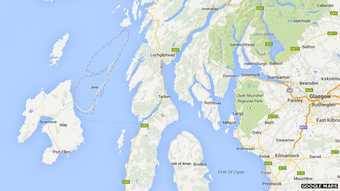
Read more“We hope to have the map of Jura back to normal as soon as possible.”
My first and best job ever — what I worked while I was a student at Cooper Union — was as a graphic designer for the MacNeil-Lehrer News Hour.
It was news I was proud to be working for, and it was 1989. That meant I was crazy young, super junior, and that about 50% of the graphics on-air (those little pictures over the shoulder of the newscaster) were still produced by hand. That meant a stat machine, Pantone paper, x-acto knives, and an airbrush.
As the kid, it meant that I could use the Quantel Paintbox better than anyone there (think Photoshop 1.0, but a dedicated machine) but also that I wasn’t allowed to (think broadcast unions). So I spent most of my time painting maps and flags, including a lot of flags that no longer exist. These used a lot of paintbrush ink — on a big news day, there would be a low haze over the graphics department cubes.
South Africa was in the news constantly back then, and a lot of my maps were of the region. Remember, there was no looking anything up except in books, and then tracing the maps I found. Like every other day, I colored in the land with a gradated burnt umber over orange, and cut out blue paper for the water.
One day was different, and it was a typewritten letter from the government of Lesotho, which had been opened and left on my desk. It was a very polite appeal to me to stop fucking representing the landlocked country of Lesotho as a lake in South Africa.
I was too embarrassed to write them back, but did fix it from that day on, and will never forget how easy it was to accidentally delete 2 million people. It seems much easier now, which is perverse, but on the other hand, it’s also much easier to fix. Khotso, Lesotho. Forgive me.
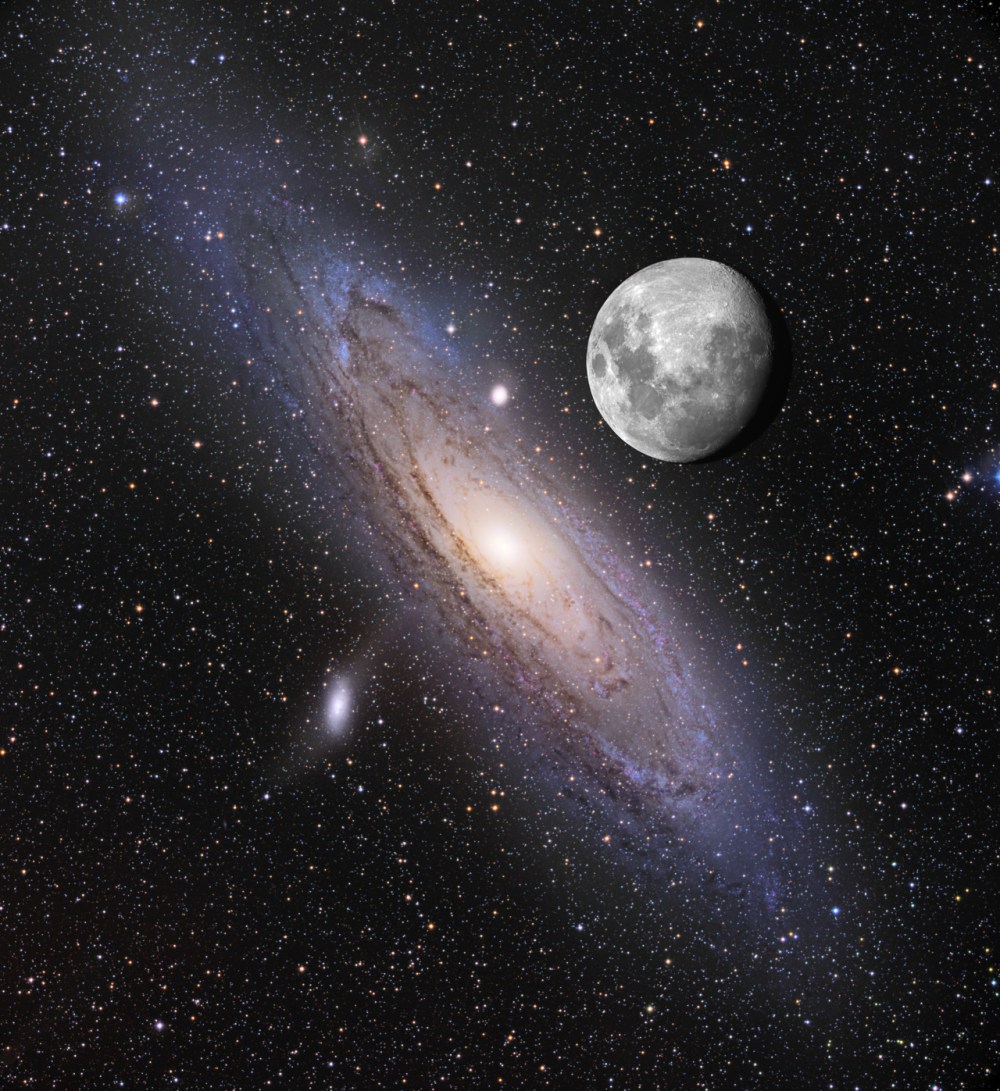
Andromeda is visible to the unaided eye as a small, faint, fuzzy patch, but because its surface brightness is so low, casual skygazers can’t appreciate the galaxy’s impressive extent in planet Earth’s sky. This entertaining composite image compares the angular size of the nearby galaxy to a brighter, more familiar celestial sight. In it, a deep exposure of Andromeda, tracing beautiful blue star clusters in spiral arms far beyond the bright yellow core, is combined with a typical view of a nearly full Moon.
Read more
The number of reactors peaked in 2002 at 444, compared with 427 today. The share of electricity they produce is down 12% from its 2006 peak, largely because of post-Fukushima shutdowns in Japan. As a proportion of all electricity generated, nuclear peaked in 1993 at 17% and has now fallen to 10%. The average age of operating plants is increasing, with the number over 40 years old (currently 31 plants) set to grow quite rapidly.
Read more
Z-40, the Dallas-raised leader of Los Zetas, captured Monday night in Nuevo Laredo with $2 million cash, 9 guns, and 500 rounds of ammo.
Narco Villainy
Read more



 The Committee to Nuke Elysium