
Read moreAviation oxygen mask, 1919?
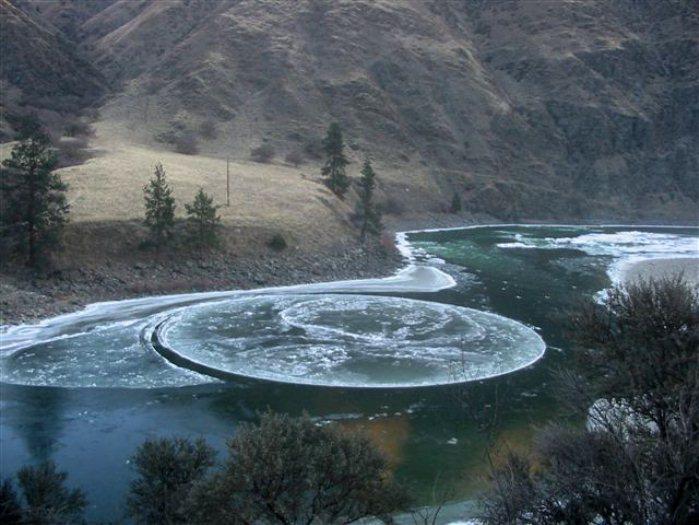
Read moreSalmon River Ice circle — A rare natural phenomenon that occurs in slow moving water in cold climates. Ice circles are thin and circular slabs of ice that rotate slowly in the water. It is believed that they form in eddy currents.In fluid dynamics, an eddy is the swirling of a fluid and the reverse current created when the fluid flows past an obstacle.
Awesome
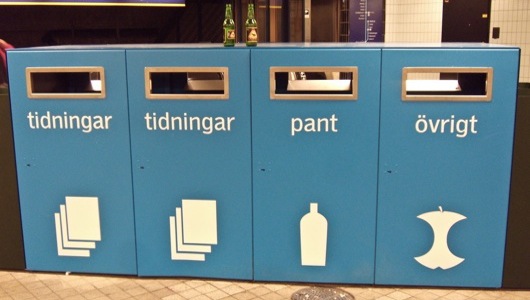
Read moreSweden’s rather unique garbage problem. (Wow! Only 4% of waste goes into landfalls).
Sweden runs out of garbage, forced to import from Norway
Sweden, a recycling-happy land where a quarter of a million homes are powered by the incineration of waste, is facing a unique dilemma: The nation has run out of much-needed fuel.
Sweden, birthplace of the Smörgåsbord, Eric Northman, and the world’s preferred solar-powered purveyor of flat-pack home furnishings, is in a bit of a pickle: the squeaky clean Scandinavian nation of more than 9.5 million has run out of garbage. The landfills have been tapped dry; the rubbish reserves depleted. And although this may seem like a positive — even enviable — predicament for a country to be facing, Sweden has been forced to import trash from neighboring countries, namely Norway. Yep, Sweden is so trash-strapped that officials are shipping it in — 80,000 tons of refuse annually, to be exact — from elsewhere.
You see, Swedes are big on recycling. So big in fact that only 4 percent of all waste generated in the country is landfilled.
Good for them! However, the population’s remarkably pertinacious recycling habits are also a bit of a problem given that the country relies on waste to heat and to provide electricity to hundreds of thousands of homes through a longstanding waste-to-energy incineration program. So with citizens simply not generating enough burnable waste to power the incinerators, the country has been forced to look elsewhere for fuel. Says Catarina Ostlund, a senior advisor for the Swedish Environmental Protection Agency: “We have more capacity than the production of waste in Sweden and that is usable for incineration.“
Public Radio International [Living on Earth] has the whole story (hat tip to Ariel Schwartz at Co.Exist), a story that may seem implausible in a country like garbage-bloated America where overflowing landfills are anything but scarce.
As mentioned, the solution — a short-term one, according to Ostlund — has been to import (well, kind of import) waste from Norway. It’s kind of a great deal for the Swedes: Norway pays Sweden to take its excess waste, Sweden burns it for heat and electricity, and the ashes remaining from the incineration process, filled with highly polluting dioxins, are returned back to Norway and landfilled.
Ostlund suggests that Norway might not be the perfect partner for a trash import-export scheme, however. “I hope that we instead will get the waste from Italy or from Romania or Bulgaria or the Baltic countries because they landfill a lot in these countries,” she tells PRI. “They don’t have any incineration plants or recycling plants, so they need to find a solution for their waste.“
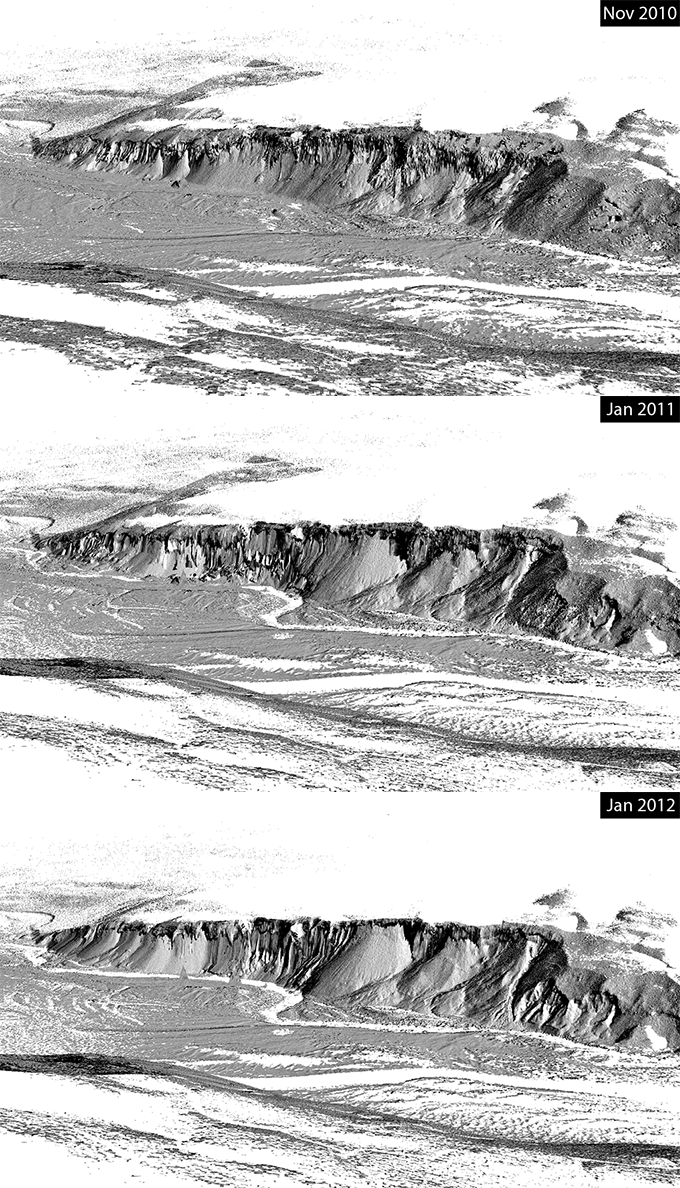
In another study, researchers from the University of Texas at Austin found that coastal Antarctic permafrost—which, unlike Arctic permafrost, was considered to be stable—is actually melting much faster than scientists had expected. Researchers had though that the permafrost in the region was in equalibrium—ice would melt during the summer, only to refreeze in the winter. But the Texas study, published in Scientific Reports, shows a rapid melting of permafrost in Antarctica’s Garwood Valley, diminishing the overall mass of ground ice. “The big tell here is that ice is vanishing—it’s melting faster each time we measure,” said Joseph Levy, a research associate at the University of Texas’s Institute for Geophysics and the lead author on the paper.
“That’s a dramatic shift from recent history.”
It’s important to note that global warming is not responsible for the permafrost melt here—that region of Antarctic actually experienced a cooling trend from 1986 to 2000, followed by relatively stable temperatures. The Scientific Letters researchers suggest instead that the melting is due to an increase in radiation from sunlight resulting from changing weather patterns that allow more light to reach the ground during the summer. (In the winter, of course, Antarctica experiences 24-hour darkness.) As the permafrost melts, it actually alters the land surface, creating “retrogressive thaw slumps.” The changes observed in the study are occurring around 10 times faster than the average during the Holocene, the current geological epoch, and can actually be seen with time-lapse photography
Read more


 The Committee to Nuke Elysium