unknownskywalker:

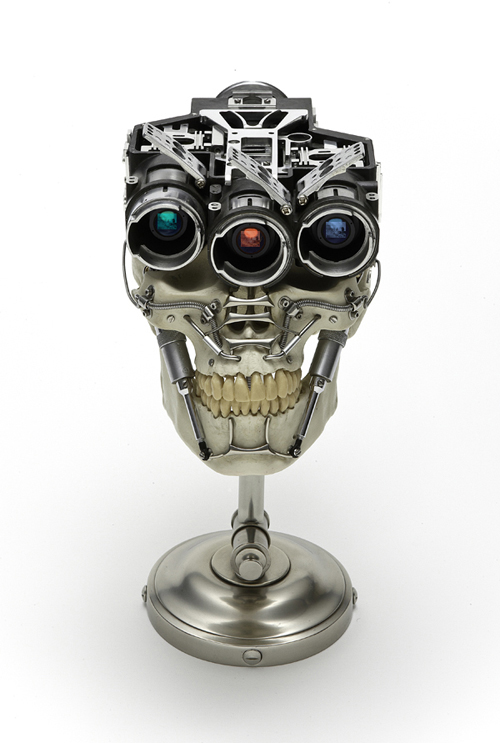
Precognitive by Christopher Conte

Custom fabricated and found object construction featuring an embedded Ipod which projects subtle video (or visions) onto the lenses of each of the three eyes. The full color source video is mechanically broken down into the three additive primary colors (RGB). View similar works

Read more

Radiation on the journey to Mars was measured by NASA’s newest Mars rover, Curiosity, which carries an instrument the size of a coffee maker that was originally intended to gauge radiation on the planet’s surface.

Investigators realized that by turning on the instrument right after the rover’s launching in November 2011, they could gather data on the radiation hitting the spacecraft from solar storms and from high-energy cosmic rays that come from outside the galaxy.

They determined that “the radiation environment is several hundred times more intense than it is on Earth,” Cary Zeitlin, a scientist at the Southwest Research Institute in Boulder, Colo., said during a NASA news conference on Thursday, “and that’s even inside a shielded spacecraft.” The findings will be published in Friday’s issue of the journal Science.

Radiation dosage is measured in units known as sieverts. A cumulative dose of one sievert is thought to raise the risk of a fatal cancer by about five percentage points.

During Curiosity’s 253-day, 350-million-mile trip, the rover absorbed about half a sievert — an average of 1.8 thousandths of a sievert per day, mostly from cosmic rays. “That could be higher under different circumstances,” Dr. Zeitlin said. The instrument measured radiation from only five solar storms, all modest.

NASA is not planning to send people to Mars until the 2030s, but with current technology, it would take six months to get there and six months to return to Earth. As such, astronauts would absorb about two-thirds of a sievert. By contrast, a person on Earth receives less than a thousandth of a sievert per year from outer space, Dr. Zeitlin said. Americans absorb a few thousandths of a sievert per year, mostly from X-rays and CT scans — still much less than from a Mars trip.

According to the National Cancer Institute, the lifetime risk of dying from cancer is 21 percent; the two-thirds of a sievert from a round-trip mission to Mars would raise that risk by three percentage points, to 24 percent.

The measurements largely agree with earlier estimates and measurements. “These are confirmatory measurements that will help us refine our models,” said Edward J. Semones, the spaceflight radiation health officer at NASA’s Johnson Space Center in Houston.

NASA’s standards currently limit the excess cancer risk for its astronauts to three percentage points.

——————————–
* All the more reason to catch a ride on a shooting star!

“Burrowing inside an asteroid whose orbit carries it past both the Earth and Mars could protect astronauts from radiation on their way to the Red Planet…” thanks past-me! http://blog.m1k3y.com/?p=823

Read more
The 30-mile stretch of ice and debris blocking the Yukon is expected to melt slowly over the next few days as temperatures reach the 80s. When the river breaks through the jam, the community of Koyukuk, located downriver, will be vulnerable to flooding.

“I’ve never seen anything like this before,” said National Weather Service hydrologist Ed Plumb to the AP. “And I don’t think these people here (have) either. The ice jam is amazing.”

Reconnaissance flights over the jam say that the river is slowly chewing away at the ice. The flooding began Sunday with waters steadily rising. Power, fresh water, cell phone service and road accessibility have all been disrupted by the flood.

Read more

But then in an almost throw-away aside to Adam, he reflected that the modern Bond villain (and he might have added, villains in pop culture in general) is placeless, ubiquitous, mobile.

His hidden fortress is in the network, represented only by a briefcase, or perhaps even just a mobile phone.

Maybe it’s in the objects. It’s not the pictures that got small, but the places our villains draw they powers from.

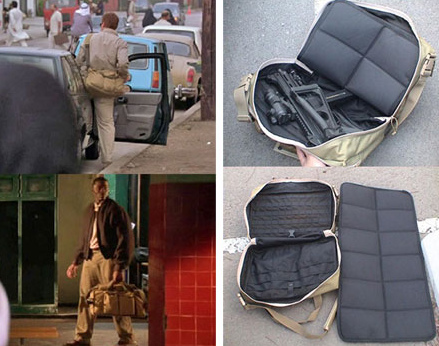
Perhaps the architypical transformation from gigantic static lair to mobile, compact “UbiLair” is in the film Spartan, where Val Kilmer’s anti-heroic ronin carries everything he needs in his “go-bag” – including a padded shooting mat that unfolds from it to turn any place into a place where he holds the advantage.

[Snip… where to my delight he starts invoking Zeke Stane, already on this tag]

So – for a “4th generation warfare” supervillain there aren’t even objects for the production designer to create and imbue with personality. The effects and the consequences can be illustrated by the storytelling, but the network and the intent can’t be foreshadowed by environments and objects in the impressionist way that Adam employed to support character and storytelling.

Read more

dress34 by brucesflickr on Flickr.

For instance, the Constrvct “Spine” dress is perfect for my blue plastic computer-generated shoes from “United Nude.” These angular Dutch shoes feature a low poly-count that makes them look like shoes off the set of Super Mario. I bought these “New Aesthetic” shoes mostly to irritate and intrigue Italians, who always notice people’s shoes. However, with the “Spine” dress, these shoes become a low-key ensemble.

Read more

The French petrochemical industry had been funding Cousteau’s adventures but were sadly less concerned with studying the seabed and more interested in exploiting it. When it was found in later years that industrial tasks underwater could be done just as well if not more efficiently by robots than human divers, it was to be the end of Conshelf. Cousteau famously publicised his regret in working with the petroleum industry on his projects. He had hoped that his manned underwater habitats might serve as base stations for future exploration of the sea, but alas, his dream of installing his colonies in oceans across the globe was never achieved.

Read more