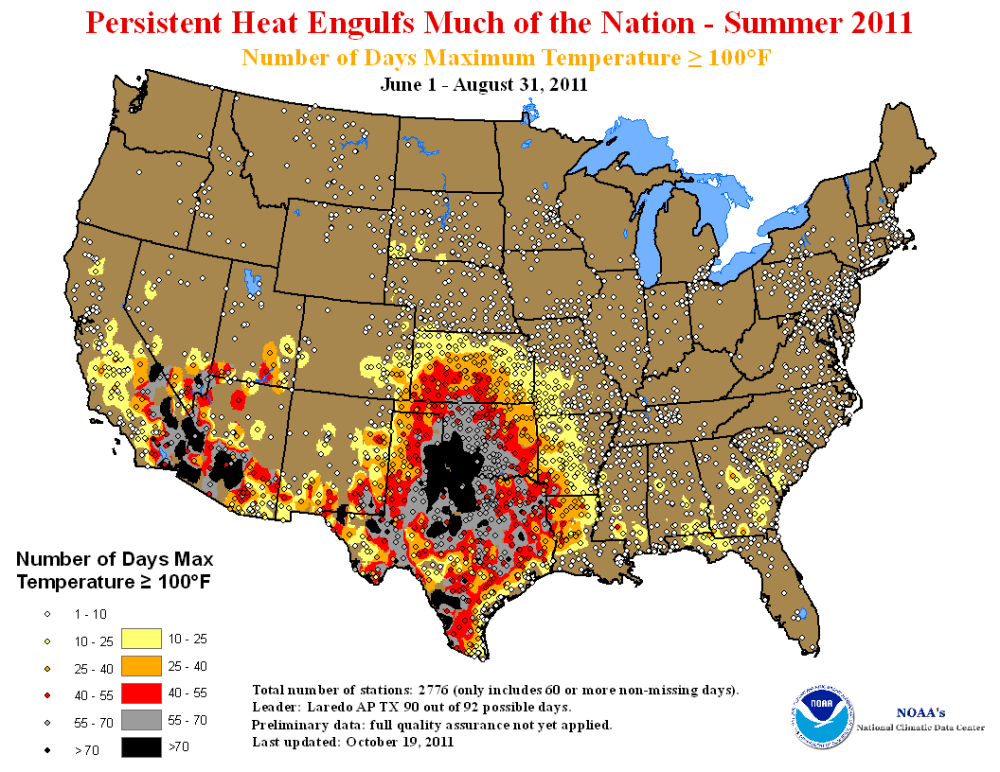
Read moreThe searing Southwestern heatwave of 2011
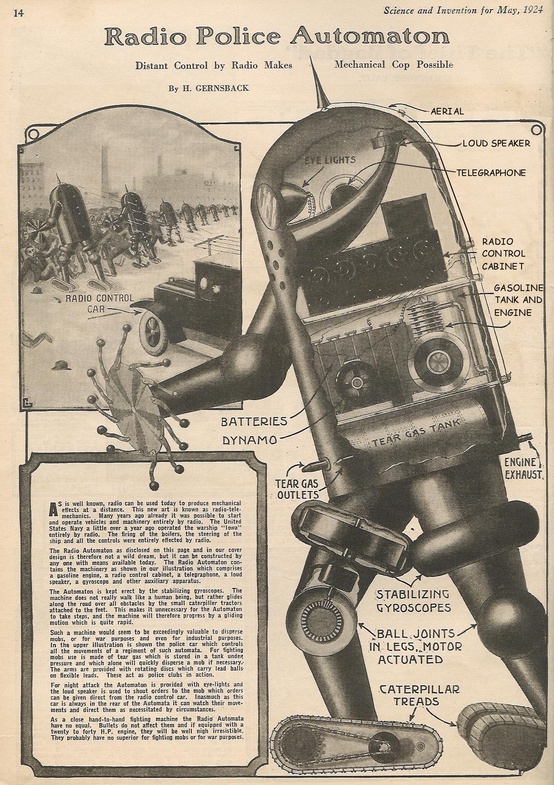
Read moreThe future of policing as seen by spec article for Science and Innovation in May 1924. John F. Ptak points out : “The inset detail is pretty interesting, the robots unleashed on a crowd, under control of a radio patrol car.” ( Via FuturePunk: When Sci-Fi Hyper-Speculation Becomes Under-Speculated)

Read moreThe Temporal Doppler Effect: Why The Future Feels Closer Than The Past
Like the sound of a passing ambulance siren, our perception of time distorts as it shoots by.
Sometimes psychologists come up with such good names for their findings that I’m powerless to resist. Take this newly minted expression: ‘the temporal Doppler effect’.
This really appeals to both the psychologists in me and my inner physics geek.
The Doppler effect is most often experienced when an ambulance with siren blaring travels past you. The pitch of the siren shifts downwards as it whizzes past. The siren’s notes aren’t actually changing in pitch; it’s the effect of the ambulance’s movement on the sound-waves reaching your ear that produces the effect. You can see the video here.
So, what is a temporal Doppler effect and what does this have to do with psychology?
It seems to suggest that as events approach us from the future they feel closer, compared with events in the past, which feel further away as they recede. In other words: one week in the future feels closer in time than one week in the past.
How far away does it feel?
Could that be true? For example, imagine I ask you one week before Valentine’s Day how psychologically distant that feels to you. Then, imagine I ask you the same question one week after Valentine’s Day. Surely they should feel about the same distance?
What the temporal Doppler effect suggests is that Valentine’s Day will feel closer in time one week beforehand than one week after.
Sounds mad? Well this is exactly the experiment that Caruso et al. (2013) carried out. And guess what? They got this temporal Doppler effect. On a 1 to 7 scale, where 1 means it feels close in time and 7 means it feels far in time, people rated an upcoming Valentine’s Day an average of 3.9 when it was one week in the future, but an average of 4.8 when it was one week in the past.
They got similar results for comparisons of time-points both one month and one year in the future and the past. This temporal Doppler effect kept showing up: the future seems to feel psychologically closer to people than the past, despite the fact we know it’s exactly the same.
Metaphors of time and space
So why does it happen? Caruso et al. put forward two explanations, one more abstract than the other. I’ll do the abstract one first but feel free to bail out and get on to the concrete one if it gets too much!
The abstract argument goes like this: we don’t directly experience time although we see its effects. Unlike space, which we can clearly see, time is invisible. In contrast, you can reach out and touch objects and feel the space between them.
Because time is abstract we try to understand it psychologically using metaphors. We say that ‘time flows like a river’, ‘time marches on’ or ‘time flies’. These are all spatial ways of thinking about an abstract idea.
The result is that we unconsciously apply the same spatial rules to time. Just like things that are coming towards us sound higher in pitch and appear to us closer in space than things going away, so we intuit that things ahead of us in time are also closer than things in the past.
Convinced?
If not you’ll be interested in a further experiment Caruso et al. carried out where they tried to reverse the temporal Doppler effect with a simple manipulation: they had people walking backwards in virtual reality (VR).
Compared to those walking forwards in VR, those walking backwards showed no tendency towards thinking the future was closer than the past. This helps support the idea that how we think about time is linked to how we think about space and why the temporal Doppler effect occurs.
Future-facing
Now here’s the more concrete explanation. The temporal Doppler effect is also highly adaptive. It’s very useful for our survival and success in life that the future seems closer than the past. What happens tomorrow we can plan for, what happened yesterday is just a memory.
Yes, it’s important to understand where you’ve come from, but without a plan, you can’t know where you’re going. The temporal Doppler effect is one example of how we’re future-oriented creatures; always scheming for, worrying about, plotting and simulating the future. So that hopefully, when we get there, we’ve got some kind of plan.

Read moreI liberated this billboard. It was a damn cold winter night in the desert but the moon stared down at me condescendingly and said “Are you gonna fucking do this?!” I just thought “Idle No More” & “get your ass out tha car!” Long story short, I ended up with cactus in my knee cause the moon didn’t feel like lighting my way and another billboard on the notch. (at I-25, Bernalillo, NM)
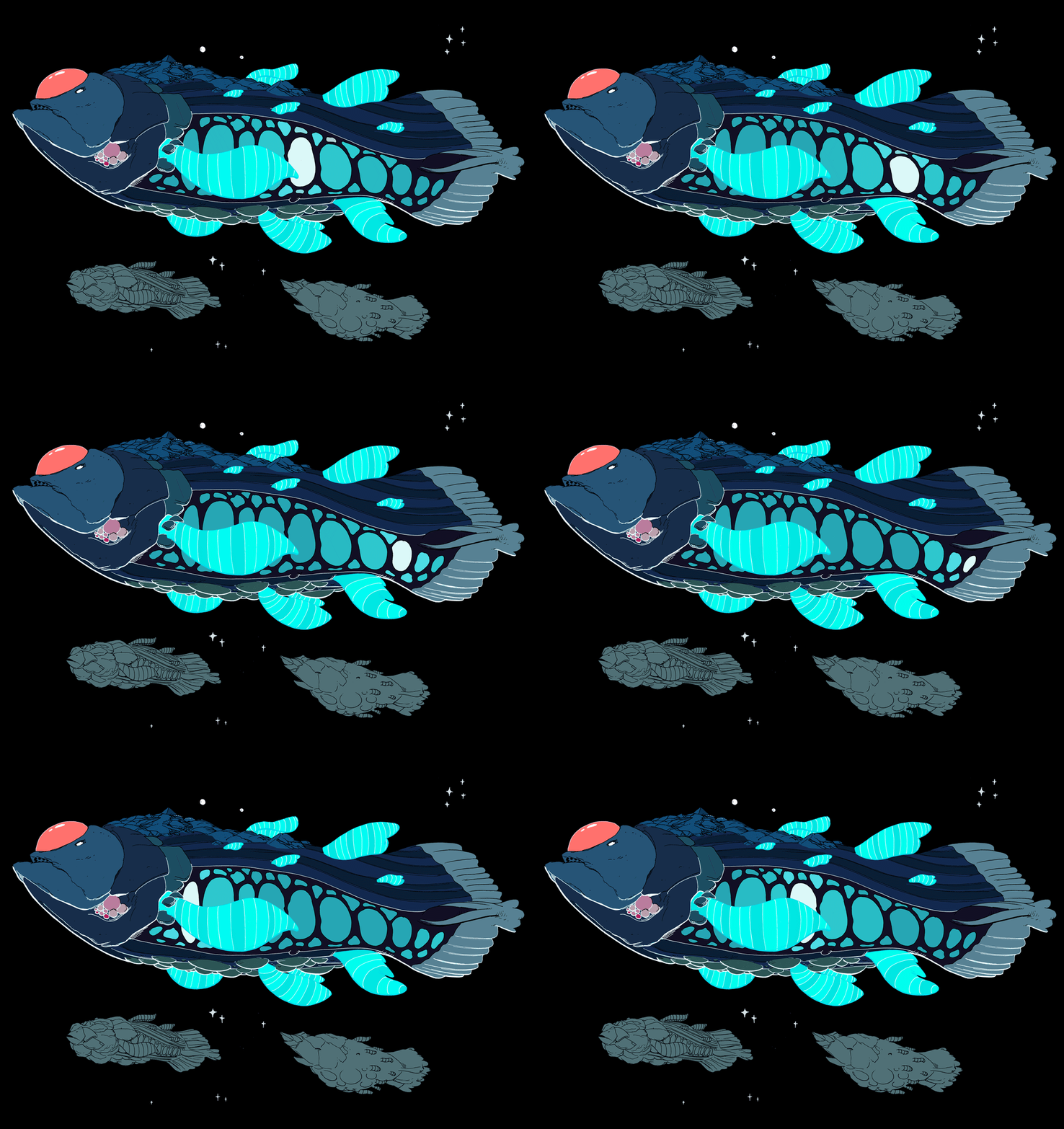
Read moreThe World fish drift through space absorbing the light from neighbouring stars. The solar energy stored in their bodies powers the homes of the peaceloving creatures who live in the pyramids and domes carved into the rocks upon their backs, as well as the undulating, bioluminescent scales and fins of the great fish. However, it’s said that the crystals on their foreheads are capable of firing a wave of psychic energy capable of destroying an entire planet.



 The Committee to Nuke Elysium