
Earth-Size Planets Common in Galaxy: 17 Percent of Sun-Like Stars Have Planets Within the Orbit of Mercury |
An analysis of the first three years of data from NASA’s Kepler mission, which already has discovered thousands of potential exoplanets, contains good news for those searching for habitable worlds outside our solar system.
This estimate includes only planets that circle their stars within a distance of about one-quarter of Earth’s orbital radius – well within the orbit of Mercury – that is the current limit of Kepler’s detection capability. Further evidence suggests that the fraction of stars having planets the size of Earth or slightly bigger orbiting within Earth-like orbits may amount to 50 percent.
The team – UC Berkeley graduate student Erik Petigura, former UC Berkeley post-doctoral fellow Andrew Howard, now on the faculty of the Institute for Astronomy at the University of Hawaii, and UC Berkeley professor of astronomy Geoff Marcy – reported their findings today (Tuesday, Jan. 8) at a session on the Kepler mission during the American Astronomical Society meeting in Long Beach, Calif.
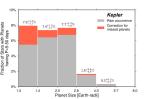
“Our key result is that the frequency of planets increases as you go to smaller sizes, but it doesn’t increase all the way to Earth-size planets – it stays at a constant level below twice the diameter of Earth,” Howard said.
Francois Fressin of the Harvard-Smithsonian Center for Astrophysics presented nearly identical results yesterday at the meeting, reporting that one in six stars, or at least 17 billion stars in the Milky Way Galaxy, have an Earth-size planet within an orbit like Mercury’s.
 The Committee to Nuke Elysium