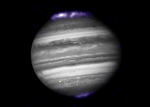

Alien Auroras
Earth’s auroras are created by charged particles from the sun interacting with our atmosphere, but they’re not just earthly phenomenon—Saturn and Jupiter have their own, although they’re not created in the same way. Jupiter spins on its axis once every 10 hours, dragging its magnetic field around to create a crackling swirl of electricity of over 10 million volts at both of its poles. Then charged particles of oxygen and sulfur shoot from Jupiter’s volcanic moon, Io, and interact with this storm of electricity, sparking a spectacular light show. Jupiter’s auroras are like Earth’s on asteroids—they’re 100 times brighter than ours, they never stop, and they’re so big they could envelop our entire planet. But auroras don’t just stop at our solar system—researchers have now found evidence of polar lights on alien planets orbiting distant stars. Using the Low-Frequency Array radio telescope based in the Netherlands, the researchers observed radio emissions they believe are caused by auroras on exoplanets. Since the emissions are powerful enough to be detectable over interstellar distances, the auroras causing them would be 100,000 times brighter than Jupiter’s. The findings suggest that these auroras are likely not formed by charged particles from solar wind—instead, the exoplanets detected so far may actually be dim, ultra-cool brown dwarfs, which are basically failed stars. Their auroras would likely behave more like Jupiter’s than Earth’s, and by studying them, researchers hope to gain insight into the exoplanets’ magnetic fields, moons, and even how they interacts with their parent star.
 The Committee to Nuke Elysium