Read moreThe dust cloud surrounds Mars and reaches altitudes more than 1,000 kilometers (621 miles) from the planet’s surface, said MAVEN lead scientist Bruce Jakosky, also with University of Colorado.
“We think the source is the (Martian) atmosphere, however we have no process to take dust from low altitude to bring it up to 200 kilometers (124 miles). So if the source is the atmosphere, we don’t understand which process is moving them up,” Andersson said.
The dust also could have come from Mars’ moons, Phobos and Deimos, from dust in the solar wind or from comet dust that fills interplanetary space.
Author: m1k3y
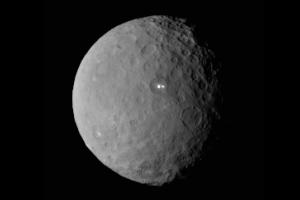
Read moreRevealing the origin of Ceres’s water could determine whether there is the potential for life beneath its surface, as is thought to be the case on icy moons around Jupiter and Saturn.
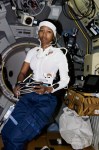

Read moreDr. Mae Jemison, MD, the first black woman in space and first actual astronaut to appear on a Star Trek show, one of the very few people on this planet of whom two pictures can be posted depicting them doing their job on a spaceship with entirely different contexts.


The newfound four-star planetary system, called 30 Ari, is located 136 light-years away in the constellation Aries. The system’s gaseous planet is enormous, with 10 times the mass of Jupiter, and it orbits its primary star every 335 days. The primary star has a relatively close partner star, which the planet does not orbit. This pair, in turn, is locked in a long-distance orbit with another pair of stars about 1,670 astronomical units away (an astronomical unit is the distance between Earth and the sun). Astronomers think it’s highly unlikely that this planet, or any moons that might circle it, could sustain life.
Were it possible to see the skies from this world, the four parent stars would look like one small sun and two very bright stars that would be visible in daylight. One of those stars, if viewed with a large enough telescope, would be revealed to be a binary system, or two stars orbiting each other.
Read moreRead moreIs everything in the movie explicable?
Everything there has a point, has a reason. Even the orbs, the glowing orbs.
i was gonna ask about them.
Those are remote antennas for the Fluid Karma energy field. You got one of those orbs around, the energy field is more highly concentrated and that’s sort of explained briefly in the graphic novels. Even when Justin Timberlake’s character, Pilot Abilene, when he’s talking about a ‘sea of black umbrellas’ in his crazy, drug-fueled monologue, he’s talking about seeing back into time, to the early 20th Century at the Santa Monica Pier, with all of the umbrellas.
Oh, was that a thing?
In the Cannes cut, there’s a scene where Boxer bleeds back in time to the 1920s and he sees a fortune-teller. He sees Beth Grant in a fortune-teller tent on the beach. There’s a lot of stuff that didn’t even make—there’s a lot of material that people haven’t seen…
There’s still some visual effects that are not where I want them to be. There’s some visual effects work. There are some shots at the end of the movie that I would like to add visual effects. Even just adding some of the content from the Cannes cut and even some of the content that never has still seen the light of day. And the animated—I have always hoped to do the first three chapters as a low-budget, animated feature. To just complete the whole thing or visualize the entire six-chapter story.


League of Extraordinary Gentlemen – America: 1988
When war-hero-turned-handyman Kesuke Miyagi is found drained of blood, it becomes clear that the occult gang known as the Lost Boys are targeting the only individuals that can stop them from complete domination of America. It’s the perfect case for the League of Extraordinary Gentlemen–except that their government contact, Oscar Goldman, disbanded the team in 1979 after they defeated Mr. Han’s army of the living dead.
Now, disgraced scientist Emmet Brown has to put together a new team to combat the growing threat of the Lost Boys and their leader, a newly resurrected vampire kingpin Tony Montana: Transportation specialist Jack Burton, ex-commando B.A. Baracus, tech wizard Angus MacGyver and the mysteriously powerful femme fatale known only as “Lisa.” But will Brown be able to stop the Lost Boys before time runs out?
The League of Extraordinary Gentlemen: 1996
Read moreAbuse of Playback, the technologically-derived drug made from distilled human memories, is sweeping the world — and Special Agent Fox Mulder learned too late that Playback was put forth on this planet by the Purity, seeking to condition humanity to their rule so as to better combat the Deadite incursion threatening the aliens’ homeworld. Now Mulder is missing, and it falls to his partner, Dana Scully, to re-activate secret protocol LXG-71, the “League of Extraordinary Gentlepersons” (protocol renamed 1993 for “sensitivity reasons”).
Scully swiftly collects Hong Kong Detective-Inspector “Tequila” Yuen, hyperviolent Wiccan practitioner Nancy Downs, the biological experiment/walking weapon known only as “Edward,” and a young high-functioning sociopath named Zack Morris who has the strange ability to stop the flow of time itself. Perhaps it is this last who attracts the attention of an enigmatic man who answers only to “Rufus,” and who asks Scully to “set history right” and see that two young musicians — that, so far as she can tell, never existed — be born anew, so that peace may flourish on Earth. But the Purity have never shown any signs of temporal travel capability… so who, then, altered history?

OK, let’s say Bruce Wayne does use this routine as prep for becoming Batman. What would you suggest he do to maintain his level of fitness once he’s in the middle of crime fighting season? The day he becomes Batman, his volume gets reduced by half. Not only because of recovery, but also because of time. I think he goes down to a more reasonable three- to four-day workout split, focusing on aerobic and muscular endurance, and then maintaining a high level of strength. But fighting criminals is probably going to keep his strength up, too. So what can an average guy take from this workout and use for himself? First, I would cut everything in half in terms of volume. I’d also reassess the weight used. You can be good at a few things, but not everything. Whatever, we’re not giving up on becoming Batman.
Read more” All culture is prosthetic and all prostheses are culture” : Artificial Intelligence as Alien Intelligence
Read more "” All culture is prosthetic and all prostheses are culture” : Artificial Intelligence as Alien Intelligence"“Arguably,” argues Bratton, “the Anthropocene itself is due less to technology run amok than to the humanist legacy that understands the world as having been given for our needs and created in our image. We hear this in the words of thought leaders who evangelize the superiority of a world where machines are subservient to the needs and wishes of humanity… This is the sentiment – this philosophy of technology exactly – that is the basic algorithm of the Anthropocenic predicament, and consenting to it would also foreclose adequate encounters with A.I.” The Anthropocene in this formulation names the emergence of environmental or planetary consciousness, an emergence sometimes coupled to the global circulation of the image of the fragility and interdependence of the whole earth as seen by humans from outer space. It is the recognition that the world in which we evolved to flourish might be impacted by our collective actions in ways that threaten us all. Notice, by the way, that multiculture and historical struggle are figured as just another “algorithm” here.
I do not agree that planetary catastrophe inevitably followed from the conception of the earth as a gift besetting us to sustain us, indeed this premise understood in terms of stewardship or commonwealth would go far in correcting and preventing such careless destruction in my opinion. It is the false and facile (indeed infantile) conception of a finite world somehow equal to infinite human desires that has landed us and keeps us delusive ignoramuses lodged in this genocidal and suicidal predicament. Certainly I agree with Bratton that it would be wrong to attribute the waste and pollution and depletion of our common resources by extractive-industrial-consumer societies indifferent to ecosystemic limits to “technology run amok.” The problem of so saying is not that to do so disrespects “technology” – as presumably in his view no longer treating machines as properly “subservient to the needs and wishes of humanity” would more wholesomely respect “technology,” whatever that is supposed to mean – since of course technology does not exist in this general or abstract way to be respected or disrespected.
The reality at hand is that humans are running amok in ways that are facilitated and mediated by certain technologies. What is demanded in this moment by our predicament is the clear-eyed assessment of the long-term costs, risks, and benefits of technoscientific interventions into finite ecosystems to the actual diversity of their stakeholders and the distribution of these costs, risks, and benefits in an equitable way. Quite a lot of unsustainable extractive and industrial production as well as mass consumption and waste would be rendered unprofitable and unappealing were its costs and risks widely recognized and equitably distributed. Such an understanding suggests that what is wanted is to insist on the culpability and situation of actually intelligent human actors, mediated and facilitated as they are in enormously complicated and demanding ways by technique and artifice. The last thing we need to do is invest technology-in-general or environmental-forces with alien intelligence or agency apart from ourselves.
I am beginning to wonder whether the unavoidable and in many ways humbling recognition (unavoidable not least because of environmental catastrophe and global neoliberal precarization) that human agency emerges out of enormously complex and dynamic ensembles of interdependent/prostheticized actors gives rise to compensatory investments of some artifacts – especially digital networks, weapons of mass destruction, pandemic diseases, environmental forces – with the sovereign aspect of agency we no longer believe in for ourselves? It is strangely consoling to pretend our technologies in some fancied monolithic construal represent the rise of “alien intelligences,” even threatening ones, other than and apart from ourselves, not least because our own intelligence is an alienated one and prostheticized through and through. Consider the indispensability of pedagogical techniques of rote memorization, the metaphorization and narrativization of rhetoric in songs and stories and craft, the technique of the memory palace, the technologies of writing and reading, the articulation of metabolism and duration by timepieces, the shaping of both the body and its bearing by habit and by athletic training, the lifelong interplay of infrastructure and consciousness: all human intellect is already technique. All culture is prosthetic and all prostheses are culture.
Another strategy for coping with the failure of artificial intelligence on its conventional terms has assumed a higher profile among its champions lately, drawing support for the real plausibility of one science-fictional conceit – construction of artificial intelligence – by appealing to another science-fictional conceit, contact with alien intelligence. This rhetorical gambit has often been […]
Read moreRead moreInstead of throwing things away in orbit (Skylab, Salyuts, Mir) we can now build upon these assets and move them around like Lego bricks to form new things as we need them – and then do this again and again. When the government is done with their hardware, it can be used by someone else – just like old military bases can become movie studios and shopping malls. The more orbital capacity that is available, the more customers it can collectively and individually serve. The more valuable these on-orbit assets become for government and non-government uses, the more everyone will want to safeguard that growing capacity (and isolate it from terrestrial squabbles) as has been the case with ISS recently.
 The Committee to Nuke Elysium