



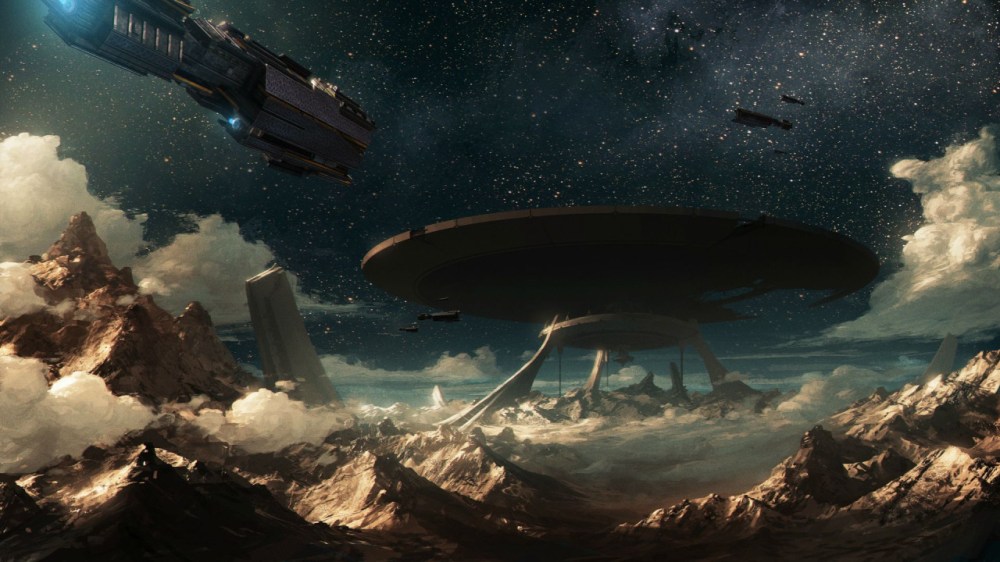
some of the mad concept art for Jupiter Ascending
kinda wish they’d gone full video game aesthetic, amongst other things
Read more
some of the mad concept art for Jupiter Ascending
kinda wish they’d gone full video game aesthetic, amongst other things
Read moreRead moreRich, crazy Elon Musk, who intends to put large and efficient electric batteries into people’s homes. Which may not be one of his weird side projects like Hyperloop, especially since Apple are hiring his car-makers away, and their car sales and shipments are under the projected numbers. And because it fits right in with the “disruption” thing. You know Musk has a solar panel company, right? This seems quite clever: SolarCity will let you lease their panels, or you can take out a 30-year loan with them. SolarCity doesn’t charge you for installing or maintaining the system, and you pay SolarCity for the power the system generates, thereby paying off the loan. Electricity as a mortgage. Now, combine that with a rechargeable fuel cell in your home that could probably power your house for at least a week all on its own. Welcome to Basic Utilities Disruption.
Have you been reading this and thinking, “well, I’m not very interested in technology”? Well, I bet you’re interested in a future where it remains cost-effective for your local electricity substations to be maintained even after a critical number of homes in your area have gone off the grid. Or, in the extreme open-market scenario, if it remains cost-effective to even supply electricity to your town at all.
Zalasiewicz is one geologist who has given some thought to what will remain in 10,000 years. Certainly some record of cities, plastics and the millions of fossil-fuel wells and mines will persist as what he calls technofossils. The concentrations of carbon dioxide in the atmosphere could still be out of whack from the emissions resulting from the burning of all those fossil fuels in just the last few decades. In a million years, barring profound shifts, the climate should have returned to its natural rhythms but any cities buried in sediment by rising seas should still be preserved, along with those signs of anthroturbation, human-induced disturbances underground, like the plutons from underground explosions of nuclear bombs. Those are good for 10 million even 100 million years, or until plate tectonics lifts them back to the surface and exposes those strata to the rain that will, ever so slowly, erode these signs away. For certain, nothing made by contemporary humanity will be left at the surface that far in the future, even stone edifices like the pyramids or Mount Rushmore will be wiped away, though the fine imprints of plastic objects, like say a vinyl record, may be legible—and even perhaps listenable—in the rock like the fronds of a fern.
Ten thousand years is all that separates today’s people from those who lived at Catalhöyük in Turkey, a city whose mud-brick homes had doors in the roofs. The inhabitants were seemingly obsessed with leopards, slept on their own ancestors’ graves and occasionally kept the skulls as mementoes. In the far future will anyone even understand the binary code and English scrawlings in the Roman alphabet in which the very idea of the Anthropocene is recorded? The Rosetta stone was required to unlock the mysteries of hieroglyphics from a mere 5,000 years ago and the world is no closer to understanding the hash marks left by ancient hominins hundreds of thousands of years ago. One million years ago, Homo sapiens did not exist and our hominin ancestors stalked the savannas of Africa and perhaps not much else, the human population explosion still far in the future.
Read moreTen years later, you could pick up a digital watch for a quid at the market, and I was working on ideas for what would become my first graphic novel, including a future where the Internet was nothing but a series of walled gardens. Ten years after that, the walled gardens of CompuServe and AOL and all the others were falling down, as the web gained pace, and we were just starting to get into the habit of looking at our mobile phones to check the time. Go forward another ten years, and you start to see the news stories about watch manufacturers starting to suffer the same woes as camera makers, yet another business disrupted by digital device uptake. And here we are today. Visit any technology news service and scroll down briefly. You’ll hit a story about “the war for our wrists.” The digital watch is back, as the “wearable,” the wrist-based Internet terminal, frothed over by writers so buried in that world and its jargon that I’ve seen tech journalists refer to net-connected clothing as “wearable shirts.” Breathless commentaries on the as-yet-unmarketed Apple Watch and its crown-button that makes things happen, with a battery life that will reportedly last within seconds per month. I, personally, want to put a gold chain on my phone, pop it into a waistcoat pocket, and refer to it as my “digital fob watch” whenever I check the time on it. Just to make the point in as snotty and high-handed a way as possible: This is the decadent end of the current innovation cycle, the part where people stop having new ideas and start adding filigree and extra orifices to the stuff we’ve got and call it the future.
Marvel Studios quickly noted that the addition of Spider-Man into their film universe has resulted in four projected films’ debut dates being changed. The third Thor film, “Thor: Ragnarok”, has been pushed to November 3, 2017; it had previously had that July 2017 spot. New film franchises “Black Panther” and “Captain Marvel” have been pushed to July 6 and November 2, 2018 (respectively), while “The Inhumans” has been shifted to July 12, 2019. The dates for the fourth and fifth installments of the “Avengers” team films (“The Infinity War Part One” and “Part Two”) remain unchanged at May 4, 2018 and May 3, 2019 (also respectively). This presents an amusing (albeit understandable) bit of hypocrisy within Marvel Studios’ itself. After Scarlet Johansson’s Black Widow saw significantly more screen time and thus popularity in 2012’s “The Avengers” than she’d seen in 2011’s “Iron Man 2” and her popularity within that role seemed to reaching a peak, Marvel Studios brass began being bombarded with questions about whether the super spy would get her own film. The gist of the response was an insistence that Marvel Studios plans films so many years in advance and can only produce so many films at once that there was absolutely no way that an unplanned Black Widow film could work out (despite the fact that a script for a “Black Widow” film written by David Hayter had existed since 2004-2006). Not even Johansson’s exceptional supporting role in 2014’s “Captain America: the Winter Soldier” swayed Marvel Studios’ official response. As a result, “Lucy”, a film starring Johansson as a woman who gains superhuman powers in an R-rated, modestly budgeted affair wound up earning almost $459 million worldwide based almost exclusively on Johansson’s increased popularity and the audience’s desire to see more of her as a lead heroine. Now, another arachnid hero has emerged within the Marvel Cinematic Universe, and all of a sudden the studio can move heaven and earth shifting around four film production schedules to make room for him. While it is easy to explain this in terms of sheer popularity, it is also hard to shake the sense that this deal was done because Spider-Man’s cinematic star had begun to dim, while Black Widow’s seems to only get brighter. It also doesn’t help that due to this deal, the rising voices demanding more diversity in big screen heroes will have to wait longer to get Marvel Studios’ first starring hero of color and their first lead super heroine.
Read morePlanetary scientists have calculated that there are hundreds of billions of Earth-like planets in our galaxy which might support life.
They found the standard star has about two planets in the so-called Goldilocks zone, the distance from the star where liquid water, crucial for life, can exist.
“The ingredients for life are plentiful, and we now know that habitable environments are plentiful,” said Associate Professor Lineweaver, from the ANU Research School of Astronomy and Astrophysics and the Research School of Earth Sciences.
“However, the universe is not teeming with aliens with human-like intelligence that can build radio telescopes and space ships. Otherwise we would have seen or heard from them.
"It could be that there is some other bottleneck for the emergence of life that we haven’t worked out yet. Or intelligent civilisations evolve, but then self-destruct.”

Humans did see these animals before they became extinct. Island hopping from Asia, humans crossed into Australia sometime around 50,000 years ago. These two bipeadal mammals overlapped for around 20,000 years before the giants vanished. There are still stories amongst the Australian aborigines with descriptions of what could only be the Giant Short-Faced Kangaroo.
Although they overlapped, there is little evidence of human butchery on fossil remains. Australia was a continent where the climate was changing constantly. Forests shrank as the climate became drier, and some areas experienced extreme droughts. Local extinctions may have taken place, leaving small refugia clinging on which never managed to regain the numbers they once had. To witness a mob of flat-faced, big bottomed kangaroos walking across the landscape surely must have been one of the most wonderful sights our species has ever witnessed.
Read moreFor each person there is a sentence — a series of words — which has the power to destroy him … another sentence exists, another series of words, which will heal the person. If you’re lucky you will get the second; but you can be certain of getting the first: that is the way it works. On their own, without training, individuals know how to deal out the lethal sentence, but training is required to deal out the second.
Phillip K. Dick “VALIS” (via autumnalwolf)
Which is why the Work is hard. By the time we learn language, we have subtly been entrained by culture.
(via coldalbion)

“We are dreamers, shapers, singers, and makers. We study the mysteries of laser and circuit, crystal and scanner, holographic demons and invocations of equations. These are the tools we employ, and we know many things … The true secrets. The important things. Fourteen words to make someone fall in love with you forever, seven words to make them go without pain; how to say goodbye to a friend who is dying; how to be poor, how to be rich, how to rediscover dreams when the world has stolen them from you.”
-Elric the Technomage, Babylon 5 ‘The Geometry of Shadows’
(via catvincent)
 The Committee to Nuke Elysium