Warren Ellis at Cognitive Cities Conference (by Cognitive Cities)
(Source: https://player.vimeo.com/)
Read more
Back for 20!!, this year’s Continuum will literately blow your mind! Guests of Honour Dave Freer and Cat Valente assured me it would be the case. Apart from liaising with these fine pre-posthumans, I am once again on several panels: 80s & 90s Weird Stop-motion latex freakery.. From Alex Cox’s Repo Man and its car […]
Read more "Continuum 7 – Changing Consciousness"Warren Ellis at Cognitive Cities Conference (by Cognitive Cities)
Read moreIn a request to industry earlier this month, SOCOM said it is looking to acquire a nondevelopmental radio for team members with a range of just over a mile. Requirements include the capacity to plug-and-play with Android devices through a USB or serial port and also to run on either a Windows or Android operating system.
SOCOM said it wants a radio that can transmit voice and data at the same time and comes equipped with both commercial and GPS receivers. The equipment also must be capable of running military applications, specifically applications like the Tactical Ground Reporting system, a map-based tool developed by the Defense Advanced Research Projects Agency and now widely used by the Army in Afghanistan.
The game, which The Sims creator hopes to have up and running in a year, riffs off of the Sterling short story Maneki Neko.
“He describes a karmic computer that’s keeping a balance of payments between different people, and causing them to interact with each other in interesting ways to improve their lives even though they’re strangers,” Wright told Eurogamer in a new interview conducted at E3 in Los Angeles.
“They earn karmic points that are redeemed by having somebody else help them.”
Wright told Eurogamer that the Sterling-inspired game he’s working on is likely set for launch on tablets, smart phones and social networks such as Facebook.
What’s inspired Will Wright’s next game? News – – Page 1 | Eurogamer.net
the Gamification of Economics? this is very 20!!

Read more“There is a dramatic, nonlinear relationship between climate conditions and tundra fires, and what one may call a tipping point,” he said. Once the temperature rises above a mean threshold of 10 degrees Celsius (50 degrees Fahrenheit) in the
June-through-September time period, he said, “the tundra is just going to burn more frequently.”
For the past 60 years, annual mean temperatures during this warm season have fluctuated between about 6 and 9 degrees Celsius (42.8 to 48.2 degrees Fahrenheit), with temperatures trending upward since 1995. In 2007, the year of the historic fire, the mean temperature was a record 11.1 degrees Celsius, while precipitation and soil moisture dipped to an all-time low.
Higher precipitation, if it occurs, could dampen the effects of higher temperatures, but only to a limited extent, said Philip Higuera, a professor of forest ecology and biogeosciences at the University of Idaho and a co-author on the study.
“As temperature rises, so too does evaporation,” he said. “So even if future precipitation increases, it’s likely that increased evaporation will result in overall lower moisture availability. This affects plants, but it also makes dead vegetation more flammable and fire prone.”
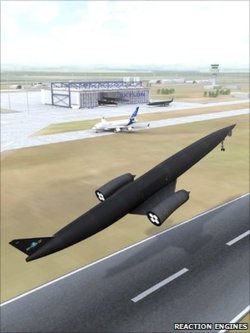
Read moreThe proposed Skylon vehicle would do the job of a big rocket but operate like an airliner, taking off and landing at a conventional runway.
The European Space Agency’s propulsion experts have assessed the details of the concept and found no showstoppers.
They want the next phase of development to include a ground demonstration of its key innovation – its Sabre engine.
…
Realising the Sabre propulsion system is essential to the success of the project.
The engine would burn hydrogen and oxygen to provide thrust – but in the lower atmosphere this oxygen would be taken directly from the air.
This means the 84m-long spaceplane can fly lighter from the outset with a higher thrust-to-weight ratio, enabling it to make a single leap to orbit, rather than using and dumping propellant stages on the ascent – as is the case with current expendable rockets.
…
The price for launching a kilogram of payload into a geostationary orbit – the location for today’s big telecoms satellites – is currently more than $15,000 (£9,000). Skylon’s re-usability could bring that down to less than $1,000, claims REL.
The worms in question were of the species Caenorhabditis elegans, and were supplied by boffins at Nottingham uni having originally been found browsing a dump in Bristol. Many of C elegans’ genes perform the same function as those in humans, and the scientists wanted to see if RNA interference therapy (RNAi) could be used to fight the serious loss of muscle which astronauts are subject to during long spaceflights.
Some millions of the worms were sent up aboard space shuttle Atlantis on the STS-129 mission in 2009, and subsequently treated in the station’s Japanese-built “Kibo” lab podule. They were subsequently brought back to Earth on the next shuttle to visit, Endeavour (now retired), executing mission STS-130.
“It was really a quite straightforward experiment,” says Nottingham uni’s Dr Nathaniel Szewczyk. “Once the worms were in space the scientists onboard the International Space Station treated them with RNAi and then returned them to us for post flight analysis.
"These results are very exciting as they clearly demonstrate that RNAi can be used effectively to block proteins which are needed for muscle to shrink.”
Szewczyk’s colleague and fellow space garbage-worm gene therapy boffin, Dr Timothy Etheridge, added: “We were very pleased… our experiments allowed us to demonstrate that this form of gene therapy works effectively during spaceflight. The unexpected finding that RNAi can effectively block protein degradation in muscle in space was also a very welcome surprise.”
Garbage-scoffing creatures prove zero G therapy

 The Committee to Nuke Elysium