The “Predator”, or how to build a camera that learns

Via a whole bunch of people, who are justifiably equal parts excited and terrified about what this might lead to:

Click here to view the embedded video.

My first question, how does it handle

The “Predator”, or how to build a camera that learns

Read more "The “Predator”, or how to build a camera that learns"

Modern technique has made it possible to diminish enormously the amount of labour required to secure the necessaries of life for everyone. This was made obvious during the war. At that time, all the men in the armed forces, all the men and women engaged in the production of munitions, all the men and women engaged in spying, war propaganda, or Government offices connected with the war, were withdrawn from productive occupations. In spite of this, the general level of physical well-being among unskilled wage-earners on the side of the Allies was higher than before or since. The significance of this fact was concealed by finance: borrowing made it appear as if the future was nourishing the present. But that, of course, would have been impossible; a man cannot eat a loaf of bread that does not yet exist. The war showed conclusively that, by the scientific organization of production, it is possible to keep modern populations in fair comfort on a small part of the working capacity of the modern world. If, at the end of the war, the scientific organization, which had been created in order to liberate men for fighting and munition work, had been preserved, and the hours of work had been cut down to four, all would have been well. Instead of that the old chaos was restored, those whose work was demanded were made to work long hours, and the rest were left to starve as unemployed. Why? because work is a duty, and a man should not receive wages in proportion to what he has produced, but in proportion to his virtue as exemplified by his industry. This is the morality of the Slave State, applied in circumstances totally unlike those in which it arose. No wonder the result has been disastrous. Let us take an illustration. Suppose that, at a given moment, a certain number of people are engaged in the manufacture of pins. They make as many pins as the world needs, working (say) eight hours a day. Someone makes an invention by which the same number of men can make twice as many pins as before. But the world does not need twice as many pins: pins arc already so cheap that hardly any more will be bought at a lower price. In a sensible world., everybody concerned in the manufacture of pins would take to working four hours instead of eight, and everything else would go on as before. But in the actual world this would be thought demoralizing. The men still work eight hours, there are too many pins, some employers go bankrupt, and half the men previously concerned in making pins are thrown out of work. There is, in the end, just as much leisure as on the other plan, but half the men are totally idle while half are still overworked. In this way, it is insured that the unavoidable leisure shall cause misery all round instead of being a universal source of happiness. Can anything more insane be imagined?

Read more

Indeed, a large proportion of our drugs and medicines come from plants, or are closely related to plant chemicals. There’s aspirin, morphine, caffeine, cocaine, quinine, and many more. It’s as if plants were going out of their way to help us.

In fact, it’s more like the opposite. Most of these drugs are poisons, produced by the plant to stop animals (that means you) from eating them. As a plant, you don’t want to get eaten, but being, well, rooted to the spot, you can’t exactly run away. All you can do is to make animals not want to eat you. So you fill yourself with noxious, or at least nasty-tasting, chemicals.

By contrast, many plants do want their seeds to get swallowed (but not chewed) by animals and birds, because this ensures that they are spread over a wide area. So they wrap them in delicious, colourful packages. This is why, with only a few exceptions, fruit are sweet and safe while while plant leaves, roots and stems are unpleasant, and often toxic.

In fact, this is quite possibly why the taste of bitter is so unpleasant. Plant toxins are usually alkaloids. Animals must have evolved to find alkaloids nasty, because many of them are poisonous and you survive longer if you don’t enjoy eating poison.

Caffeine, for example, is found in the seeds (“beans”) of the coffee plant, and it makes them taste bitter, to deter herbivores. But those seeds are themselves wrapped in a fruit called the coffee cherry, which is apparently sweet and tasty, although most of them get thrown away in the production of coffee. Coffee wants you to eat the fruit, but swallow the seeds whole, and thereby help spread its DNA. Quinine is one of the bitterest substances on earth, and it’s there to protect the bark of the tree. Nicotine is a bitter insecticide. And so on.

There are some plant chemicals which have medicinal effects which are entirely coincidental: St John’s Wort for example contains some molecules with interesting effects on animals, which are probably quite unrelated to its role in the plant (it absorbs light). It’s also true that plants contain lots of nutrients and the non-toxic ones are, by and large, “healthy” foods, compared to animal products. I say this as a vegetarian. But that doesn’t mean that they cure anything.

Read more

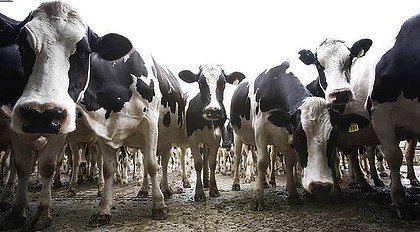
Writing in the journal Public Library of Science One, the researchers said they were able to create cows that produced milk containing a human protein called lysozyme, which is found in large quantities in human breast milk and helps to protect infants from bacterial infections. (via Genetically modified cows produce human milk)

Read more

Also, suggests Mr Hanff, the interactive nature of ‘Gladverts’ may offer a service in return for information – a trend already seen with public Wifi hotspots which require assorted personal details before use.

“We wouldn’t be surprised to see digital signage also serving as WiFi hotspots in the future to collect even more data.

"Since it is likely these signs will be networked, they serve as a very good opportunity for the industry to offer free Wifi hotspots as well.”

via Minority Report ads ‘next year’

Read more

Governments and companies now possess dozens of these independently developed computer programs, known in industry jargon as “safety codes.” Many of these institutions — including ones in Japan — are relying on forensic modeling to analyze the disaster at Fukushima Daiichi to plan for a range of activities, from evacuations to forecasting the likely outcome.

“The codes got better and better” after the accident at Three Mile Island revealed the poor state of reactor assessment, said Michael W. Golay, a professor of nuclear science and engineering at the Massachusetts Institute of Technology.

If events in Japan unfold as they did at Three Mile Island in Pennsylvania, the forensic modeling could go on for some time. It took more than three years before engineers lowered a camera to visually inspect the damaged core of the Pennsylvania reactor, and another year to map the extent of the destruction. The core turned out to be about half melted.

Micro-Simulation Technology, a software company in Montville, N.J., used its own computer code to model the Japanese accident. It found core temperatures in the reactors soaring as high as 2,250 degrees Celsius, or more than 4,000 degrees Fahrenheit — hot enough to liquefy many reactor metals.

“Some portion of the core melted,” said Li-chi Cliff Po, the company’s president. He called his methods simpler than most industry simulations, adding that the Japanese disaster was relatively easy to model because the observable facts of the first hours and days were so unremittingly bleak — “no water in, no injection” to cool the hot cores.

“I don’t think there’s any mystery or foul play,” Dr. Po said of the disaster’s scale. “It’s just so bad.”

The Sandia National Laboratories in Albuquerque wrote one of the most respected codes. It models whole plants and serves as a main tool of the Nuclear Regulatory Commission, the Washington agency that oversees the nation’s reactors.

Areva and French agencies use a reactor code-named Cathare, a complicated acronym that also refers to a kind of goat’s milk cheese.

On March 21, Stanford University presented an invitation-only panel discussion on the Japanese crisis that featured Alan Hansen, an executive vice president of Areva NC, a unit of the company focused on the nuclear fuel cycle.

“Clearly,” he told the audience, “we’re witnessing one of the greatest disasters in modern time.”

via Japan’s Nuclear Crisis Is Seen Clearly From Afar – NYTimes.com

Read more

Dr. Young represents the surging interest of young Americans in combating the deadly epidemics ravaging the world’s poorest countries, fueled in part by the billions of dollars that the American government, the Bill & Melinda Gates Foundation and other organizations have poured into international health in recent year.

Across sub-Saharan Africa, an extreme shortage of health workers remains a critical barrier to fighting illness. The region bears a quarter of the world’s burden of disease, but has only 3 percent of its health care workers, according to the World Health Organization.

Public health experts say efforts like the one involving Dr. Young have proved particularly useful on a continent that sorely needs pediatricians, surgeons and other specialists to train African doctors and nurses in the field.

And demand for such opportunities is rising. More than 70 universities in the United States and Canada now offer formal academic programs in global health, most of them developed in just the past five years, according to the Consortium of Universities for Global Health.

“Today’s students really want to make a difference in the world,” said Michael H. Merson, director of Duke University’s Global Health Institute. “They have a passion for sacrifice and service. It reminds me of the ’60s.”

Read more