The heliosphere, the bubble of energy provided by the sun which envelops all the planets in the solar system, was known to block cosmic rays coming in from the rest of the universe. It seems that it doesn’t do so alone. The Interstellar Boundary Explorer (IBEX) orbited earth, in an attempt to map the edges of the solar system. The maps it brought back show that there is a specific energy barrier wrapped around the solar system. IBEX scientists have looked over maps made by the mission, and have managed to chart the shape of this huge ribbon of energy.

The IBEX used cameras that were sensitive to energetic neutral atoms, instead of photons, to focus on the boundary of the bubble of energy around our solar system. The heliosphere is puffed up, to a large degree, by the high-energy particles that shoot out of the sun. The ribbon appears to stretch down and wind around the heliosphere like stripes on a candy cane, and then move on.

(via Our solar system is wrapped in a mysterious energy ribbon)

Read more
There is a major point missing from this argument: readers don’t care. Bad, “unpublishable” books are finding an audience. I cannot claim to have read many of the books on the Kindle self-published bestseller list, but without a doubt there are many books that some people would find totally inept, but are finding an audience with many honest 5-star reviews.

Read more

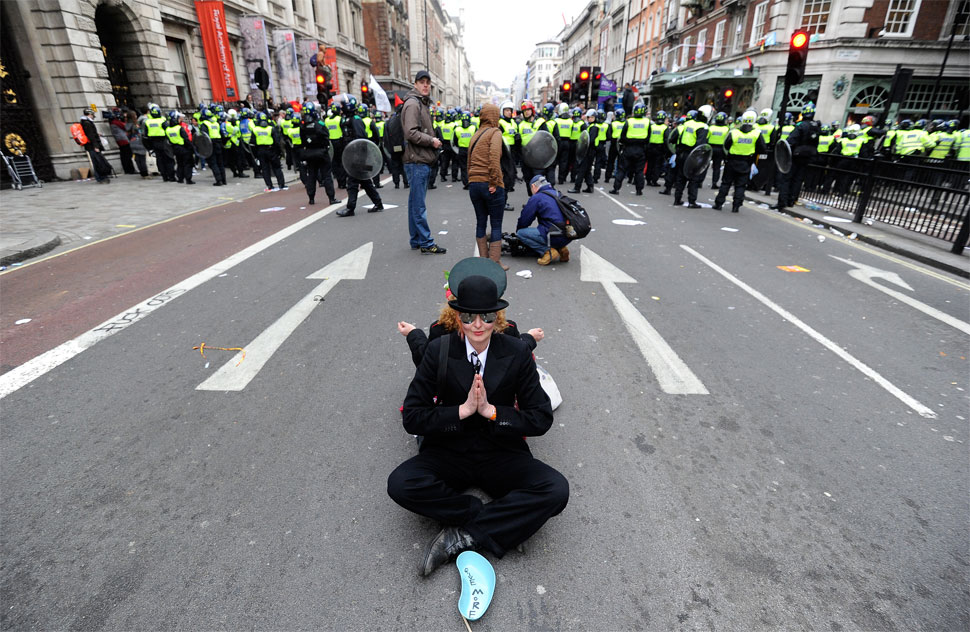
Marching from A to B to voice vague objections to government spending plans, marching behind Labour and union leaders who fail entirely to offer a coherent alternative, is no longer a sufficient response to these cuts. It is not sufficient because this government, like the previous government, is not at all worried by the prospect of hundreds of thousands of people marching from A to B. They are worried about the prospect of a truly popular people’s uprising. They are worried about losing the ideological argument over the necessity of destroying the welfare state. They are worried by the prospect of a run on the banks engineered by digital people power, as just occurred in Holland, and they are worried about the prospect of a general strike. It’s safe to say that the government has a lot less to worry about this week than it did last week- and activists, anarchists, unions and the Labour movement all need to be asking ourselves why.

Read more

ING customers mobilised on Twitter and other social networks to protest at bonuses paid to bosses at the bank, one of the biggest in the country. The threat of direct action raised the spectre of a partial run on ING, terrifying the Dutch establishment.

..Jan Hommen, ING’s chief executive, was due to receive a £1m bonus – a pittance when you consider that Stephen Hester, head of state-controlled RBS in the UK, is in line for up to £7.7m, Bob Diamond of Barclays is to collect as much as £6.5m, and some senior bankers at Goldman Sachs and JP Morgan are looking at windfalls of about £40m each…

So severe was the public reaction to Hommen’s bonus that within days he had agreed to waive the award and told other ING directors to do the same.

Now the Netherlands is going through a painful period of introspection and soul-searching. Politicians have voted to implement a 100% retrospective tax on all bonuses paid to executives at institutions that received state aid as a result of the financial crisis. In other words, no banker should get a bonus until the debt is cleared, and they should return payments made since 2008.

ING was thrown a €10bn (£8.7bn) lifeline to stop it going under, while ABN Amro was nationalised. Numerous other Dutch financial firms received capital support, including Aegon, SNS Reaal and ASR Nederland.

Read more

Award winning campaign of revolutionary optimism: Tunisia – June 16th, 2014

Now this is my kind of advertising campaign, stimulating collective Futurism by the citizens of Tunisia after re-claiming their country. Sure, I’m far more in favour of the envisioning process than…

Award winning campaign of revolutionary optimism: Tunisia – June 16th, 2014

Read more "Award winning campaign of revolutionary optimism: Tunisia – June 16th, 2014"

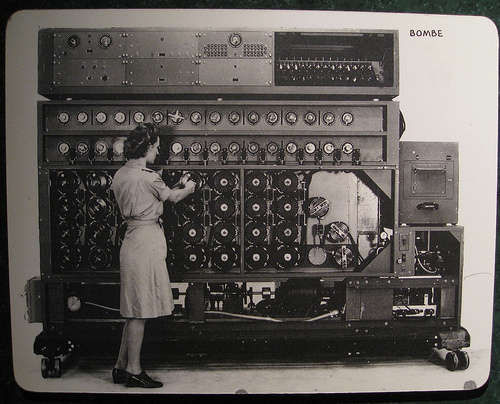
The US NAvy cryptanalytic Bombes had only one purpose: Determine the rotor settings used on the German cipher machine ENIGMA. Originally designed by Joseph Desch with the National Cash Register Company in Dayton, Ohio, the Bombes worked primarily against the German Navy’s four-rotor ENIGMAs. Without the proper rotor settings, the messages were virtually unbreakable. The Bombes took only twenty minutes to complete a run, testing the 456,976 possible rotor settings with one wheel order. Different Bombes tried different wheel orders, and one of them would have the final correct settings. When the various U-boat settings were found, the Bombe could be switched over to work on German Army and Air Force three-rotor messages.

US Navy Cryptanalytic Bombe (by brewbooks)

Read more