the very factors that have brought Facebook and similar sites such commercial success have huge appeal for a secret police force. A dissident’s social networking and Twitter feed is a handy guide to his political views, his career, his personal habits and his network of like-thinking allies, friends and family. A cybersurfing policeman can compile a dossier on a regime opponent without the trouble of the street surveillance and telephone tapping required in a pre-Net world.

If Mr. Mubarak’s Egypt has resorted to the traditional blunt instrument against dissent in a crisis — cutting off communications altogether — other countries have shown greater sophistication. In Belarus, officers of the K.G.B. — the secret police agency has preserved its Soviet-era name — now routinely quote activists’ comments on Facebook and other sites during interrogations, said Alexander Lukashuk, director of the Belarus service of Radio Free Europe/Radio Liberty. Last month, he said, investigators appearing at the apartment of a Belarusian photojournalist mocked her by declaring that since she had written online that they usually conducted their searches at night, they had decided to come in the morning.

In Syria, “Facebook is a great database for the government now,” said Ahed al-Hindi, a Syrian activist who was arrested at an Internet cafe in Damascus in 2006 and left his country after being released from jail. Mr. Hindi, now with the United States-based group CyberDissidents.org, said he believes that Facebook is doing more good than harm, helping activists form virtual organizations that could never survive if they met face to face. But users must be aware that they are speaking to their oppressors as well as their friends, he said.

Spotlight Again Falls on Web Tools and Change – NYTimes.com

– hence the return of internet in all things cypherpunk

Read more

The +336+, designed by Robert Stadler (of the French design group Radi Designers), is a mirror able to receive SMS messages sent from a mobile phone. The messages appear as luminous text, running on the mirrors’ surface when one gets close to the mirror. (via Generate Design | +336+ SMS Mirror by Robert Stadler for – Free Shipping)

Read more

So who are the players in Egypt’s drama? Sayyid Qutb, decades dead, is one: an angry young man sent from Egypt to America by friends who wanted him to loosen up, he underwent instead a kind of transformation. His journey through early 20th Century America as a man who was obviously not white, and who was inclined towards a conservative and faith-based perception, so appalled him that he crafted a synthesis of modern revolutionary ideas and Islam which effectively took the evils of capitalism as the evils of unrighteousness and substituted the deity for socialism or anarchy. That synthesis is one of the foundations of modern Islamism (and the Muslim Brotherhood), and of Al Qaeda and the Taliban. Above all, their strength is in a clear, simple rhetoric and a pre-existing power structure.

Democrats, for sure: basic assumption is that they’re urban and educated middle class people, cosmopolitan in outlook and desperate for prosperity and gentle social progression (but not too much of it). A powerful, intellectual minority, but not a power base in and of themselves. And nuance plays badly in revolution.
The army, inevitably: classically the poorer and less well-educated people from rural and urban-poor backgrounds. Are they largely secular or moderate, or do they tend towards the Muslim Brotherhood? The officer class may have sympathies with the democrats or may be vested in Mubarak’s regime, depending on their own culpability and their assessment of the threat from within.
The rural and urban lower classes – farmers and manual workers. The ‘real people’. Historically – in other cases, which may or may not be similar – they know when they can’t take any more, and what they need – but which way will they break? Absent a charismatic and powerful leader emerging from this group and creating his or her own structures, they will be channelled by a nearby, compelling narrative. The slogan will be akin to ‘food, peace, freedom’, and the new regime will have either to delivery very fast or suppress the inevitable cries of outrage and betrayal. This is where the Russian February Revolution fell and the October Revolution changed the course of Russia from nascent distributed democracy to one-party state.
External forces – the US, EU, Israel, Pakistan, Hamas, Al Qaeda, the other Arab states. All or any of the above may seek to influence events and any such attempt will change what happens, but not necessarily in a predictable way.
So, yes, Mubarak’s regime is nasty. But given Egypt’s place in the world and the powers in play, it’s not clear to me that its fall is going to take us anywhere good. Given that it’s happening, of course, we will have to be in the mix, trying to get an outcome which suits us. The trouble is, again looking at history, our power brokers will prefer a strongman to a democrat vulnerable to being unseated by a religious ideologue. Someone, somewhere, is even now submitting a recommendation to back such a person over and above a genuine democrat, and if that course is followed we will yet again be in the business of supporting a monster for fear of a worse one, and the reputation of the developed northwest will sink further in the eyes of the Arab world – and, indeed, anyone else who’s paying attention.

Read more

hitRECordJoe: The Social Network & My Generation an open letter to my friend Peter…

hitrecordjoe:

The Social Network & My Generation
an open letter to my friend Peter Travers

Peter,

Hey man! So, I finally watched The Social Network the other night, and today I read your review of it, curious about your claim that this film defines my generation. First let me say, I agree that…

hitRECordJoe: The Social Network & My Generation an open letter to my friend Peter…

Read more "hitRECordJoe: The Social Network & My Generation an open letter to my friend Peter…"

Up till now we thought of cultural developments leading to the opportunity of people to move out of Africa. Now we see, I think, that it was the environment that was the key to this and the change from a glacial period into an interglacial opened the other possibility to leave Africa though the southern corridor and this certainly not only happened once, this happened many times during the (quarternerly) and this leaves a lot of possibilities for human migrations and keeping this in mind, might change our view completely. There are not many exits from Africa. You can only exit by the Sinai or by the south. That’s the only – that’s the only points where you can leave it. so either it’s the route that we propose, or it could be the route from Egypt to Sinai and both are possible, both have their problems and in any case, our findings open a second way, which in my opinion is more plausible for massive movements than the northern route.

Read more

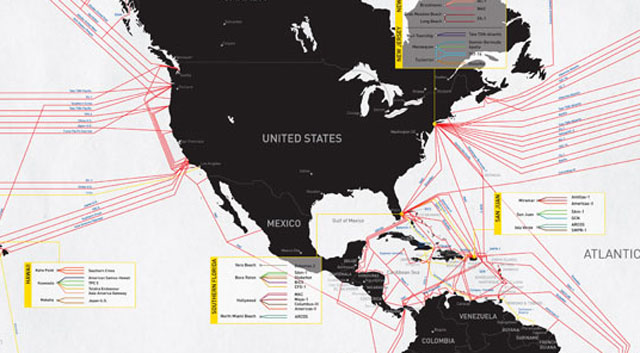
There are only a limited number of cables leading out of the U.S. to other parts of the world (see cable map above). Physically cut them and you’ve got what network geeks call “an air gap.” No network traffic can cross the empty air between the cable’s severed ends.

from http://io9.com/5746338/

Read more

German engineers create the most robust robotic hand yet

We’re seriously entering into “chop my weak flesh off and give me that” territory here.

From IEEE Spectrum:

German researchers have built an anthropomorphic robot hand that can endure…

German engineers create the most robust robotic hand yet

Read more "German engineers create the most robust robotic hand yet"