Read more..tonight, I am watching a country in the throes of a populist uprising turn off the internet as a protective measure. And I can’t help but wonder: If I were one of eighty million people living in a country in the midst of a nascent political upheaval whose access to the rest of the world was being antagonistically removed, would I start to think that maybe those simple packets that transport Facebook updates and Twitter status messages and mass emails are perhaps something more than the byproduct of business but a fundamental right of human beings to communicate with other human beings?
I have nothing more trenchant to offer than that as I get ready to go to sleep in my warm, secure bed. So I pass the buck to you: Is access to the internet a human right? And if so, to what end should we expect others to go to maintain it?
Author: m1k3y
Research In Motion unveiled a concept design for a phone called the BlackBerry Empathy, which is based on a wireless “mood ring.” (No, I’m not making this up.) The ring somehow gathers your biometric data, which is sent to the phone. The phone would also detect the emotions of people near you, and would let you know if they’re angry, sad or bored; it would do the same with your social networking contacts. The idea is that everyone would know via Facebook how everyone else was feeling, based on biometric data.
Elgan: When the iPhone feels your pain – Computerworld
two words RIM: fuck.no



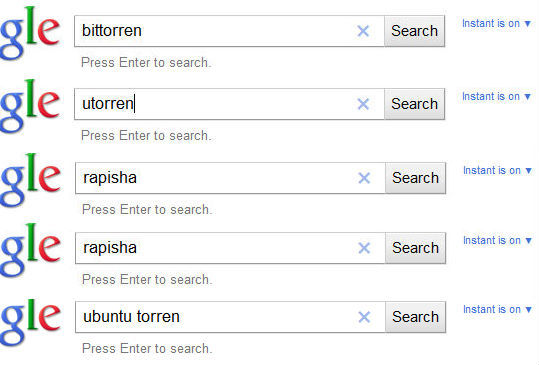
Without a public notice Google has compiled a seemingly arbitrary list of keywords for which auto-complete is no longer available. Although the impact of this decision does not currently affect full search results, it does send out a strong signal that Google is willing to censor its services proactively, and to an extent that is far greater than many expected.
Among the list of forbidden keywords are “uTorrent”, a hugely popular piece of entirely legal software and “BitTorrent”, a file transfer protocol and the name of San Fransisco based company BitTorrent Inc. As of today, these keywords will no longer be suggested by Google when you type in the first letter, nor will they show up in Google Instant.
All combinations of the word “torrent” are also completely banned. This means that “Ubuntu torrent” will not be suggested as a user types in Ubuntu, and the same happens to every other combination ending in the word torrent. This of course includes the titles of popular films and music albums, which is the purpose of Google’s banlist.
(via Google Starts Censoring BitTorrent, RapidShare and More | TorrentFreak)
Read more The Committee to Nuke Elysium