Organic semiconductor materials look key to creating retinal prosthetics

From New Scientist:

Light-sensitive plastic might be key to repairing damaged retinas. Creating neuro-prosthetic devices such as retinal implants is tricky because biological tissue doesn’t…

Organic semiconductor materials look key to creating retinal prosthetics

Read more "Organic semiconductor materials look key to creating retinal prosthetics"

After all, the radical transparency of Mark Zuckerberg and Facebook may not be mutually exclusive with what we might as well call the radical opacity of Christopher ‘moot’ Poole and 4chan. Their uses may even be mutually necessary. Peretti puts it this way: if 4chan is the id of the Internet, then ‘Google is kind of like the ego, and Facebook is kind of like the superego.’ If that’s so, then there’s only one way the trend toward radical transparency won’t end up killing the Internet’s soul: if we can leave the light of all that openness every now and then to spend some time in the shadows where the crazy lives.

Read more

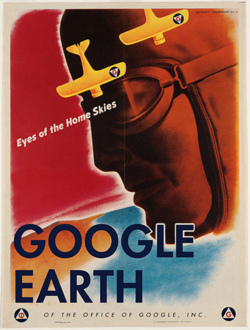
..augmented humanity implies inserting tech deliberately in the way of normal life, to better it. And Schmidt’s unspoken line is that job should fall to Google–it has diverse tools that operate in all of these “augmented info” spaces and beyond, and if they were all centralized and presented to you seamlessly via Android smartphones, then it could improve the human race. After all, thanks to its vast user-info databases, Google already knows pretty much everything about you, and almost what you’re thinking about where you’re going next (as Schmidt has previously noted.) He caveated his argument with lots of references to the phrase “with your permission,” obviously concerned he was overstepping the user-privacy boundary. But do we trust Google with the future of 21st century humankind? There’s a big assumption here that Google will always promise not to be evil.

Read more

Humanity has the power to fill outer space with life. Today our solar system is filled with plasma, gas, dust, rock, and radiation – but very little life; just a thin film around the third rock from the Sun. We can change that. In the 1970’s Princeton physicist Gerard O’Neill with the help of NASA Ames Research Center and Stanford University showed that we can build giant orbiting spaceships and live in them. These orbital space colonies could be wonderful places to live; about the size of a California beach town and endowed with weightless recreation, fantastic views, freedom, elbow-room in spades, and great wealth. In time, we may see hundreds of thousands of orbital space settlements in our solar system alone. Building these settlements will be an evolutionary event in magnitude similar to, if not greater than, ocean-based Life’s colonization of land half a billion years ago

Space Settlement 

– links galore here

Read more

Red Dawn 2, the forthcoming sequel to the nineteen eighties B-movie about a Soviet occupation of America, was shot last year in downtown Detroit. A long-abandoned modernist skyscraper coincidentally undergoing demolition served as a backdrop for battle scenes between American guerrillas and the Communist occupiers, now Chinese. For weeks, Chinese propaganda posters fluttered in the foreground of the half-destroyed office building, whose jagged entrails were visible through the holes opened by the wrecking ball. A pedestrian routinely bumped into Asian-American extras with Michigan accents and fake Kalashnikovs, while a parking garage played the role of a Communist police station. It was an uncanny spectacle: the very real rubble of the Motor City’s industrial economy serving as the movie backdrop for post-industrial America’s paranoid fantasies of national victimization. What made it even weirder was the fact that the film’s producers just left the posters hanging when they packed up. A red-and-yellow poster on that same parking garage assured us for weeks afterward that our new rulers were “here to help.”

Read more

slavin:

TURN THE PEARL RIVER DELTA INTO ONE

And let @moleitau know his battlesuit is warming up.

kateoplis:

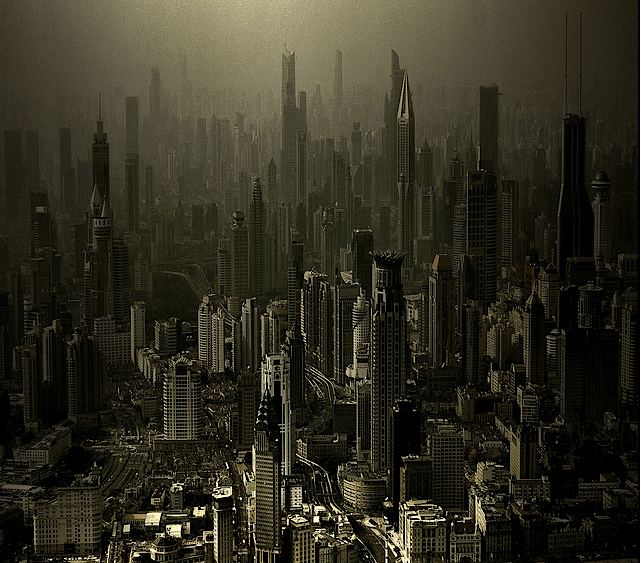
China is planning to create the world’s biggest mega city by merging nine cities to create a metropolis twice the size of Wales with a population of 42 million.

The “Turn The Pearl River Delta Into One” scheme will create a 16,000 sq mile urban area that is 26 times larger geographically than Greater London. The new mega-city will cover a large part of China’s manufacturing heartland, stretching from Guangzhou to Shenzhen and including Foshan, Dongguan, Zhongshan, Zhuhai, Jiangmen, Huizhou and Zhaoqing. Together, they account for nearly a tenth of the Chinese economy.

Telegraph (image by rastaschas)

More China . . . . . . .

Read more