
Author: m1k3y
Read more“Preliminary analysis shows that there is no threat posed to Russia by Julian Assange’s resource. You have to understand that if there is the desire and the right team, it’s possible to shut it down forever,” an expert from the FSB’s Center for Information Security was quoted by Life News as saying on Tuesday.
Links between hacker cells and the FSB made in the past lend credence to this thinly veiled secret services threat. In his recent book on Russia’s secret services, investigative journalist Andrei Soldatov details how the Russian FSB “maintain a sophisticated alliance with unofficial hackers, such as those who carry out cyber attacks on the Web sites of enemies of the state,” drawing attention to hacker forums such as Informacia.ru.
Given Russia’s notoriously malleable extremism legislation, which Wikimedia (despite its name, not affiliated to WikiLeaks) recently fell foul of, it is hard to imagine that classified information on Russia from WikiLeaks could pass as anything short of “extreme.” Indeed, a Gazeta.Ru editorial yesterday pointed out precisely this contradiction in the claim that WikiLeaks is “no threat posed to Russia.”
…
According to Assange, “the despotic regimes of Russia, China and Central Asia” were the original focus of his project when he was pitching it to potential investors four years ago.
…
Speaking to The Christian Science Monitor yesterday, Andrei Soldatov said that the problem for WikiLeaks would not be actually leaking information on Russia, but rather that leaking that information would not stimulate any public discussion in Russia’s muzzled media.
Soldatov drew attention to a Web site that in June published what it claimed was leaked FSB correspondence detailing intelligence operations in the CIS, including in Turkmenistan and Ukraine. The site called Lubyankapravda.com, hosted in the United States, has since gone offline, but during its three-week existence won no media attention. Because of what Soldatov blamed on the lack of media freedom in Russia, the FSB correspondence was never authenticated through public discussion, precluding the possibility of analyzing its claims. “It is no accident that I am not quoting details from these documents. The point is that there is one big difference between these documents and the WikiLeaks collection. Unlike the American reports, the FSB correspondence, although it was put out on the Internet, never did land in the public sphere,” Andrei Soldatov wrote in an August article posted on his Agentura.ru Web site.
Lieven said that discussion in the mass media of WikiLeaks dossiers on Russia was unrealistic, although it was more possible in the print media, which has comparative freedom within certain boundaries. “The problem has always been direct attacks on Vladimir Putin or Dmitry Medvedev, or those directly compromising state security. I’m sure if you started leaking stuff about the Russian armed forces similar to what’s been leaked about the American armed forces, I think something very nasty might happen to you,” said Lieven.
Nathan Barley was right
The show that is, not the main character. Let me explain. I was sitting with Court3nay on Friday afternoon, in Little Creatures, after an expedition up and down Brunswick St, seeking clothing worthy of purchase. He was telling me about the smartphone app Bump and all the fun ways people have found to use it. […]
Read more "Nathan Barley was right"Read moreBecause we know we can never go back, we feel free to reimagine the past as a haven from of the existential horrors of The Now; dreaming about a holiday you can never take is safe, because you can never be disappointed by the reality. Yesterday’s Now isn’t so scary, firstly because its bad sides are almost unimaginable from our current vantage point of Panglossian privilege, and secondly because our very existence implies it was survivable at a civilisational scale – two certainties that The Now doesn’t deliver.
The past is a poster on your bedroom wall. Hi-ho, atemporality.

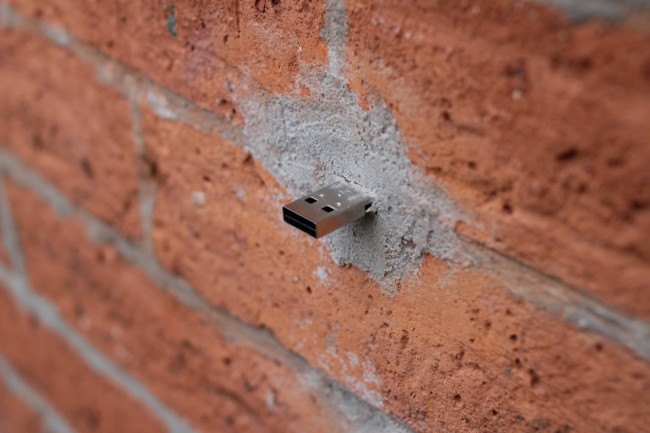
‘Dead Drops’ is an anonymous, offline, peer to peer file-sharing network in public space. I am ‘injecting’ USB flash drives into walls, buildings and curbs accessable to anybody in public space. You are invited to go to these places (so far 5 in NYC) to drop or find files on a dead drop. Plug your laptop to a wall, house or pole to share your files and date. Each dead drop contains a readme.txt file explaining the project. (via “Dead Drops” preview at Aram Bartholl – Blog)
Read morepeer2peer file transfer via dead drops
Then, one bright spark had the idea of automating the local file-transfer process. ‘Cause who wanted to batch up their viewings, when they could be getting the latest eps hours after screening, without having to wait for John-Bob Smith to rock up from Springvale with the latest ep of Lost. This bright spark, in one […]
Read more "peer2peer file transfer via dead drops"Once mentioned as a possible contender for a post in the Obama administration or as a potential senator, the governor is now being talked about as more of an ambassador-at-large for the planet.
As of now, Schwarzenegger is offering no clues as to his future plans. During his Tweetcast he said he was thinking of writing a book, and that he was unsure if he would return to making films, as he was not sure he still had the patience to sit on a movie set for three or six months at a time.
He may prefer life on the move. Schwarzenegger was at the Copenhagen climate change summit last year, and has recently returned from China, after speaking out about its advances in clean technology. For his allies in California, a continuing environmental role does not seem far-fetched. “He has the ability to get an audience, and can attract really good people,” Epstein said.
Arnold Schwarzenegger flexes muscles to defend climate-change law | Environment | The Guardian
– Arnie as a future first world president? like, it couldn’t be any stranger than this right?

 The Committee to Nuke Elysium