






Late last month Matthew Plummer-Fernandez, the 31-year-old creative technologist for Goldsmith College’s Interaction Research Studio at the University of London, released what he’s calling ‘Disarming Corruptor,’ a piece of free software designed to distort 3D-printable blueprints such that only another user with the app and the knowledge of a certain key combination can reverse the distortion and print the object. That means any controversial file–say, a figurine based on Mickey Mouse or another copyrighted or patented shape, or the 3D-printable gun created earlier this year known as the Liberator–could be ‘encrypted’ and made available on a public repository for 3D-printing blueprints like the popular site Thingiverse without tipping off those who would try to remove the file.
Read more
Read moreTHE BLACK TRIBBLES x AFROFUTURIST AFFAIR RETURN TO OCTAVIA CITY!
Inspired by Hugo and Nebula Award winning author, the late Octavia Butler, OCTAVIA CITY presents original tales of Afrofuturism, science fiction fused with perspectives born from the African diaspora.
The Black Tribbles Radio show is CALLING ALL WRITERS AND STORYTELLERS OF BLACK SCI-FI & AFROFUTURISM for OCTAVIA CITY Pt. 2, original tales of Afrofuturism, w/ return special guest Rasheedah Phillips of The AfroFuturist Affair!
You are invited to share your stories with the world on Thursday, November 7, 2013 from 8-11pm LIVE on the BLACK TRIBBLES radio show w/ co-host Gabriel Bryant of Stepping Into Tomorrow on Gtown Radio. Musical soundscape provided by DJ AURA of Places & SPaces.
Part One and Part Two of the first Octavia City event.
Read moreThe second way today’s plutocrats flex their political muscle is more novel. Matthew Bishop and Michael Green, a pair of business writers, have called this approach “philanthrocapitalism” — activist engagement with public policy and social problems. This isn’t the traditional charity of supporting hospitals and museums, uncontroversial good causes in which sitting on the board can offer the additional perk of status in the social elite. Philanthrocapitalism is a more self-consciously innovative and entrepreneurial effort to tackle the world’s most urgent social problems; philanthrocapitalists deploy not merely the fortunes they accumulated, but also the skills, energy and ambition they used to amass those fortunes in the first place.
Bill Gates is the leading philanthrocapitalist, and he has many emulators — nowadays, having your own policy-oriented think tank is a far more effective status symbol among the super-rich than the mere conspicuous consumption of yachts or private jets. Philanthrocapitalism can be partisan — George Soros, one of the pioneers of this new approach, backed a big effort to try to prevent the re-election of George W. Bush — but it is most often about finding technocratic, evidence-based solutions to social problems and then advocating their wider adoption.
Philanthrocapitalism, particularly when you agree with the basic values of the capitalist in charge, can achieve remarkable things. Consider the work the Bill and Melinda Gates Foundation has done on malaria, or the transformative impact of Mr. Soros’s Open Society Foundations in Eastern Europe.
Mr. Bloomberg took philanthrocapitalism one step further — he used his résumé and his wealth to win elected political office. In City Hall, Mr. Bloomberg’s greatest achievements were technocratic triumphs — restricting smoking in public places, posting calorie counts and championing biking. As he prepares for life after political office, he is already honing the more typical plutocratic skill of using his money to shape public policy by energetically engaging in national battles over issues like gun control and immigration reform.
At its best, this form of plutocratic political power offers the tantalizing possibility of policy practiced at the highest professional level with none of the messiness and deal making and venality of traditional politics. You might call it the Silicon Valley school of politics — a technocratic, data-based, objective search for solutions to our problems, uncorrupted by vested interests or, when it comes to issues like smoking or soft drinks, our own self-indulgence.
But the same economic forces that have made this technocratic version of plutocratic politics possible — particularly the winner-take-all spiral that has increased inequality — have also helped define its limits. Surging income inequality doesn’t create just an economic divide. The gap is cultural and social, too. Plutocrats inhabit a different world from everyone else, with different schools, different means of travel, different food, even different life expectancies. The technocratic solutions to public-policy problems they deliver from those Olympian heights arrive in a wrapper of remote benevolence. Plutocrats are no more likely to send their own children to the charter schools they champion than they are to need the malaria cures they support.





Read moreOccupy The Cloud – James Bridle (via @jamesbridle)
I realised it would be possible to make a very public work; and there was no point in being subtle…
Edward Snowden has revealed that we are not moving toward a surveillance state: we live in the heart of one.” Paglen asserts that networked technologies as they are employed now do “not merely provide the capacity for “turnkey tyranny”—they render any other future all but impossible.” Powerful organisations which are cavalier with democratic rights are also cavalier with personal data and privacy: the two are linked, directly.
The depredations of corporations and governments on the internet reveal that it, too, is only a potential commons: not a zone of freedom, but one of conflict and power. We have re-discovered the efficacy of spatial protest: we can take the banks to protest unjust tax arrangements, but can we occupy the datacentres over the same issues?
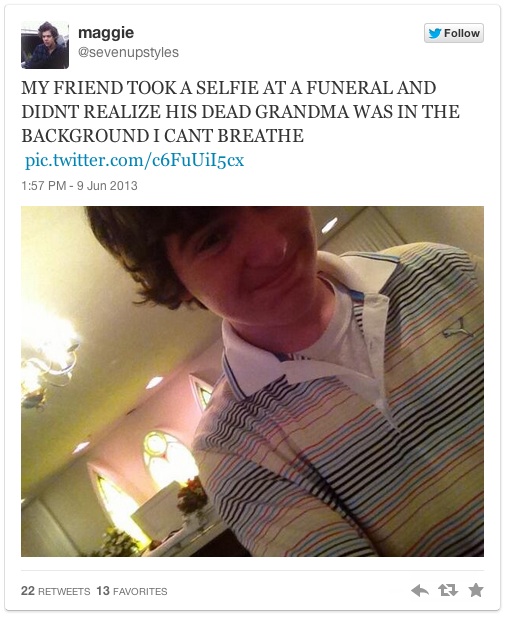
Funeral Selfies… Joining Cop Selfies and Rich Kids on Instagram to form… something. The #idonteven genre?
Read moreRead moreThe Russian press reports that local officials intercepted a shipment from China that contained home appliances with “spy” microchips capable of spreading malware to wi-fi enabled devices within 200 meters. Tea kettles were apparently the chief culprit.
Specific details of the dodgy shipments remain shady. It’s unclear, for example, if the chips were installed by the Chinese or by cyber criminals en route to Russia. It’s also unclear how Russian authorities spotted the contraband in the first place, although one report claims that the weight of some shipments were slightly off. Finally, the extent of the fiasco is also unclear, though limited press coverage suggests that it’s contained to a small shipment in St. Petersburg.