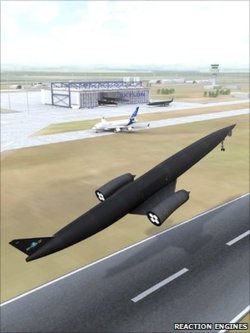
The proposed Skylon vehicle would do the job of a big rocket but operate like an airliner, taking off and landing at a conventional runway.

The European Space Agency’s propulsion experts have assessed the details of the concept and found no showstoppers.

They want the next phase of development to include a ground demonstration of its key innovation – its Sabre engine.

Realising the Sabre propulsion system is essential to the success of the project.

The engine would burn hydrogen and oxygen to provide thrust – but in the lower atmosphere this oxygen would be taken directly from the air.

This means the 84m-long spaceplane can fly lighter from the outset with a higher thrust-to-weight ratio, enabling it to make a single leap to orbit, rather than using and dumping propellant stages on the ascent – as is the case with current expendable rockets.

The price for launching a kilogram of payload into a geostationary orbit – the location for today’s big telecoms satellites – is currently more than $15,000 (£9,000). Skylon’s re-usability could bring that down to less than $1,000, claims REL.


Read more

The worms in question were of the species Caenorhabditis elegans, and were supplied by boffins at Nottingham uni having originally been found browsing a dump in Bristol. Many of C elegans’ genes perform the same function as those in humans, and the scientists wanted to see if RNA interference therapy (RNAi) could be used to fight the serious loss of muscle which astronauts are subject to during long spaceflights.

Some millions of the worms were sent up aboard space shuttle Atlantis on the STS-129 mission in 2009, and subsequently treated in the station’s Japanese-built “Kibo” lab podule. They were subsequently brought back to Earth on the next shuttle to visit, Endeavour (now retired), executing mission STS-130.

“It was really a quite straightforward experiment,” says Nottingham uni’s Dr Nathaniel Szewczyk. “Once the worms were in space the scientists onboard the International Space Station treated them with RNAi and then returned them to us for post flight analysis.

"These results are very exciting as they clearly demonstrate that RNAi can be used effectively to block proteins which are needed for muscle to shrink.”

Szewczyk’s colleague and fellow space garbage-worm gene therapy boffin, Dr Timothy Etheridge, added: “We were very pleased… our experiments allowed us to demonstrate that this form of gene therapy works effectively during spaceflight. The unexpected finding that RNAi can effectively block protein degradation in muscle in space was also a very welcome surprise.”

Brit rubbish-dump worms in space station science triumph

Garbage-scoffing creatures prove zero G therapy

Read more

Clipping on to your belt or waistband, the Tail has many settings, selected by turning a switch in your pocket. Use a glorious mix of all of them for full Tail expressivity. Moves include slow-fast wag, standing up, tremble, shy, twist and many more. (via In the City)

Read more

In addition to calling on governments to maintain Internet access “during times of political unrest,” the report goes on to urge States to change copyright laws, not in favor of the music and movie industries as has been the recent trend, but in keeping with citizens’ rights.

Read more

Cilium – robotic recreation of microscopic hairs

Click here to view the embedded video.

via Justin Pickard


Cilium – robotic recreation of microscopic hairs

Read more "Cilium – robotic recreation of microscopic hairs"