Award winning campaign of revolutionary optimism: Tunisia – June 16th, 2014

Now this is my kind of advertising campaign, stimulating collective Futurism by the citizens of Tunisia after re-claiming their country. Sure, I’m far more in favour of the envisioning process than…

Award winning campaign of revolutionary optimism: Tunisia – June 16th, 2014

Read more "Award winning campaign of revolutionary optimism: Tunisia – June 16th, 2014"

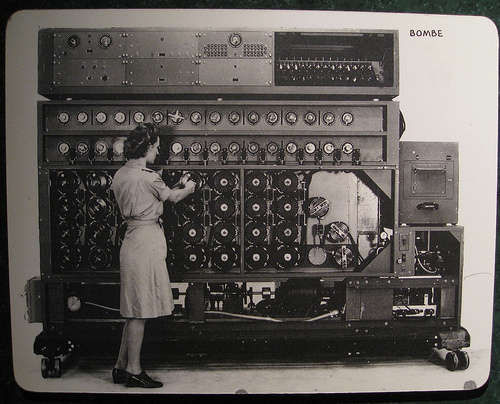
The US NAvy cryptanalytic Bombes had only one purpose: Determine the rotor settings used on the German cipher machine ENIGMA. Originally designed by Joseph Desch with the National Cash Register Company in Dayton, Ohio, the Bombes worked primarily against the German Navy’s four-rotor ENIGMAs. Without the proper rotor settings, the messages were virtually unbreakable. The Bombes took only twenty minutes to complete a run, testing the 456,976 possible rotor settings with one wheel order. Different Bombes tried different wheel orders, and one of them would have the final correct settings. When the various U-boat settings were found, the Bombe could be switched over to work on German Army and Air Force three-rotor messages.

US Navy Cryptanalytic Bombe (by brewbooks)

Read more

China now plans to raise the relative growth rate of real wages and to encourage increased consumer spending. There will also be more emphasis on expanding service industries and less on manufacturing. State-owned enterprises will be forced to distribute more of their profits. The rising value of the renminbi will induce Chinese manufacturers to shift their emphasis from export markets to production for markets at home. And the government will spend more on low-income housing and to expand health-care services.

All of this will mean a reduction in national saving and an increase in spending by households and the Chinese government. China now has the world’s highest saving rate, probably close to 50% of its GDP, which is important both at home and globally, because it drives the country’s current-account surplus.

A country that saves more than it invests in equipment and structures (as China does) has the extra output to send abroad as a current-account surplus, while a country that invests more than it saves (as the United States does) must fill the gap by importing more from the rest of the world than it exports. And a country with a current-account surplus has the funds to lend and invest in the rest of the world, while a country with a current-account deficit must finance its external gap by borrowing from the rest of the world. More precisely, a country’s current-account balance is exactly equal to the difference between its national saving and its investment.

The future reduction in China’s saving will therefore mean a reduction in China’s current-account surplus – and thus in its ability to lend to the US and other countries. If the new emphasis on increased consumption shrank China’s saving rate by 5% of its GDP, it would still have the world’s highest saving rate. But a five-percentage-point fall would completely eliminate China’s current-account surplus. That may not happen, but it certainly could happen by the end of the five-year plan.

If it does, the impact on the global capital market would be enormous. With no current-account surplus, China would no longer be a net purchaser of US government bonds and other foreign securities. Moreover, if the Chinese government and Chinese firms want to continue investing in overseas oil resources and in foreign businesses, China will have to sell dollar bonds or other sovereign debt from its portfolio. The net result would be higher interest rates on US and other bonds around the world.

Whether interest rates do rise will also depend on how US saving and investment evolves over the same period. America’s household saving rate has risen since 2007 by about 3% of GDP. Corporate saving is also up. But the surge in the government deficit has absorbed all of that extra saving and more.

Indeed, the only reason that America’s current-account deficit was lower in 2010 than in previous years is that investment in housing and other construction declined sharply. If Americans’ demand for housing picks up and businesses want to increase their investment, a clash between China’s lower saving rate and a continued high fiscal deficit in the US could drive up global interest rates significantly.

Read more

In 1966, the specialists at the Pentagon went to US President Lyndon Johnson – a thug prone to threatening to “crush” entire elected governments – with a plan to end the Vietnam War: nuke the country. They “proved”, using their computer modeling, that a nuclear attack would “save lives.”

It was a plan that might well have appealed to him. But Johnson pointed out the window, towards the hoardes of protesters, and said: “I have one more problem for your computer. Will you feed into it how long it will take 500,000 angry Americans to climb the White House wall out there and lynch their President?” He knew that there would be a cost – in protest and democratic revolt – that made that cruelty too great. In 1970, the same plan was presented to Richard Nixon – and we now know from the declassified documents that the biggest protests ever against the war made him decide he couldn’t do it. Those protesters went home from those protests believing they had failed – but they had succeeded in preventing a nuclear war. They thought they were impotent, just as so many of us do – but they really had power beyond their dreams to stop a nightmare.

Read more

Economic inequality among nations and other factors have contributed to a global food system in which a billion people are hungry (lacking access to sufficient amounts of macronutrients such as carbohydrates, fats and proteins), another billion suffer from “hidden hunger” (lacking crucial vitamins and minerals from their diet), while yet another billion are “substantially overconsuming,” spawning a new public health epidemic involving chronic conditions such as Type 2 diabetes and widespread cardiovascular disease.

The report, which was prepared by the research firm Foresight on behalf of the British government, also predicts that the cost of food worldwide will rise sharply in coming decades, increasing the likelihood of food-based conflicts and migration, and that people won’t be able to feed themselves without destroying the planet—unless we can transform the global food system on the scale of the industrial revolution.

Read more

The country will reduce its nuclear capacity goal of 80 gigawatts, Ren Dongmin, the head of the economic planner’s renewable energy development, said at a Beijing conference today, without giving a new target. The goal for solar-power capacity will increase from the current target of 20 gigawatts, he said.

Read more

all, even the least religious, retain in their minds when they think of the future, an idea of the deus ex machina, of some transcendental, superhuman event which will, without their help, bring the universe to perfection or destruction. We want the future to be mysterious and full of supernatural power; and yet these very aspirations, so totally removed from the physical world, have built this material civilization and will go on building it into the future so long as there remains any relation between aspiration and action.

Read more

Wherever modern humans, living outside the narrow social mores of the clan, are allowed to pursue their genetic interests without constraint, they will hurt other people. They will grab other people’s resources, they will dump their waste in other people’s habitats, they will cheat, lie, steal and kill. And if they have power and weapons, no one will be able to stop them except those with more power and better weapons. Our genetic inheritance makes us smart enough to see that when the old society breaks down, we should appease those who are more powerful than ourselves and exploit those who are less powerful. The survival strategies that once ensured cooperation among equals now ensure subservience to those who have broken the social contract.

The democratic challenge, which becomes ever more complex as the scale of human interactions increases, is to mimic the governance system of the small hominid troop. We need a state that rewards us for cooperating and punishes us for cheating and stealing. At the same time, we must ensure that the state is also treated like a member of the hominid clan and punished when it acts against the common good. Human welfare, just as it was a million years ago, is guaranteed only by mutual scrutiny and regulation.

I doubt that Ridley would be able to sustain his beliefs in a place where the state has broken down. Unless taxpayers’ money and public services are available to repair the destruction it causes, libertarianism destroys people’s savings, wrecks their lives and trashes their environment. It is the belief system of the free-rider, who is perpetually subsidised by responsible citizens. As biologists we both know what this means. Self-serving as governments might be, the true social parasites are those who demand their dissolution.

Read more