Jamais Cascio on Evolving our Society to Survive

This is a long, dense piece.. it’s Jamais Cascio’s speech to his Institute For The Future colleagues at their recent annual Ten Year Forecast event. It’s written in their native Futurist…

Jamais Cascio on Evolving our Society to Survive

Read more "Jamais Cascio on Evolving our Society to Survive"

Of more pressing concern to TEPCO is the toxic water found in the basements of three turbine buildings and adjoining tunnels that approach the sea. The tunnels terminate in shafts that are less than 100 meters from the shore and the water level is close to the top.

Workers are putting sandbags and concrete blocks around the shaft openings to stop water reaching the sea, in case it overflows. They are also pumping water from the tunnels, but the operation is slow because they lack tanks to store it all. (via Japan on ‘Maximum Alert’ as Workers Try to Stem Leaks of Toxic Water | East Asia and Pacific | English)

Read more

In place of an obvious indigenous militant group, and with scant evidence of organised al-Qa’ida activity, the regime has focused on Darnah. The city has a tradition of sending volunteers for jihad. In 2007, US forces in Iraq found a list of foreign fighters: of the 112 from Libya, Darnah, with its population of 48,000, supplied 52.

Abdul Hakim Al-Hasidi, who took over as ‘chief of security’ at Darnah at the start of the uprising on 17 February, spent five years in Afghanistan where he supposedly met bin Laden and frequented, according to US intelligence briefings at the time, a training camp used by both the Taliban and al-Qa’ida. Mr al-Hasidi claims he has 1,200 fighters, which would make his group one of the largest contingents among the revolutionaries, known as the Shabaab. He has personally led units into battles in Bin Jawad and Ras Lanuf where the action has been fierce.

It is, however, not easy to ascertain details of Mr Al-Hasidi’s links with Islamic militancy. During a recent meeting in Darnah, he was reticent to talk about his Afghan sojourn and his alleged meetings with bin Laden. He was not a member of al-Qa’ida, he stated, and did not follow its ethos. Mr Al-Hasidi refused to elaborate on a previous observation that bin Laden “had his good points” and described claims of his links with the head of al-Qa’ida as “just tales”.

He was keen to point out he was a member of the Benghazi regional council, which liaised with the administration now being recognised by a number of states as Libya’s de facto government and whose members are attending the summit in London.

The 45-year-old teacher insisted he did not want the Talibanisation of Libya. “Afghanistan is a different country,” he said. “We have got our own situation in Libya and I am a member of the council which has all kinds of people in it. If I wanted to have a state like the Taliban, would I belong to the council? We are already a Muslim country and we shall follow the path of Islam. We do not need to bring in foreign ideas on how to be Muslims. I am not even teaching religion in my job, I teach geography.”

While refusing to discuss who gave him lessons in arms in Afghanistan, Mr Al-Hasidi acknowledged: “Yes I was there. I did not like the attack by America (in 2001) because it was unjust. A lot of civilians, women and children, were killed by bombs dropped from the sky.” The Tripoli regime, he continued, was simply trying to demonise its opponents. “I was a political prisoner in Libya and all I want is justice for our community.”
Read more

From a counterterrorism point of view, a more serious danger is that the civil war will continue without end. Bin Laden has proved adept at exploiting civil wars and strife. In Afghanistan, Chechnya, and Iraq, among other countries, al-Qaida and like-minded groups initially worked with local fighters motivated primarily to throw out outsiders or redress other local grievances. Slowly but surely they made the struggle more global, casting it as a fight against the United States and making the jihadist component of the resistance larger. Given the strong Libyan representation in al-Qaida and the historic role jihadists played in the anti-Qaddafi struggle, al-Qaida might try to bend this conflict to its will. So Qaddafi’s swift end is all the more necessary.

Read more

“Today, we see constant attempts by cyber means to steal the nation’s secrets, as well as information vital to the effective operation of critical national industries and infrastructure, not to mention commercial intelligence and criminal fraud,” said David Irvine, director-general of the Australian Security Intelligence Organisation (ASIO).

“The cyber world will be a principal mechanism of warfare in the 21st century [and] has the potential to reduce the conventional and nuclear weapons advantage of a country.”

Last month Canada’s Treasury Board confirmed there had been an unauthorised attempt to penetrate its networks after broadcaster CBC reported China-based hackers had attacked government computer systems.

This month the French Finance Ministry shut down 10,000 computers after hackers using Chinese internet addresses hunted for documents about the G20 group comprising the world’s biggest economies, which France is this year chairing.

Read more

http://www.twitvid.com/embed.php?guid=WBIFB&autoplay=0

Matt Fraction at w00tstock, ruminating upon the various meanings of comic books. He goes through his childhood experiences with comics, why comic books work as a medium, and how he went about killing a villain when he was first given the chance. This presentation is equal parts hilarious, insightful and entertaining.

(via Chad Collier – The Batman Dreams of Hieronymus Machines – TwitVid)

Read more

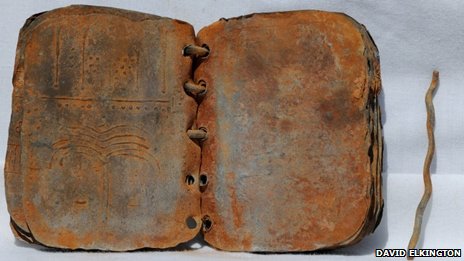
They could be the earliest Christian writing in existence, surviving almost 2,000 years in a Jordanian cave. They could, just possibly, change our understanding of how Jesus was crucified and resurrected, and how Christianity was born.

A group of 70 or so “books”, each with between five and 15 lead leaves bound by lead rings, was apparently discovered in a remote arid valley in northern Jordan somewhere between 2005 and 2007. (via BBC News – Jordan battles to regain ‘priceless’ Christian relics)

Read more