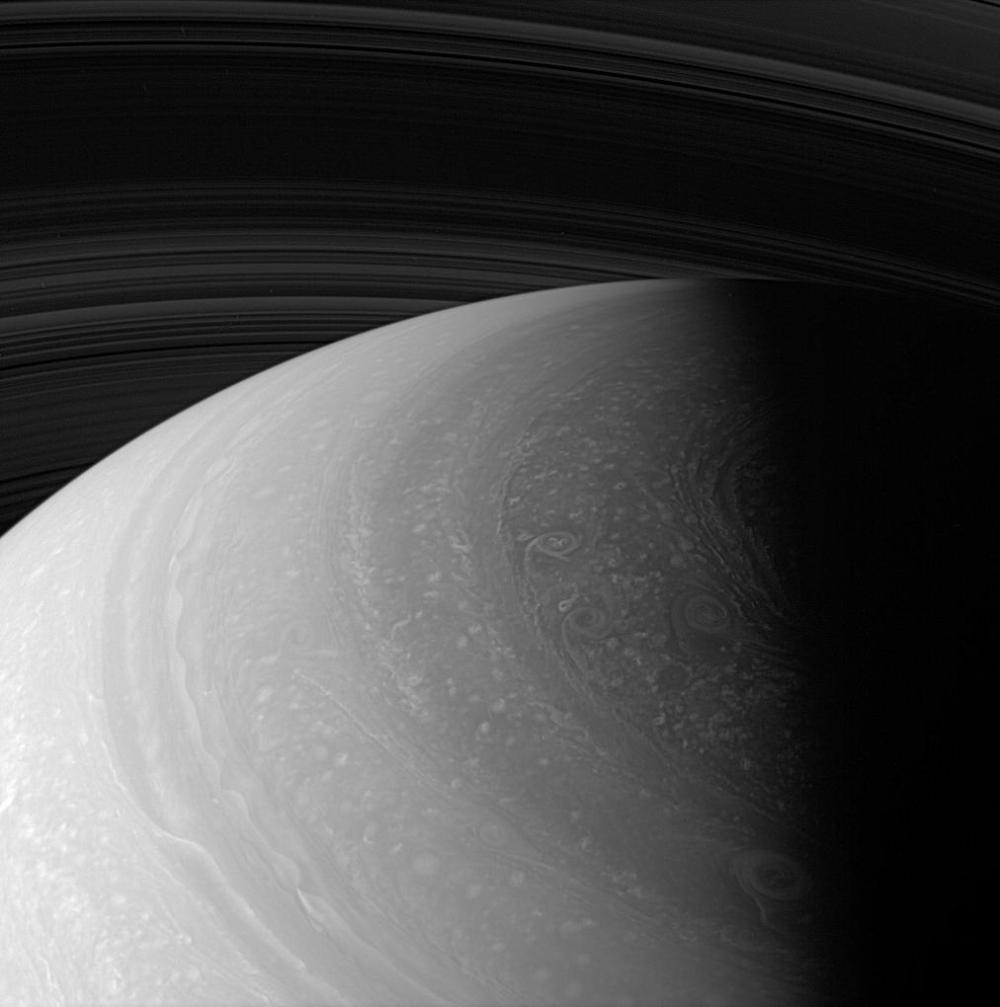
This scene reveals many features in Saturn’s dynamic and beautiful atmosphere, including a detail largely obscured from the imaging cameras until now. On the terminator at center right is part of the polar hexagon, which was previously observed by Cassini’s Visible and Infrared Mapping Spectrometer (VIMS) and Composite Infrared Spectrometer (CIRS). These instruments used heat radiated from Saturn to observe the polar hexagon (rather than reflected sunlight, as is the case in this view). The hexagon was first imaged by the Voyager spacecraft more than 25 years ago.

Read more

Nasa scientist Daniel Glavin described the results from the first “wet chemistry” experiment carried out by Curiosity.

A long-chain carboxylic acid, or fatty acid, was a good fit for one of the data peaks detected in a mudstone called Cumberland, he told an audience at the meeting. A form of alcohol molecule may also be among the compounds analysed.

The preliminary result will excite scientists because fatty acids are key components of the cell membranes found in all life forms, including microbial organisms.

Dr Glavin told an audience that the result was “provocative”, and said the link to biology was the “million-dollar question”. But he explained that a non-biological origin was equally plausible at this stage of the research.

One scientist commenting on the presentation suggested that contamination could not be ruled out as a cause of the signal.

The SAM team have been working to address the leak of a pre-existing chemical called MTBSTFA within the instrument.

The fact this is also an organic molecule has complicated the search for indigenous carbon-containing compounds in Martian rocks.

However, team members say they have turned the leak into an advantage, using their understanding of how MTBSTFA reacts with other compounds to identify Martian organics.

Read more

Using NASA’s Kepler satellite, astronomers have found about 1,000 planets around stars in the Milky Way and they have also found about 3,000 other potential planets. Many of the stars have planetary systems with 2-6 planets, but the stars could very well have more planets than those observable with the Kepler satellite, which is best suited for finding large planets that orbit relatively close to their stars.
Planets that orbit close to their stars would be too scorching hot to have life, so to find out if such planetary systems might also have planets in the habitable zone with the potential for liquid water and life, a group of researchers from the Australian National University and the Niels Bohr Institute at the University of Copenhagen made calculations based on a new version of a 250-year-old method called the Titius-Bode law.

The Titius-Bode law was formulated around 1770 and correctly calculated the position of Uranus before it was even discovered. The law states that there is a certain ratio between the orbital periods of planets in a solar system. So the ratio between the orbital period of the first and second planet is the same as the ratio between the second and the third planet and so on. Therefore, if you knew how long it takes for some of the planets to orbit around the Sun/star, you can calculate how long it takes for the other planets to orbit and can thus calculate their position in the planetary system. You can also calculate if a planet is ‘missing’ in the sequence.

“We decided to use this method to calculate the potential planetary positions in 151 planetary systems, where the Kepler satellite had found between 3 and 6 planets. In 124 of the planetary systems, the Titius-Bode law fit with the position of the planets. Using T-B’s law we tried to predict where there could be more planets further out in the planetary systems. But we only made calculations for planets where there is a good chance that you can see them with the Kepler satellite,” explains Steffen Kjær Jacobsen, PhD student in the research group Astrophysics and Planetary Science at the Niels Bohr Institute at the University of Copenhagen.

In 27 of the 151 planetary systems, the planets that had been observed did not fit the T-B law at first glance. They then tried to place planets into the ‘pattern’ for where planets should be located. Then they added the planets that seemed to be missing between the already known planets and also added one extra planet in the system beyond the outermost known planet. In this way, they predicted a total of 228 planets in the 151 planetary systems.

“We then made a priority list with 77 planets in 40 planetary systems to focus on because they have a high probability of making a transit, so you can see them with Kepler. We have encouraged other researchers to look for these. If they are found, it is an indication that the theory stands up,” explains Steffen Kjær Jacobsen.

Planets that orbit very close around a star are too scorching hot to have liquid water and life and planets that are far from the star would be too deep-frozen, but the intermediate habitable zone, where there is the potential for liquid water and life, is not a fixed distance. The habitable zone for a planetary system will be different from star to star, depending on how big and bright the star is.

The researchers evaluated the number of planets in the habitable zone based on the extra planets that were added to the 151 planetary systems according to the Titius-Bode law.

***The result was 1-3 planets in the habitable zone for each planetary system.***

Out of the 151 planetary systems, they now made an additional check on 31 planetary systems where they had already found planets in the habitable zone or where only a single extra planet was needed to meet the requirements.

“In these 31 planetary systems that were close to the habitable zone, our calculations showed that there was an average of two planets in the habitable zone. According to the statistics and the indications we have, a good share of the planets in the habitable zone will be solid planets where there might be liquid water and where life could exist,” explains Steffen Kjær Jacobsen.

If you then take the calculations further out into space, it would mean that just in our galaxy, the Milky Way, ***there could be billions of stars with planets in the habitable zone***, where there could be liquid water and where life could exist.

He explains that what they now want to do is encourage other researchers to look at the Kepler data again for the 40 planetary systems that they have predicted should be well placed to be observed with the Kepler satellite.
Planets in the habitable zone around most stars, researchers calculate  – http://www.sciencedaily.com/releases/2015/03/150318074515.htm
Read more

The dust cloud surrounds Mars and reaches altitudes more than 1,000 kilometers (621 miles) from the planet’s surface, said MAVEN lead scientist Bruce Jakosky, also with University of Colorado.

“We think the source is the (Martian) atmosphere, however we have no process to take dust from low altitude to bring it up to 200 kilometers (124 miles). So if the source is the atmosphere, we don’t understand which process is moving them up,” Andersson said.

The dust also could have come from Mars’ moons, Phobos and Deimos, from dust in the solar wind or from comet dust that fills interplanetary space.

Read more

fuckyeahdarkextropian:

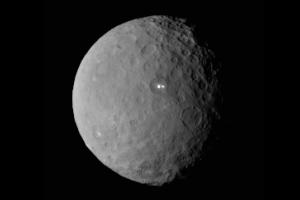
Revealing the origin of Ceres’s water could determine whether there is the potential for life beneath its surface, as is thought to be the case on icy moons around Jupiter and Saturn.

Read more

flavorcountry:

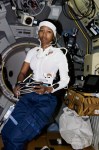
Dr. Mae Jemison, MD, the first black woman in space and first actual astronaut to appear on a Star Trek show, one of the very few people on this planet of whom two pictures can be posted depicting them doing their job on a spaceship with entirely different contexts.

Read more

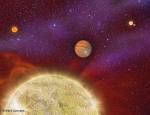
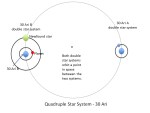
The newfound four-star planetary system, called 30 Ari, is located 136 light-years away in the constellation Aries. The system’s gaseous planet is enormous, with 10 times the mass of Jupiter, and it orbits its primary star every 335 days. The primary star has a relatively close partner star, which the planet does not orbit. This pair, in turn, is locked in a long-distance orbit with another pair of stars about 1,670 astronomical units away (an astronomical unit is the distance between Earth and the sun). Astronomers think it’s highly unlikely that this planet, or any moons that might circle it, could sustain life.

Were it possible to see the skies from this world, the four parent stars would look like one small sun and two very bright stars that would be visible in daylight. One of those stars, if viewed with a large enough telescope, would be revealed to be a binary system, or two stars orbiting each other.

Read more

Is everything in the movie explicable?

Everything there has a point, has a reason. Even the orbs, the glowing orbs.

i was gonna ask about them.

Those are remote antennas for the Fluid Karma energy field. You got one of those orbs around, the energy field is more highly concentrated and that’s sort of explained briefly in the graphic novels. Even when Justin Timberlake’s character, Pilot Abilene, when he’s talking about a ‘sea of black umbrellas’ in his crazy, drug-fueled monologue, he’s talking about seeing back into time, to the early 20th Century at the Santa Monica Pier, with all of the umbrellas.

Oh, was that a thing?

In the Cannes cut, there’s a scene where Boxer bleeds back in time to the 1920s and he sees a fortune-teller. He sees Beth Grant in a fortune-teller tent on the beach. There’s a lot of stuff that didn’t even make—there’s a lot of material that people haven’t seen…

There’s still some visual effects that are not where I want them to be. There’s some visual effects work. There are some shots at the end of the movie that I would like to add visual effects. Even just adding some of the content from the Cannes cut and even some of the content that never has still seen the light of day. And the animated—I have always hoped to do the first three chapters as a low-budget, animated feature. To just complete the whole thing or visualize the entire six-chapter story.

Read more

League of Extraordinary Gentlemen – America: 1988

When war-hero-turned-handyman Kesuke Miyagi is found drained of blood, it becomes clear that the occult gang known as the Lost Boys are targeting the only individuals that can stop them from complete domination of America. It’s the perfect case for the League of Extraordinary Gentlemen–except that their government contact, Oscar Goldman, disbanded the team in 1979 after they defeated Mr. Han’s army of the living dead.
Now, disgraced scientist Emmet Brown has to put together a new team to combat the growing threat of the Lost Boys and their leader, a newly resurrected vampire kingpin Tony Montana: Transportation specialist Jack Burton, ex-commando B.A. Baracus, tech wizard Angus MacGyver and the mysteriously powerful femme fatale known only as “Lisa.” But will Brown be able to stop the Lost Boys before time runs out?

The League of Extraordinary Gentlemen: 1996 

Abuse of Playback, the technologically-derived drug made from distilled human memories, is sweeping the world — and Special Agent Fox Mulder learned too late that Playback was put forth on this planet by the Purity, seeking to condition humanity to their rule so as to better combat the Deadite incursion threatening the aliens’ homeworld. Now Mulder is missing, and it falls to his partner, Dana Scully, to re-activate secret protocol LXG-71, the “League of Extraordinary Gentlepersons” (protocol renamed 1993 for “sensitivity reasons”).
Scully swiftly collects Hong Kong Detective-Inspector “Tequila” Yuen, hyperviolent Wiccan practitioner Nancy Downs, the biological experiment/walking weapon known only as “Edward,” and a young high-functioning sociopath named Zack Morris who has the strange ability to stop the flow of time itself. Perhaps it is this last who attracts the attention of an enigmatic man who answers only to “Rufus,” and who asks Scully to “set history right” and see that two young musicians — that, so far as she can tell, never existed — be born anew, so that peace may flourish on Earth. But the Purity have never shown any signs of temporal travel capability… so who, then, altered history?

Read more

OK, let’s say Bruce Wayne does use this routine as prep for becoming Batman. What would you suggest he do to maintain his level of fitness once he’s in the middle of crime fighting season? The day he becomes Batman, his volume gets reduced by half. Not only because of recovery, but also because of time. I think he goes down to a more reasonable three- to four-day workout split, focusing on aerobic and muscular endurance, and then maintaining a high level of strength. But fighting criminals is probably going to keep his strength up, too. So what can an average guy take from this workout and use for himself? First, I would cut everything in half in terms of volume. I’d also reassess the weight used. You can be good at a few things, but not everything. Whatever, we’re not giving up on becoming Batman.

Read more