As a member of a team sponsored by NASA that searches the skies for potentially dangerous asteroids and comets, he generally focuses on objects that orbit the sun on the same plane as the planets. But coming up from below that plane was a comet that had apparently originated in the Oort cloud, a vast, primordial region that surrounds the solar system.

The comet was well beyond Jupiter when Mr. McNaught sighted it, but he and other so-called comet modelers were nonetheless able to predict its 125,000-mile-per-hour path into the inner solar system. To their surprise and consternation, it appeared to be heading straight for Mars, and some of their most precious equipment.

Comet trajectories are notoriously changeable, and more recent projections suggest the comet, named Siding Spring, is highly unlikely to strike the planet or to do much damage to the two NASA rovers on its surface or the five research satellites orbiting it.

Still, on Oct. 19, the comet is expected to pass within 82,000 miles of Mars, a stone’s throw in astronomical terms — one-third the distance between Earth and the moon, and much closer to Mars than any comet has come to Earth in recorded history.

The dust, water vapor and other gases spewed by a comet can spread for tens of thousands of miles, so the upper reaches of the Martian atmosphere are expected to be showered by Siding Spring — perhaps briefly, perhaps more extensively. Shock waves may rock the atmosphere.

The dust particles may be tiny, but when traveling at 125,000 m.p.h. (35 miles per second) they would pierce the skin of any satellite orbiting the planet. “Essentially, they would be like bullets out there,” said Richard Zurek, the chief scientist of the Mars program at NASA’s Jet Propulsion Laboratory.

He added that although the danger to satellites and rovers appeared to be limited, there was a small possibility that the comet could break up as it approaches Mars — a fate similar to that of Comet ISON as it neared the sun last year. As a precaution, the five satellites’ orbits have been tweaked so they will be on the far side of the planet when the greatest threat from dust arrives.

But for the most part, the initial worries have given way to excitement about the scientific opportunities presented by the very close encounter.

The satellites and rovers — along with ground and space observatories such as the Spitzer and Hubble Space Telescopes — will offer a front-row seat to the event, which may provide important images and science for days.

‘We have an opportunity to see what happens when a comet comes so close to a planet,” he continued. “We can follow the planet as it responds to the dust and water and shock, and hope to learn more about how it processes it all. Comets have played a huge role in transforming planets, and now we’ll see the process as it’s happening.”

Comet Siding Spring is especially interesting because of its formation in the Oort cloud during the early days of the solar system, making it a “long period” comet with an orbit of millions of years. What’s more, it is believed to be what comet specialists call a virgin — one that has never reached the inner solar system.

As a result, its icy nucleus (the “dirty snowball” at the core of a comet) has never been thawed and reshaped, like those of comets that pass by more regularly.

“We’ve studied the nuclei of comets before but never a long-period comet from the Oort cloud,” Dr. Zurek said. “The comet may well be bringing us primordial material unchanged since the creation of the solar system.”

As luck would have it, Siding Spring will pass Mars just a month after the arrival of NASA’s newest orbiter, Maven, short for Mars Atmosphere and Volatile Evolution.

That satellite has instruments designed to study the Martian atmosphere, and in particular how water vapor and other material escape into space. Siding Spring may well produce atmospheric dynamics that the Maven team expected to study in a far more static state.

“If particles from the comet hit the atmosphere, we’ll absolutely be able to measure what happens,” said Bruce Jakosky, principal investigator for the satellite mission. Initially worried that the comet could damage Maven just as its mission began, he now sees the flyby as exploration science at its best.

“We’ll follow how different chemical processes play out and will be looking to see if the arrival of those fast-moving dust particles, with all their energy, heats up the atmosphere,” he said. “We know there were lots of comet and asteroid impacts and near misses on early Mars, and now we’re in a position to learn about some possible consequences.”

The implications for Mars science are substantial. The Curiosity rover has confirmed and substantially expanded earlier findings that Mars was warmer and much wetter a long time ago. But the question of how and when the planet lost those potentially life-supporting conditions remains largely unresolved.

Because all the cameras orbiting above Mars are designed to focus on the planet, they are not expected to produce the best images of the flyby. That role is likely to be played by the Hubble and by observatories on Earth. Some believe that Curiosity might be lucky and snap an image of the comet passing above.

One especially powerful orbiting camera, however, has a chance of capturing what is considered the most important and interesting part of the comet — its nucleus, the “dirty snowball.” Little changed for billions of years, the ball of dust and ice warms as it enters the inner solar system and emits a vast surrounding cloud of material called the coma, followed by the long tail. The camera, named HiRise for High Resolution Imaging Science Experiment, produces finely detailed images that have revolutionized our understanding of the Martian surface; now its operators will try to do the same for the comet’s primordial nucleus.

Dr. McEwen said the team also planned to photograph jets of water vapor and dust that often shoot out of the nucleus.

Most comets that form in the Oort cloud stay in place, orbiting the sun once every million to 30 million years. Sometimes, however, gravitational forces from nearby stars, or giant planets that many scientists believe wander in space, push a comet out of orbit and send it toward the sun. For Comet Siding Spring, that voyage has taken a million years.

Astronomers will also be using Earth and space observatories to identify the comet’s chemical makeup. Of particular interest is what carbon-based organic compounds might be detected. These compounds, the building blocks of life, are known to reside in comets and asteroids. NASA’s Stardust mission to the comet Wild 2 collected samples in 2006. In labs, scientists found not only organics in the stardust, but small yet detectable amounts of evolved amino acids.

“We don’t know how life begins, but we do know that organics are necessary,” Dr. Glavin said. “And how do organics appear? Maybe they’re formed on the surface of a planet like Earth, or maybe they get delivered by comets like Siding Spring.”

One of the main goals of the Curiosity mission is to search for organic compounds that might help show whether Mars was once habitable.

Siding Spring is not expected to get close enough to send organic compounds to the surface, but Dr. Green, NASA’s Mars program director, does not want to take any chances. Although Curiosity will be in a defensive position for the flyby, he has plans for the small scoop that the rover uses to deliver crushed rock samples to the instruments inside.

“What I told the Curiosity team is that the chances are very slight that organics or comet dust would fall on the rover,” he said. “But we should have the scoop out to catch some just in case.”

http://mobile.nytimes.com/2014/08/05/science/space/celestial-traveler-closing-on-mars.html

* The ESA have Rosetta out chasing a comet, NASA has to maneuver its Martian robot explorers to avoid being destroyed by one.

Read more

Meet the electric life forms that live on pure energy

The discovery of electric bacteria shows that some very basic forms of life can do away with sugary middlemen and handle the energy in its purest form – electrons, harvested from the surface of minerals. “It is truly foreign, you know,” says Nealson. “In a sense, alien.”

Nealson’s team is one of a handful that is now growing these bacteria directly on electrodes, keeping them alive with electricity and nothing else – neither sugars nor any other kind of nutrient. The highly dangerous equivalent in humans, he says, would be for us to power up by shoving our fingers in a DC electrical socket.

To grow these bacteria, the team collects sediment from the seabed, brings it back to the lab, and inserts electrodes into it.

First they measure the natural voltage across the sediment, before applying a slightly different one. A slightly higher voltage offers an excess of electrons; a slightly lower voltage means the electrode will readily accept electrons from anything willing to pass them off. Bugs in the sediments can either “eat” electrons from the higher voltage, or “breathe” electrons on to the lower-voltage electrode, generating a current. That current is picked up by the researchers as a signal of the type of life they have captured.

“Basically, the idea is to take sediment, stick electrodes inside and then ask ‘OK, who likes this?’,” says Nealson.

At the Goldschmidt geoscience conference in Sacramento, California, last month, Shiue-lin Li of Nealson’s lab presented results of experiments growing electricity breathers in sediment collected from Santa Catalina harbour in California. Yamini Jangir, also from the University of Southern California, presented separate experiments which grew electricity breathers collected from a well in Death Valley in the Mojave Desert in California.

Over at the University of Minnesota in St Paul, Daniel Bond and his colleagues have published experiments showing that they could grow a type of bacteria that harvested electrons from an iron electrode (mBio, doi.org/tqg). That research, says Jangir’s supervisor Moh El-Naggar, may be the most convincing example we have so far of electricity eaters grown on a supply of electrons with no added food.

But Nealson says there is much more to come. His PhD student Annette Rowe has identified up to eight different kinds of bacteria that consume electricity. Those results are being submitted for publication.

Nealson is particularly excited that Rowe has found so many types of electric bacteria, all very different to one another, and none of them anything like Shewanella or Geobacter. “This is huge. What it means is that there’s a whole part of the microbial world that we don’t know about.”

Discovering this hidden biosphere is precisely why Jangir and El-Naggar want to cultivate electric bacteria. “We’re using electrodes to mimic their interactions,” says El-Naggar. “Culturing the ‘unculturables’, if you will.” The researchers plan to install a battery inside a gold mine in South Dakota to see what they can find living down there.

NASA is also interested in things that live deep underground because such organisms often survive on very little energy and they may suggest modes of life in other parts of the solar system.

Meet the electric life forms that live on pure energy

Read more "Meet the electric life forms that live on pure energy"

Bill Nye: We May Discover Life on Europa

This plan does not involve landing on Europa and therefore meets the approval criteria from Posthuman Flight Club.

Start sending your empty coffee cups to NASA now, or something.

Read more

So why don’t we see advanced civilizations swarming across the Universe? One problem may be climate change. It is not that advanced civilizations always destroy themselves by over-heating their biospheres (although that is a possibility). Instead, because stars become brighter as they age, most planets with an initially life-friendly climate will become uninhabitably hot long before intelligent life emerges.

The Earth has had four billion years of good weather despite our Sun burning a lot more fuel than when Earth was formed. We can estimate the amount of warming this should have produced thanks to the scientific effort to predict the consequences of man-made greenhouse-gas emissions.

These models predict that our planet should warm by a few degrees centigrade for each percentage increase in heating at Earth’s surface. This is roughly the increased heating produced by carbon dioxide at the levels expected for the end of the 21st century. (Incidentally, that is where the IPCC prediction of global warming of around three degrees Celsius comes from.)

Over the past half-billion years, a time period for which we have reasonable records of Earth’s climate, the Sun’s surface temperature increased by four percent, and terrestrial temperatures should have risen by roughly 10 degrees Celsius. But the geological record shows that, if anything, on average temperatures fell.

Simple extrapolations show that over the whole history of life, temperatures should have risen by almost 100 degrees Celsius. If that were true, early life must have emerged upon a completely frozen planet. Yet, the young Earth had liquid water on its surface. So what’s going on?

The answer is that it’s not only the Sun that has changed. The Earth also evolved, with the appearance of land plants around 400 million years ago changing atmospheric composition and the amount of heat Earth reflects back into space. There has also been geological change with the continental area steadily growing through time as volcanic activity added to the land-mass. This too had an effect on the atmosphere and Earth’s reflectivity.

Remarkably, biological and geological evolution have generally produced cooling, and this has compensated for the warming effect of our aging Sun. There have been times when compensation was too slow or too fast, and the Earth warmed or cooled, but not once since life first emerged has liquid water completely disappeared from the surface.

Our planet has therefore miraculously moderated climate change for four billion years. This observation led to the development of the Gaia hypothesis that a complex biosphere automatically regulates the environment in its own interests. However, Gaia lacks a credible mechanism and has probably confused cause and effect: a reasonably stable environment is a precondition for a complex biosphere, not the other way around.

Other inhabited planets in the Universe must also have found ways to prevent global warming. Watery worlds suitable for life will have climates that, like the Earth, are highly sensitive to changing circumstances. The repeated canceling of star-induced warming by “geobiological” cooling, required to keep such planets habitable, will have needed many coincidences, and the vast majority of such planets will have run out of luck long before sentient beings evolved.

http://arstechnica.com/science/2014/06/why-havent-we-encountered-aliens-yet-the-answer-could-be-climate-change/ (via fuckyeahdarkextropian)

A solar system full of dead worlds and moons.

Dried up sea beds of underground oceans rich in the fossils of life that lasted just a while. And the ones that made it in their own unique way.

Let’s go see.

Read more

Nearly twice as tall as Mount Everest, Arsia Mons is the third tallest volcano on Mars and one of the largest mountains in the solar system. This new analysis of the landforms surrounding Arsia Mons shows that eruptions along the volcano’s northwest flank happened at the same time that a glacier covered the region around 210 million years ago. The heat from those eruptions would have melted massive amounts of ice to form englacial lakes — bodies of water that form within glaciers like liquid bubbles in a half-frozen ice cube.

The ice-covered lakes of Arsia Mons would have held hundreds of cubic kilometers of meltwater, according to calculations by Kat Scanlon, a graduate student at Brown who led the work. And where there’s water, there’s the possibility of a habitable environment.

“This is interesting because it’s a way to get a lot of liquid water very recently on Mars,” Scanlon said.

While 210 million years ago might not sound terribly recent, the Arsia Mons site is much younger than the habitable environments turned up by Curiosity and other Mars rovers. Those sites are all likely older than 2.5 billion years. The fact that the Arsia Mons site is relatively young makes it an interesting target for possible future exploration.

“If signs of past life are ever found at those older sites, then Arsia Mons would be the next place I would want to go,” Scanlon said

Based on the sizes of the formations, Scanlon could estimate how much lava would have interacted with the glacier. Using basic thermodynamics, she could then calculate how much meltwater that lava would produce. She found that two of the deposits would have created lakes containing around 40 cubic kilometers of water each. That’s almost a third of the volume of Lake Tahoe in each lake. Another of the formations would have created around 20 cubic kilometers of water.

Even in the frigid conditions of Mars, that much ice-covered water would have remained liquid for a substantial period of time. Scanlon’s back-of-the-envelope calculation suggests the lakes could have persisted or hundreds or even a few thousand years.

That may have been long enough for the lakes to be colonized by microbial life forms, if in fact such creatures ever inhabited Mars.

“There’s been a lot of work on Earth — though not as much as we would like — on the types of microbes that live in these englacial lakes,” Scanlon said. “They’ve been studied mainly as an analog to [Saturn’s moon] Europa, where you’ve got an entire planet that’s an ice covered lake.”

In light of this research, it seems possible that those same kinds of environs existed on Mars at this site in the relatively recent past.

There’s also possibility, Head points out, that some of that glacial ice may still be there. “Remnant craters and ridges strongly suggest that some of the glacial ice remains buried below rock and soil debris,” he said. “That’s interesting from a scientific point of view because it likely preserves in tiny bubbles a record of the atmosphere of Mars hundreds of millions of years ago. But an existing ice deposit might also be an exploitable water source for future human exploration.”

Read more

Are ‘Super-Earths’ and ‘Habitable Zones’ Misleading Terms?

The “burdensome” problem for the scientific community in describing a habitable zone is that scientists know little about where life forms, Marcy said.

“There’s a split brain that we scientists have right now. Half of our brain says there’s a habitable zone and it lies between a region inward of where the Earth is and a region outside the Earth’s orbit [for stars our size],” he said. “The other half of our brain knows perfectly well that excellent destinations for our search for life lie elsewhere in the Solar System.”

Are ‘Super-Earths’ and ‘Habitable Zones’ Misleading Terms?

Read more "Are ‘Super-Earths’ and ‘Habitable Zones’ Misleading Terms?"

Researchers Report Breakthrough in Creating Artificial Genetic Code

The work also gives some backing to the concept that life can exist elsewhere in the universe using genetics different from that on earth.

“This is the first time that you have had a living cell manage an alien genetic alphabet,” said Steven A. Benner, a researcher in the field at the Foundation for Applied Molecular Evolution in Gainesville, Fla., who was not involved in the new work.

Researchers Report Breakthrough in Creating Artificial Genetic Code

Read more "Researchers Report Breakthrough in Creating Artificial Genetic Code"

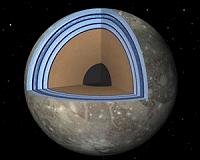
The results support the idea that primitive life might have possibly arisen on the icy moon. Scientists say that places where water and rock interact are important for the development of life; for example, it’s possible life began on Earth in bubbling vents on our sea floor.

Prior to the new study, Ganymede’s rocky sea bottom was thought to be coated with ice, not liquid – a problem for the emergence of life. The “club sandwich” findings suggest otherwise: the first layer on top of the rocky core might be salty water.

“This is good news for Ganymede,” said Vance. “Its ocean is huge, with enormous pressures, so it was thought that dense ice had to form at the bottom of the ocean. When we added salts to our models, we came up with liquids dense enough to sink to the sea floor.”

The results can be applied to exoplanets too, planets that circle stars beyond our sun. Some super-Earths, rocky planets more massive than Earth, have been proposed as “water worlds” covered in oceans. Could they have life? Vance and his team think laboratory experiments and more detailed modeling of exotic oceans might help find answers.

Ganymede is one of five moons in our solar system thought to support vast oceans beneath icy crusts. The other moons are Jupiter’s Europa and Callisto and Saturn’s Titan and Enceladus.

Read more

Move over exoplanets, exomoons may harbour life too

if a Jupiter-like exoplanet orbits within a star’s habitable zone, it begs the question: might that exoplanet host habitable moons? Jupiter has Europa, which is suspected to have liquid water buried under an ice crust, and Saturn has Enceladus, which definitely has water hidden underneath its coat of hydrocarbon ices. So Earth-like exomoons are certainly not out of the question.

Recent research by Duncan Forgan and Vergil Yotov at the University of Edinburgh highlights the various factors that may make an exomoon more or less habitable. They investigate how the climate of an exomoon will be affected by tidal stresses which provide a source of internal heating for the exomoon as it is stretched and deformed by the gravitational pull of its planet. They also investigated how light reflected from the exoplanet, and eclipses by the exoplanet, can also subtly alter the exomoon’s climate.

The researchers lump theoretical exomoons into a number of classifications: “habitable”, “hot”, “snowball” or “transient”. Those in the first class have more than 10% of their surface at a temperature between the freezing and boiling points of water, with only a small fluctuation around the average temperature value.

Those in the second class have average temperatures above 100°C at all times, whereas those in the third class are permanently frozen – in both cases less than 10% of the surface is habitable. Exomoons in the fourth, transient class are on average habitable, but the amount of habitable surface area varies widely with time. Overall, this research shows that exomoon climates are rather more complex than previous research has supposed.

As yet, no exomoons have been discovered, but there are various techniques proposed for finding them. One way is by studying the effects that an exomoon will have on the exoplanet it is orbiting – their gravitational connection means there will be a to-and-fro tugging between them. This will cause variations in the times at which the planet transits in front of its star and in the durations of these transits, which we are able to measure.

Move over exoplanets, exomoons may harbour life too

Read more "Move over exoplanets, exomoons may harbour life too"

Miller had filled the vial in 1972 with a mixture of ammonia and cyanide, chemicals that scientists believe existed on early Earth and may have contributed to the rise of life.

He had then cooled the mix to the temperature of Jupiter’s icy moon Europa—too cold, most scientists had assumed, for much of anything to happen. Miller disagreed. Examining the vial in his laboratory at the University of California at San Diego, he was about to see who was right. As Miller and his former student Jeffrey Bada brushed the frost from the vial that morning, they could see that something had happened. The mixture of ammonia and cyanide, normally colorless, had deepened to amber, highlighting a web of cracks in the ice. Miller nodded calmly, but Bada exclaimed in shock. It was a color that both men knew well—the color of complex polymers made up of organic molecules. 

Tests later confirmed Miller’s and Bada’s hunch. Over a quarter-century, the frozen ammonia-cyanide blend had coalesced into the molecules of life: nucleobases, the building blocks of RNA and DNA, and amino acids, the building blocks of proteins…

Although life requires liquid water, small amounts of liquid can persist even at –60°F. Microscopic pockets of water within the ice may have gathered simple molecules like the ones Miller synthesized, assembling them into longer and longer chains. A single cubic yard of sea ice contains a million or more liquid compartments, microscopic test tubes that could have created unique mixtures of RNA that eventually formed the first life.

If life on Earth arose from ice, then our chances of finding life elsewhere in the solar system—not to mention elsewhere in the galaxy—may be better than we ever imagined…

Cyanide is a good candidate as a precursor molecule in the life-in-a-freezer model for several reasons. First, planetary scientists suspect that cyanide was abundant on early Earth, deposited here by comets or created in the atmosphere by ultraviolet light or by lightning (once the atmosphere became oxygen rich, 2.5 billion years ago, the process would have stopped). Second, although cyanide is lethal to modern animals, it has a convenient tendency to self-assemble into larger molecules. Third, and perhaps most important, no matter how much cyanide rained down, it could become concentrated only in a cold environment—not in warm coastal lagoons—because it evaporates more quickly than water…

According to some solar evolution models, the sun was some 30 percent dimmer at that time, providing less heat to Earth. So as soon as the hail of asteroids stopped, Earth may have cooled to an average surface temperature of –40°F and a crust of ice as much as 1,000 feet thick may have covered the oceans. Many scientists have puzzled over how life could have arisen on a planet that was essentially a giant snowball…

Biebricher sealed small amounts of RNA nucleobases—adenine, cytosine, guanine—with artificial seawater into thumb-size plastic tubes and froze them. After a year, he thawed the tubes and analyzed them for chains of RNA. For decades researchers had tried to coax RNA chains to form under all sorts of conditions without using enzymes; the longest chain formed, which Orgel accomplished in 1982, consisted of about 40 nucleobases. So when Biebricher analyzed his own samples, he was amazed to see RNA molecules up to 400 bases long. In newer, unpublished experiments he says he has observed RNA molecules 700 bases long…

Vlassov and his coworkers, Sergei Kazakov and Brian Johnston, realized that the ice was driving both enzymes to work in reverse. Normally when an enzyme cuts an RNA chain in two, a water molecule is consumed in the process, and when two RNA chains are joined, a water molecule is expelled. By removing most of the liquid water, the ice creates conditions that allow the RNA enzyme to work in just one direction, joining RNA chains. The SomaGenics scientists wondered whether an icy spot on early Earth could have driven a primitive enzyme to do the same.

To investigate this, they introduced random mutations into the hairpin RNA, shortened it from its normal length of 58 bases, and even cut it into pieces—all in an effort to produce RNA enzymes that were as dodgy and imperfect as early Earth’s first enzymes likely were.

These pseudoprimitive RNA enzymes do nothing at room temperature. But freeze them and they become active, joining other RNA molecules at a slow but measurable rate. These findings inspired a theory that the first, extremely inefficient RNA enzymes got help from ice, which created an environment that encouraged short segments of RNA to stick together and behave as a single, larger RNA molecule.

“Freezing stabilizes the complexes formed from multiple pieces of RNA,” concludes Kazakov. “So small pieces of RNA could be enzymes, not just large 50-base molecules.”

… On the young Earth, pockets of liquid could have expanded into a network of channels that mixed their contents during freeze-thaw cycles, like day-night temperature changes in summer. In winter, the liquid pores would have contracted and become isolated again, returning to their separate experiments. With all the mixing, something special might eventually have formed: an RNA molecule that made rough copies of itself. And as Earth warmed, these molecules might have found a home in newly thawed seas or ponds, where something even more complex might have emerged—such as a cell-like membrane…

Those speculations are more relevant than ever, with recent discoveries of geysers on Saturn’s icy moon Enceladus and elaborate organic molecules on Titan, another Saturnian moon. Recent studies show that Mars too has vast quantities of buried ice, especially at its poles.

Read more