
what’s the amplification of the Overview Effect when you’ve also gone extraterrestrial?
Read moreThe future of Congress has been on our minds. Recently, we considered how advances in technology and data analysis can and will change the way legislators do their work. There are places that are pushing the envelope in this arena. In Brazil official state hackers are building apps, games and data visualizations to help Brazilians […]
Read more
These objects are not catalogued as Mars-crossers in databases such as the Jet Propulsion Laboratory’s online Small-body Database Browser. Instead, they are categorized as Near Earth Objects (NEOs).

To continue its investigation, the car-sized rover is on an expedition to roll up Mt. Sharp, the central peak of the large crater in which it landed. Life might have shown preference for water that once ran down the Martian mountain. Two weeks ago, to avoid more dangerous and rocky terrain, Curiosity was directed to roll across a one-meter high sand dune that blocked a useful entrance to Mt. Sharp. Just after the short trip over Dingo Gap was successful, the robotic rover took the above image showing the now-traversed sand mound covered with its wheel tracks.
Read more“The question is, ‘What is the most efficient way of colonizing the solar system?’” he said. “And the notion of doing that might be so-called ‘living off the land.’ Instead of bringing resources that we need to colonize Mars, asteroids, etc. all the way from the Earth, what if we were able to actually extract those essential materials that are needed locally?”
With a current cost of about $10,000 per pound to send something into orbit, the possibility of using materials found in space, as opposed to bringing all supplies from Earth, would be the most cost- and energy-effective option available.
This would fit into what Engineering Prof. Brian Gilchrist said is a “resurgence and entrepreneurial mindset of new things we can do in space that haven’t been considered at all.”
Gilchrist’s research focuses on space tethering, which involves connecting two spacecraft with a conductive cable. As the spacecraft orbit in Earth’s electromagnetic field, the cable becomes charged. Solar power is used to add or leak charge from this circuit, causing the two spacecraft to move up or down. This theoretical system would allow the satellites to gain momentum without a propellant, and could have practical applications for tugging asteroids around in the Moon’s orbit.
Apart from colonization of the solar system, another potential purpose for mining asteroids is bringing materials back to Earth for environmental and commercial purposes.
“I think one of the best products from (asteroid mining), whether you’re mining for precious metals that are rare on earth or water for propulsion, is that there’s the opportunity for us to stop destroying the Earth’s environment,” said Engineering senior Bradley Costa.
Costa is currently engaged in a co-op with Planetary Resources, a leading private-sector company that conducts research on asteroid mining.
Along with sustainability benefits, corralling an asteroid could result in long-term economic benefits.
“One study I read says that one asteroid about a mile in diameter has enough precious metal on it to help humanity with all its needs for 10,000 years or so,” said Gallimore.
Asteroid mining could be useful to space travel
Read more "Asteroid mining could be useful to space travel"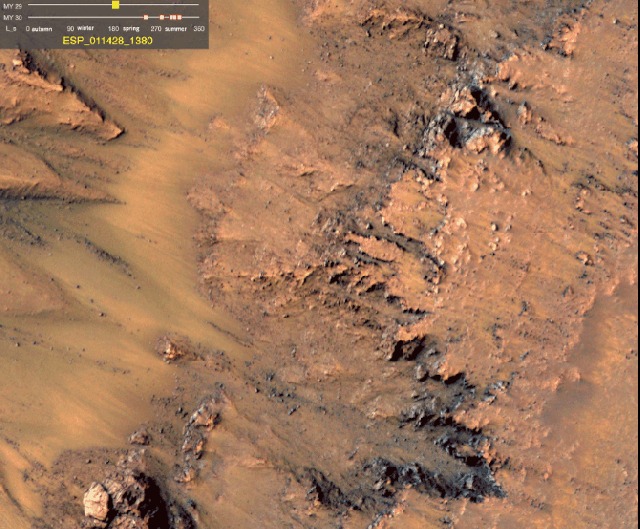
Researchers have long theorized that Mars had at one point held flowing water, and probably even held frozen water still. But, the presence of darkening lines moving downwards along a slope as the temperatures rise in the warmer months, suggests that there could be water flowing even now — and also suggests a mechanism for how it might be able to do it.
So, how does water flow in the frigid Martian temperatures that are present, even in the summer months? Researchers think that there may be a naturally-occurring anti-freeze in the water, caused by the high-iron content…
More details and pix http://io9.com/are-these-pictures-of-water-flowing-on-mars-right-now-1520115138
Read more
Mars may be an alien world, but if you went there and looked up at the night sky you’d see something that might surprise you: the stars would look exactly the same. The distance between the Earth and Mars isn’t nearly enough to change the perspective on the much more distant stars. You’d see all the familiar constellations, the Big Dipper and Orion and the Milky Way. The only difference in the sky, other than the sharp brilliance of everything seen through such thin air, would be that “extra” evening or morning star and its little companion.
You would look at that spark, and you would know you weren’t alone.
Read more
Read moreIn the Martian winter, carbon dioxide freezes out of the air (and you thought it was cold where you are). In the summer, that CO2 sublimates; that is, turns directly from a solid to a gas. When that happens the sand gets disturbed, and falls down the slopes in little channels, which spreads out when it hits the bottom. But this disturbs the red dust, too, which flows with the sand. When it’s all done, you get those feathery tendrils. Note that at the tendril tips, you see blotches of red; that’s probably from the lighter dust billowing a bit before settling down.
Now, you might think I’m making this all up. How do we know this stuff is flowing downhill like that? Ah, because in this picture we’ve caught it in the act! In this image, a closeup of a region just to the left of center of the big image, you can actually see the cloud of dust from an avalanche as it occurs.
Oh, baby. The cloud is only a few dozen meters across, and can’t be more than a few seconds old.

 The Committee to Nuke Elysium